Your watchlist
Built from your products: ingredients and CAS numbers, markets and product types.
A quarterly digest filtered to your products and markets, an alert in between when a change touches one of your products, deadlines tracked for each product, and your questions answered in writing.
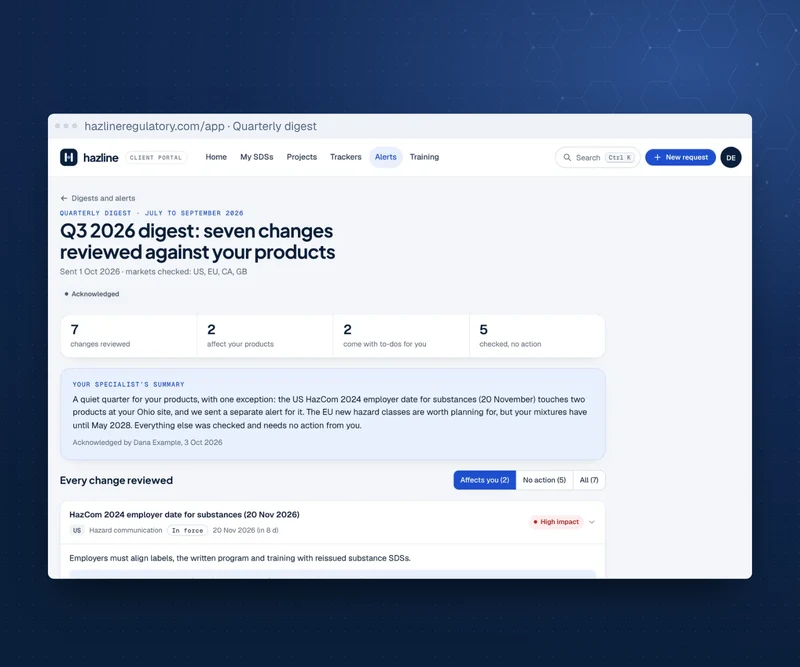 Quarterly digest
Each change is read by a specialist and matched to your own products, so the digest tells you what it means for you, not just what changed.
Built from your products: ingredients and CAS numbers, markets and product types.
Every relevant change of the quarter explained in plain language, with what it means for the products it affects.
Compliance dates for each product and market, so nothing arrives as a surprise.
New harmonised classifications in the EU and GB that change how an ingredient, and the mixtures containing it, are classified.
An alert when a change touches one of your products before the next digest, and written answers to your questions about a customer request, an inspection or a new market.
When a change needs new documents, the updates are quoted separately at a fixed fee.
Each digest item says which products are affected, what to do and by when. The tracker keeps every upcoming date in one place.
Deadline 1 November 2026. Two of your raw materials need confirmation from their suppliers.
20 November 2026. Workplace labels and training for substances must be updated.
1 February 2027. None of the revised entries appear in your products.
Your Canadian SDSs were updated in 2025. Nothing further needed.
| Product and action | Market | Due |
|---|---|---|
| Isopropyl Alcohol 99%Substance already on the market: confirm no new hazard class applies | EU | 1 Nov 2026 |
| Solvent Blend 220Mixture: SDS and label updated to HazCom 2024 | US | 19 Nov 2027 |
| Citrus Surface CleanerMixture already on the market: new hazard classes | EU | 1 May 2028 |
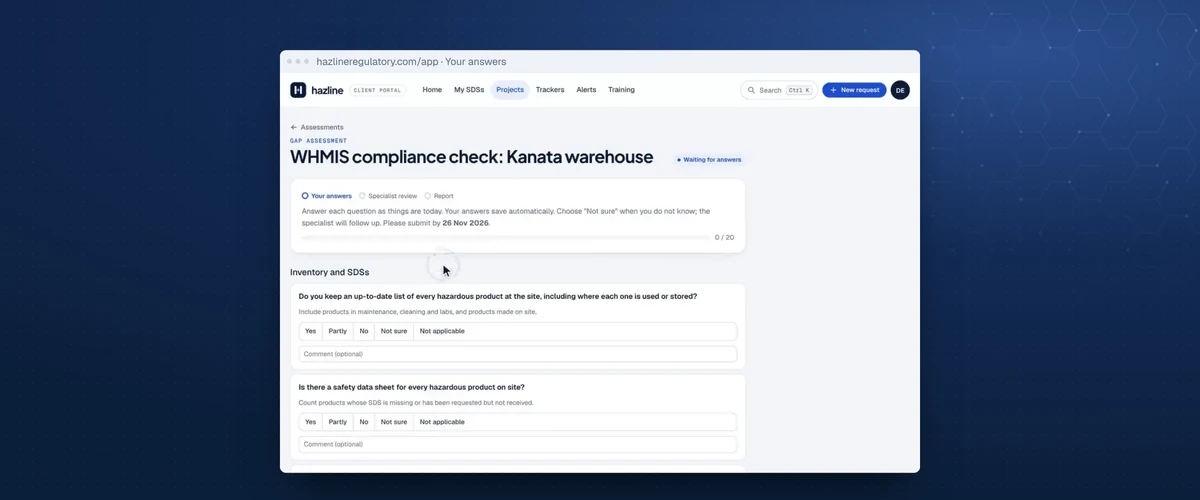
Real screens from the Hazline client portal, shown with a fictitious company.
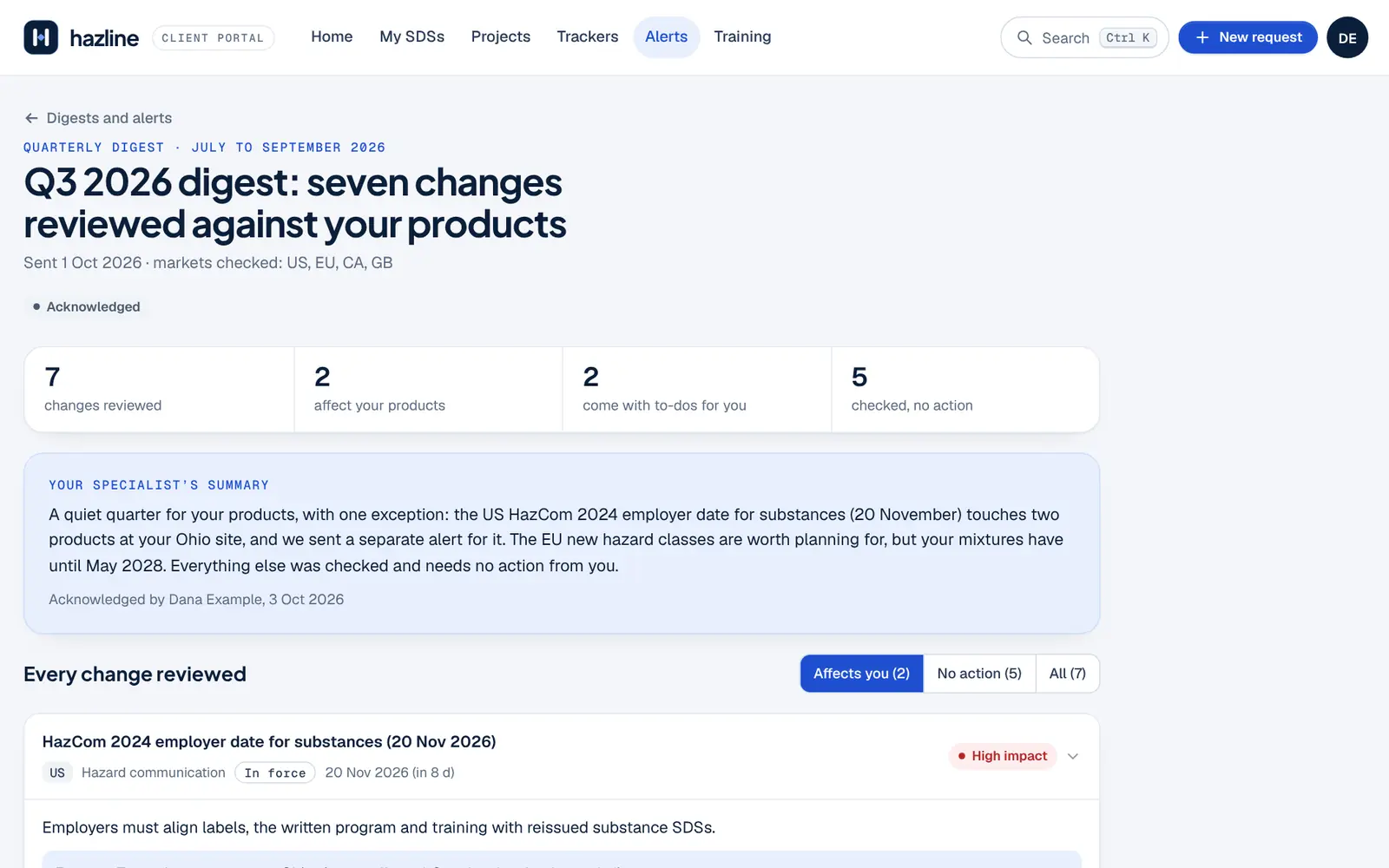 Fictitious example company
Every digest item links back to the official text, so you can see exactly where a change comes from.
Amendments to the Hazardous Products Regulations, WHMIS guidance and consultations, such as the proposal to remove the consumer product exclusion.
Hazard Communication rulemaking, compliance dates and letters of interpretation.
Adaptations to CLP (ATPs), the CLP revision, REACH Annex II and ECHA guidance.
GB mandatory classifications, GB CLP changes and UK REACH.
New revisions of the GHS, which each market adopts on its own timetable.
Cosmetics, consumer chemical products and other rules that apply to your sector.
We agree your watchlist: products, ingredients and markets.
Each quarter you receive the changes that affect you, with what to do and by when. A change that cannot wait reaches you as an alert.
Ask anything, any time. Answers come back in writing.
When a change needs new SDSs or labels, they are prepared on the agreed terms.
HPR amendments, Health Canada guidance and the Canada Gazette.
OSHA rulemaking, compliance dates and interpretations.
ATPs, the CLP revision, REACH Annex II and poison centre rules.
GB MCL decisions, GB CLP changes and UK REACH.
A news feed lists everything. The digest only includes changes that affect your products and markets, explains what each one means for you, and says what to do and by when.
Ingredients and CAS numbers are enough to screen for reclassifications. Percentages help us tell you whether a mixture's classification will change.
Hazard communication rules in Canada, the US, the EU and the UK: classification, SDS and label requirements, and the deadlines that go with them. Product-specific rules can be added for your sector.
Yes. Many companies start with an audit or a gap assessment, then move to monitoring once their documents are up to date.
The checks to run before selling a chemical product in Canada, the US, the EU or the UK: SDS and label, inventories, product rules, transport and more.
Read article
Endocrine disruptors, PBT/vPvB and PMT/vPvM are now CLP hazard classes. Substances already on the market must comply by 1 November 2026.
Read article
OSHA aligned HazCom with GHS Revision 7 in 2024, then pushed every compliance date back four months. Here is the current timeline.
Read article
How US importers check the TSCA Inventory, when to give positive or negative import certification, and what to do if a substance is new: PMN, LVE or SNUN.
Read article
When a chemical is new under TSCA, who must notify EPA, and how a PMN and a low volume exemption compare on volume, review time, conditions and fees.
Read article
What Minnesota's Amara's Law and Maine's PFAS law require as of October 2026: the product bans in force, who reports, the deadlines and the 2032 CUU test.
Read article
Who registers substances under EU REACH when you export to the EU, how an Only Representative works, and what EU customers need: SDS, CLP and SVHC data.
Read article
The UK has moved the UK REACH registration deadlines for substances already on the GB market. The new dates, what falls in each band, and what still applies today, including in Northern Ireland.
Read article
Hazardous mixtures sold in the EU must be notified to the poison centres in the harmonised format of Annex VIII to CLP before they are placed on the market, and carry a unique formula identifier on the label. The duty holders, the scope, the dates that have all passed, and the updates that catch companies out.
Read article
In the United States a disinfectant or sanitizer is a pesticide. It needs an EPA registration under FIFRA before sale, efficacy data behind every public-health claim, an EPA registration number on the label, and a registration in each state where it is sold. The main steps and the traps.
Read article
Since 31 May 2025, surface disinfectants and sanitizers in Canada are biocides that need a market authorization. What is covered, the routes to authorization, and the transition dates for existing DIN and PCP products.
Read article
In the EU, a disinfectant, sanitiser or preservative is a biocidal product that needs an authorisation, and its active substance must be approved and bought from a supplier on the Article 95 list. The two-step system, the routes to authorisation, and the transitional rules that still cover many products.
Read article
A coating, resin, adhesive or additive that touches food in the US must be allowed by the FDA in one of five ways: an existing regulation, a food contact notification, GRAS status, a prior sanction or the threshold of regulation. How each route works and how to document which one covers your material.
Read article
In the EU, plastics that touch food follow Regulation (EU) 10/2011: only substances on the Union list may be used, migration must stay within the limits, and every business in the chain passes a declaration of compliance downstream. What the declaration must say, how migration is tested, and the BPA ban that applies from 2026.
Read article
How Canada regulates food packaging under Division 23, what a Health Canada Letter of No Objection is, what a submission needs and why buyers ask for one.
Read articleUse these before you call anyone. When you want the work done for you, we quote it in writing.
Book a 20-minute call. Tell us what you sell and where, and a specialist shows you what applies and what we would do about it.
Tell us what you need to find out or get done. We scope it on a call and send a fixed fee in writing. Monitoring and gap assessments are the projects we run most often. The four video courses have a published price.