- Importers and downstream users who place a mixture classified for health or physical hazards on the EU market must notify it in the ECHA submission portal before the first sale.
- The harmonised rules applied from 1 January 2021 for consumer and professional products and 1 January 2024 for industrial products; the transition for older national notifications ended on 1 January 2025.
- Each mixture gets a unique formula identifier (UFI), a 16-character code printed on the label next to the other hazard information, or in the SDS for industrial-use products.
- A change of composition beyond the allowed ranges, of classification, of trade name or of duty holder needs an updated notification, and often a new UFI.
Article 45 of the CLP Regulation has long required companies to give the body appointed by each Member State, usually its poison centre, the information needed to treat a poisoning. Until 2021, each country had its own form and its own portal. Annex VIII to CLP, added by Regulation (EU) 2017/542, harmonised the content, the format and the portal, and introduced the unique formula identifier, the UFI, that links a product on a shelf to the formula on file. Every date in that transition has now passed, and enforcement has begun.
- Consumer and professionalAnnex VIII applies to new consumer and professional mixtures.
- IndustrialAnnex VIII applies to new industrial mixtures.
- Transition endsMixtures notified under national systems must be renotified in the harmonised format.
- EnforcementEU-wide inspection project on poison centre notifications under way.
Who must notify
The duty falls on the importer and the downstream user who places a hazardous mixture on the market: the formulator, the repackager, the company that imports a finished product, and a distributor who rebrands or relabels a product and so becomes its supplier. A distributor who sells a product unchanged does not notify, but must make sure the product it sells has been notified and carries a UFI, and may need its own submission if the upstream supplier's notification does not cover the Member State concerned. A company outside the EU cannot notify; its EU importer does, which is one more reason to give the importer the information it needs.
Which mixtures
Mixtures classified as hazardous for health or physical hazards under CLP are in scope, whether sold to consumers, professionals or industry. Mixtures classified only for environmental hazards, substances, gases under pressure, explosives of certain divisions, and mixtures for research and development are out of scope, as are products governed by other regimes such as medicines and cosmetics. Mixtures that are themselves components of another product follow the product.
What is submitted
The notification is made in the harmonised format through ECHA's submission portal and covers the trade names, the UFI, the classification and label elements, the product category, the intended use (consumer, professional, industrial), the packaging, and the full composition: every component with its concentration or concentration range within the bands Annex VIII allows, including components that are not hazardous above 1%. For mixtures used only at industrial sites, a limited submission may give the composition as in the SDS, provided a 24-hour telephone number can supply the full details in an emergency. Group submissions cover several products that differ only in perfume or colourant. One submission can be addressed to all the Member States where the product is sold.
The UFI
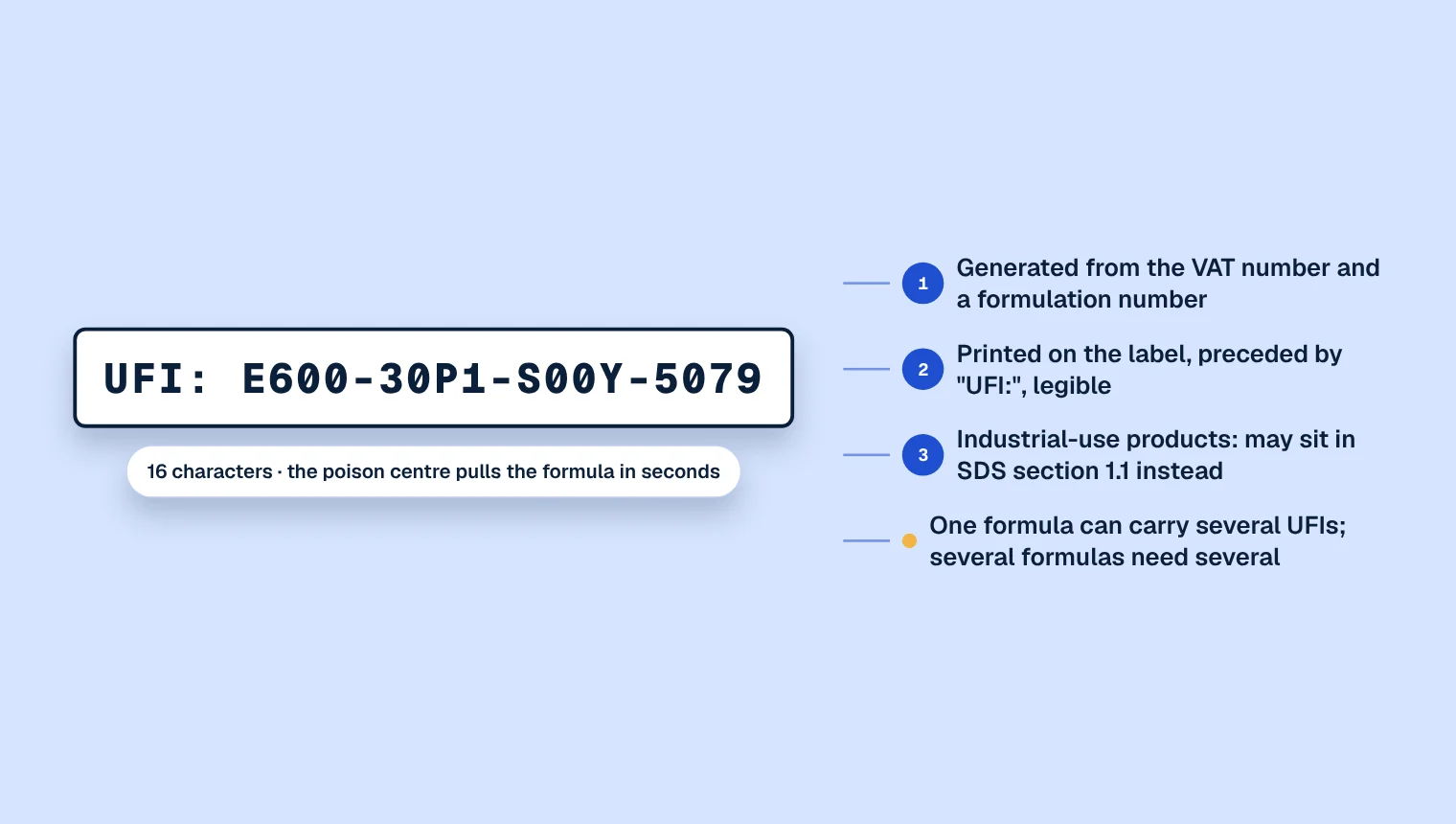
The UFI is a 16-character code generated from the company's VAT number and a formulation number with ECHA's generator. It is printed on the label, preceded by "UFI:", near the other label elements, and must be legible; for industrial-use products it may instead appear in section 1.1 of the SDS, and for multi-layer packaging it is required on the inner packaging. The same formula can carry several UFIs (one per trade name or market), and a product with several formulas needs several UFIs. The code is the hook that lets a poison centre pull the formula in seconds, so a wrong or missing UFI defeats the system.
When to update
A new submission is needed before a change is placed on the market when the composition changes beyond the ranges allowed by Annex VIII, when a component is added or removed, when the classification changes, when the trade name or the UFI changes, or when the duty holder changes. Keeping the formula, the SDS and the notification in step is the recurring work: many companies notified in 2020 and have not looked since, while their formulas have moved.
Great Britain
Since Brexit, Great Britain is outside the EU system. Products placed on the GB market are notified to the National Poisons Information Service under GB CLP on a voluntary basis, and the UFI is not required there, though it does no harm. Northern Ireland follows the EU rules.
Sources
General information, not legal advice. Checked against the official sources above on 18 October 2026. Rules change: for your own products, ask for a spot-check.