US and Canadian manufacturers
A first European distributor asking for EU SDSs and labels.
An SDS written for North America does not meet REACH Annex II or the CLP Regulation. In the EU the SDS must follow the Annex II format, be in the language of each country where the product is sold, and match a label that names a supplier established in the EU. Great Britain has its own versions of both rules. We write EU and GB SDSs and label text from your formula, for your importer or distributor to use, signed off by a regulatory specialist.
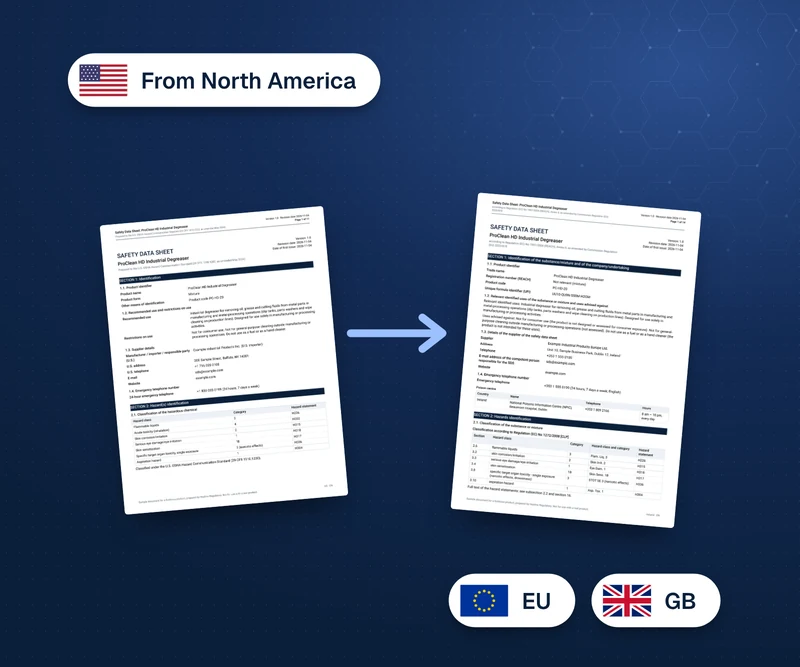
The 16 sections stay, but the format, classification, languages and supplier change. These are the points where a North American SDS usually fails in Europe.
Under CLP the supplier is the manufacturer, importer, downstream user or distributor established in the EU, so your EU importer or distributor is named on the label. In Great Britain it is a GB-based supplier. A company outside Europe cannot be that supplier itself.
Learn moreCLP adds environmental hazards, the EUH statements and, since 2023, endocrine disruption, PBT/vPvB and PMT/vPvM classes. Great Britain did not adopt those new classes and uses its own mandatory classification list, so the EU and GB results can differ.
Learn moreSince 1 January 2023 every EU SDS must follow Annex II as revised by Regulation (EU) 2020/878, with content required in all 16 sections, including sections 12 to 15, which OSHA does not enforce.
Learn moreThe SDS and label must be in an official language of each EU country where the product is sold, unless that country allows otherwise. A GB SDS is in English. Mixtures classified for health or physical hazards also carry a UFI from the EU company's poison centre notification.
Learn moreSend your current SDS and the full formula, under your non-disclosure agreement if you prefer, and tell us the countries you are shipping to and who your importer is. We classify the product under EU CLP and GB CLP, write the SDS in the REACH Annex II format with your EU or GB supplier's details, translate it into the languages of each country, and write the matching label text. A regulatory specialist signs off each SDS, and you receive Word and PDF files in your portal. Written, fixed quote within two business days; the SDSs in about 10 business days once we have your complete data, plus translation time for extra languages.
A first European distributor asking for EU SDSs and labels.
SDSs your importer can put its name on and use in each country.
GB SDSs with a GB supplier, under GB CLP and UK REACH.
SDSs and label text in each language before the launch date.
Illustrative scopes, not client results; every project is quoted on its own.
Starting point. Five concentrates with OSHA SDSs, and a distributor in the Netherlands selling into the Netherlands, Belgium and Germany.
What we do. Each product classified under CLP including environmental hazards and the new classes, SDSs written in the Annex II format with the distributor as supplier, translated into Dutch, French and German, and label text for each language.
What you receive. EU SDSs in three languages and label text for all five products, signed off and in your portal.
Starting point. Three products with bilingual WHMIS SDSs and a UK distributor asking for GB SDSs.
What we do. Each product classified under GB CLP using the GB mandatory classification list, SDSs written in the UK REACH Annex II format in English with the GB distributor as supplier.
What you receive. GB SDSs and label text for all three products.
Not as it stands. Europe uses the REACH Annex II format, its own classification rules including environmental hazards, the languages of each country and an EU or GB supplier on the label. A free check of one SDS tells you what yours needs.
The supplier established in the EU who places the product on the market there: usually your importer or distributor. For Great Britain, a GB-based supplier.
An official language of each EU country where the product is sold, unless that country allows another. A GB SDS is in English. Tell us the countries and we confirm the languages for each one in the quote.
Usually not. Great Britain has its own CLP and REACH, did not adopt the EU's 2023 hazard classes and uses its own mandatory classification list, and the supplier must be based in GB. Northern Ireland follows the EU rules. We write the GB version alongside the EU one.
No. REACH registration, Only Representative services and poison centre notifications are made by an EU or GB company. We write the SDSs and label text, and tell you which of those steps your importer needs to look at.
About 10 business days on the standard route once we have the formula and raw-material SDSs, plus translation time for each extra language. Each SDS has a fixed fee per product, country version and language, set by how complex the formula is and how complete your data are, quoted in writing within two business days.
Who registers substances under EU REACH when you export to the EU, how an Only Representative works, and what EU customers need: SDS, CLP and SVHC data.
Read article
Endocrine disruptors, PBT/vPvB and PMT/vPvM are now CLP hazard classes. Substances already on the market must comply by 1 November 2026.
Read article
Hazardous mixtures sold in the EU must be notified to the poison centres in the harmonised format of Annex VIII to CLP before they are placed on the market, and carry a unique formula identifier on the label. The duty holders, the scope, the dates that have all passed, and the updates that catch companies out.
Read articleSend one SDS for a free check. A specialist replies with a short written summary within one business day.