Importers of chemicals and raw materials
Supplier SDSs reviewed and brought up to local rules.
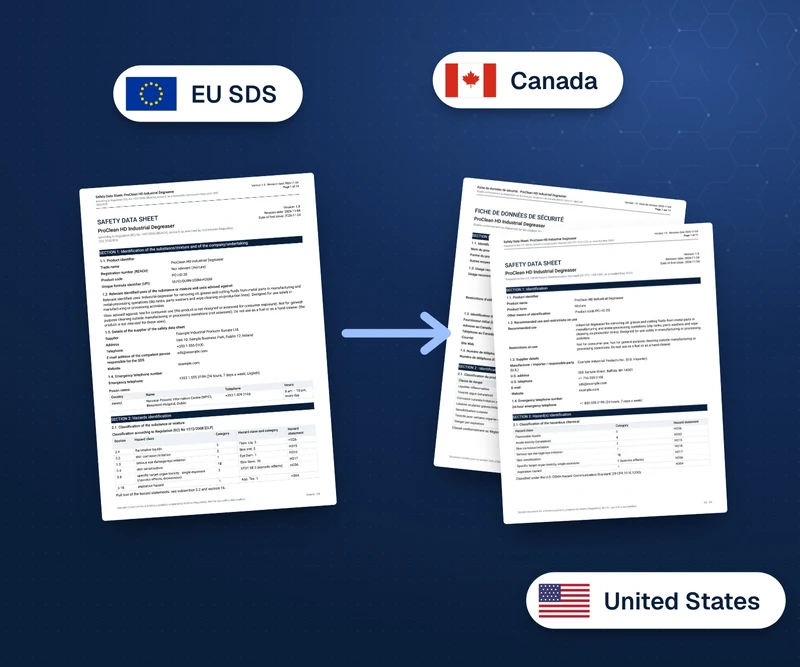
In Canada, a company that imports hazardous products for workplace use is a supplier, with the same SDS and label duties as a manufacturer; the US, the EU and the UK have their own versions of the rule. We check what your suppliers send you and fix what needs fixing, in English and French for Canada.
Not all of it applies to every company. On a call we go through your products and markets and tell you which of these you actually need.
A foreign supplier's SDS is written for its own market. We tell you which supplier documents can be passed on as they are and which need work.
Learn moreProducts sold in Canada need the Canadian supplier on the SDS and label, in English and French; the EU label must name an EU supplier. We rewrite what needs rewriting.
Learn moreEvery product on your list with a current SDS, kept in date, with missing supplier SDSs chased for you.
Learn moreThe first importer is often the producer under packaging EPR. The tracker shows the rules of 21 provinces, states and countries side by side.
Learn moreMost importers start with an audit of the supplier SDSs they already have. Large catalogues are triaged first, so the riskiest documents are reviewed and fixed before the rest. The audit tells you which SDSs can be passed on, which need the Canadian supplier and a French version, and which need rewriting.
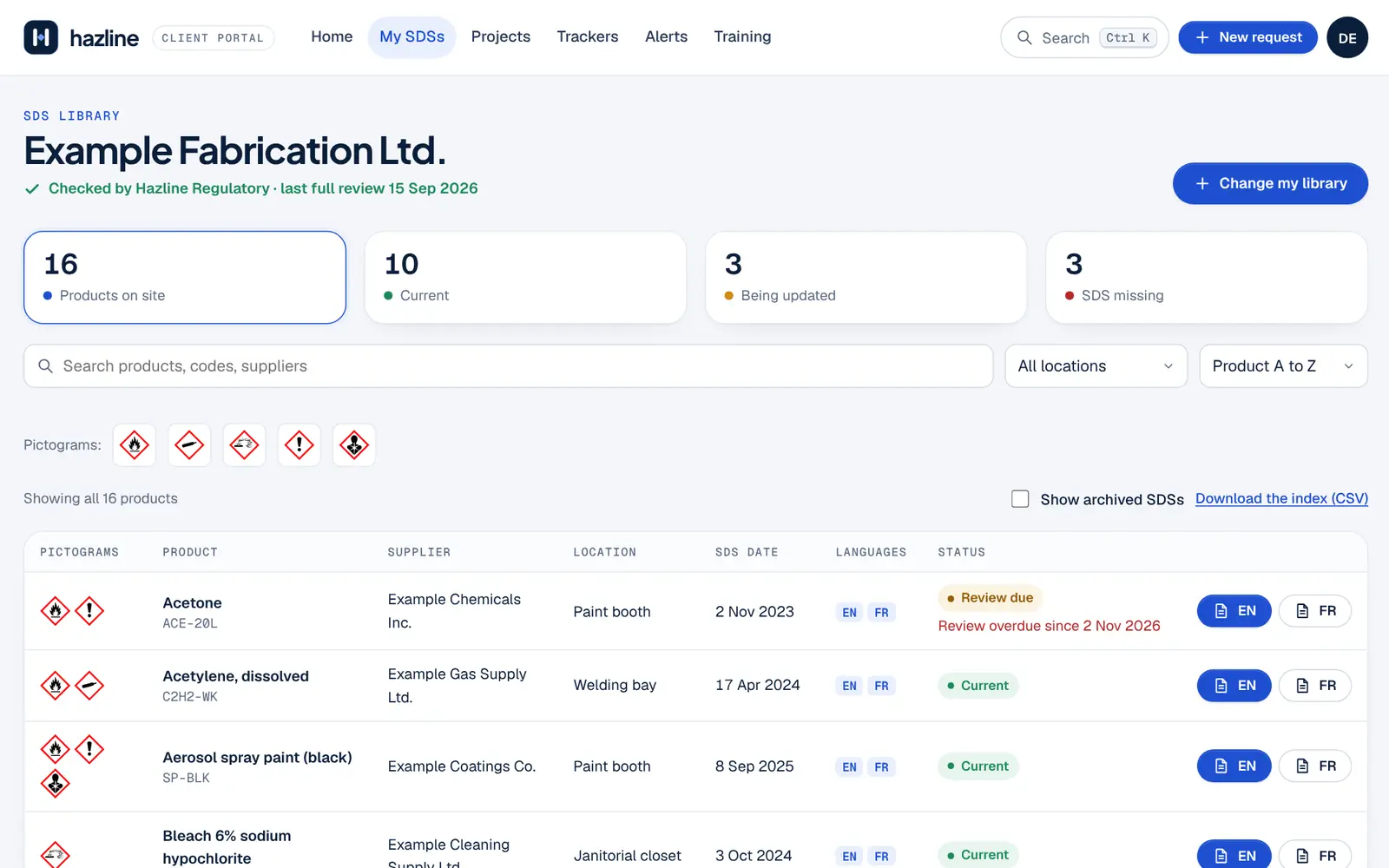
Supplier SDSs reviewed and brought up to local rules.
Every product on your list with a current, compliant SDS.
Local supplier details and French versions on every SDS and label.
SDSs accepted by marketplaces and carriers, and the packaging EPR tracker.
Illustrative scopes, not client results; every project is quoted on its own.
Starting point. Foreign supplier SDSs in English only, and no check of the import duties.
What we do. Each SDS checked against WHMIS, the Canadian supplier added, French versions and labels written, and the substances checked against the Domestic Substances List.
What you receive. Bilingual SDSs and labels, a change log for each product, and every issued version in your portal.
Starting point. Several hundred products from a dozen suppliers, and SDSs of every age.
What we do. The catalogue triaged by risk, the riskiest SDSs reviewed and fixed first, and the SDS library set up as we go.
What you receive. A current SDS for every product, a list of what was changed and why, and the next review dates in your portal.
Rarely as it is. Both follow the GHS, but WHMIS needs the Canadian supplier, French, and a few Canadian differences in classification and content. The audit lists exactly what to change for each document.
In Canada, the Canadian manufacturer or importer, unless an exemption applies. In the EU, an EU supplier. We add your details and write the labels in both languages for Canada.
For products sold to Canadian workplaces, yes: the SDS and the label must be available in English and French. We deliver one bilingual document or two matching versions.
With a triage. We rank the catalogue by risk, review the top of the list first and set up your SDS library as we go, so the products that matter most are compliant first.
An importer is a supplier under the Hazardous Products Act. What you need before the product arrives: a Canadian SDS and label in English and French, the right supplier details, and six years of records.
Read article
Both systems are based on the GHS, but a US SDS is rarely enough on its own for WHMIS. The differences that matter, and how to cover both markets.
Read article
Yes. WHMIS requires every SDS and supplier label to be in both official languages. What counts as bilingual, how the two versions must be delivered, and how to keep the French accurate.
Read articleA 20-minute call with a specialist: what applies to your products, what we would do first, and a written, fixed quote within two business days.