- Every information element on an SDS and a supplier label must be in English and French (HPR section 6.2).
- You can use one bilingual SDS, or two unilingual versions that together make one bilingual SDS. Both go to the buyer.
- The rule applies to hazardous products sold or imported for workplace use anywhere in Canada, not only in Quebec.
- Standard phrases such as signal words and hazard statements have official French wording. Use it rather than a free translation.
It is the most common reason a foreign or US safety data sheet fails in Canada. Under WHMIS, an SDS or label in only one official language does not comply, however good the content is.
Selling US products in Canada? We turn OSHA SDSs into bilingual WHMIS SDSs and labels: see WHMIS SDSs for US companies selling in Canada, or send one SDS for a free spot-check.
What the rule says
Section 6.2(1) of the Hazardous Products Regulations is short: the information elements on a safety data sheet and on a label must be in both official languages of Canada. Section 6.2(2) then allows two formats:
- SDS: a single bilingual safety data sheet, or a document in two unilingual parts that together make up one bilingual safety data sheet.
- Label: a single bilingual label, or the information elements in two unilingual parts.
CCOHS adds the practical point: if you use separate English and French SDSs, both must be provided together. Giving the buyer only the English version, with French "available on request", does not meet the rule.
Does it apply outside Quebec?
Yes. The Hazardous Products Regulations are federal and apply to every hazardous product sold or imported for use, handling or storage in a Canadian workplace. A product sold only in Alberta or British Columbia still needs a bilingual SDS and label. Quebec's Charter of the French language adds its own rules for products sold in Quebec, but it is not the source of the WHMIS requirement.
What has to be in both languages
Every required information element: the 16 section headings and their content on the SDS, and the six label elements, including any supplemental label information required by the classification. Information you add voluntarily should also be in both languages so the two versions say the same thing.
Getting the French right
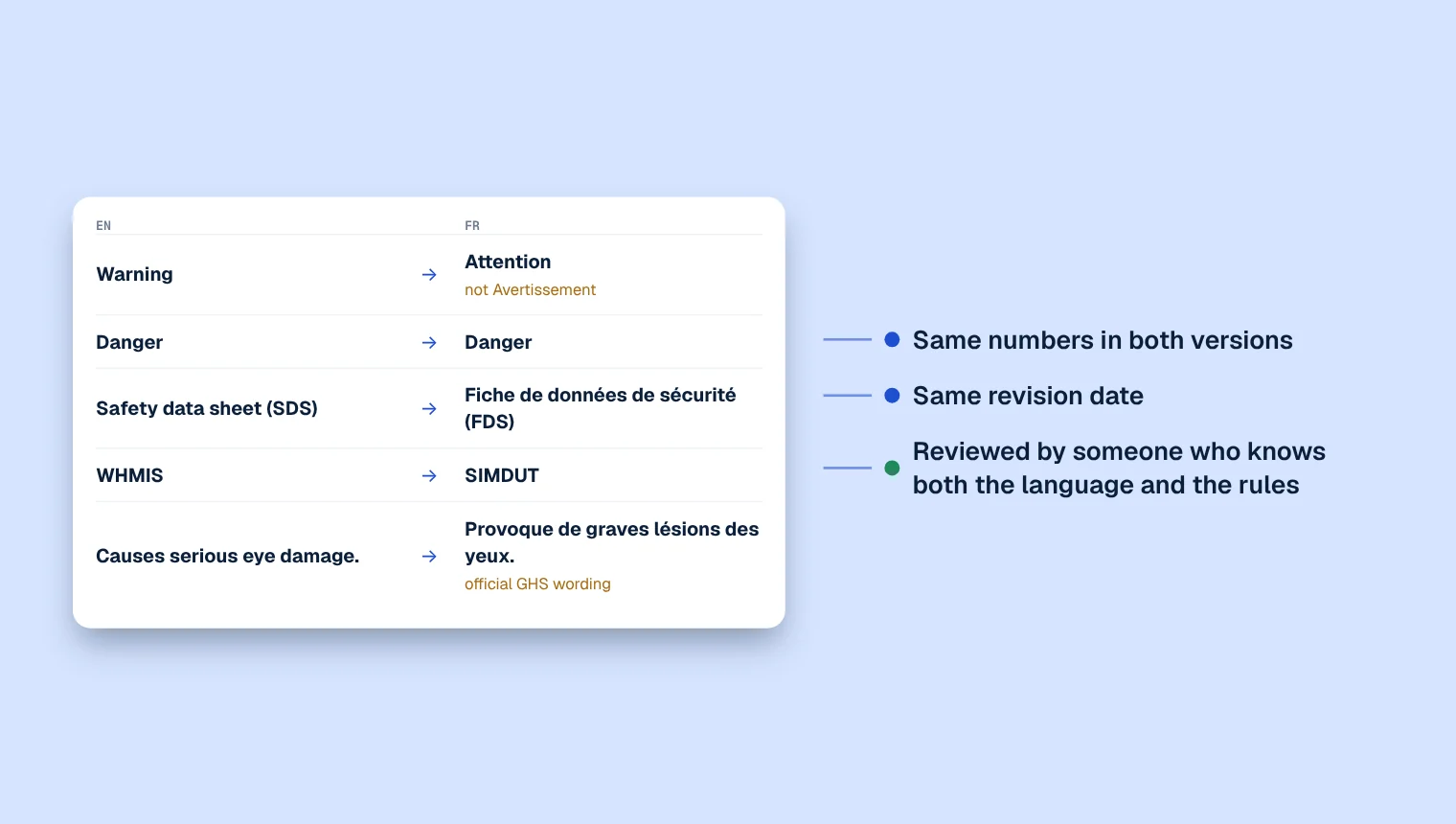
- Use the official standard phrases. Signal words, hazard statements and precautionary statements come from the GHS, which has official French texts. "Warning" is "Attention", not "Avertissement".
- Use Canadian terminology. In French, an SDS is a fiche de données de sécurité (FDS) and WHMIS is SIMDUT.
- Keep the numbers identical. Flash points, exposure limits and concentration ranges must be the same in both versions. A value rounded or converted in only one language is a common inconsistency.
- Update both versions together. When the English SDS changes, the French must change at the same time, with the same revision date.
- Have it reviewed. Machine translation is a reasonable first draft for free text such as first-aid advice, but the result should be checked by someone who knows both the language and the regulations.
Quick checklist
- Is there a French version of every SDS and label you supply in Canada?
- If the versions are separate, do your customers receive both?
- Do the two versions have the same revision date, classification and numbers?
- Are the standard phrases the official French wording?
Sources
General information, not legal advice. Checked against the official sources above on 10 October 2026. Rules change: for your own products, ask for a spot-check.