- WHMIS requires SDSs and labels in both English and French; OSHA requires English.
- The SDS must identify a Canadian supplier, with limited exceptions for importers using products in their own workplace.
- Some hazard classes differ, such as biohazardous infectious materials (WHMIS only).
- One combined SDS can work for both markets, but only if it is written to meet both sets of rules.
Canada and the US worked together when adopting the GHS, so WHMIS 2015 and OSHA's Hazard Communication Standard look very similar. Both use a 16-section SDS and the same pictograms. That similarity is exactly why importers get caught out: a US SDS is usually not compliant in Canada as it stands.
Selling US products in Canada? We turn OSHA SDSs into bilingual WHMIS SDSs and labels: see WHMIS SDSs for US companies selling in Canada, or send one SDS for a free spot-check.
The differences that matter most
1. Language
Under WHMIS, the SDS and label must be in both English and French, either as one bilingual document or as two separate ones. OSHA requires English and allows other languages to be added.
2. Supplier identification
A WHMIS SDS must identify a Canadian supplier: the name, address and phone number of the Canadian manufacturer, importer or distributor. A US manufacturer's details alone are not enough. There is a limited exception for importers bringing a product in for use in their own workplace.
3. Hazard classes
The two systems adopted slightly different parts of the GHS. WHMIS includes biohazardous infectious materials, which OSHA does not, while explosives and desensitized explosives are covered by OSHA but excluded from WHMIS. Some label rules differ too: a mixture containing between 0.1% and 1% of a category 2 carcinogen must carry the carcinogen label elements in Canada, while in the US this is optional.
4. Updates after new information
The deadlines for updating an SDS after new data differ: 90 days in Canada (180 days for the label), three months in the US. See how often you need to update an SDS.
Can one SDS cover both countries?
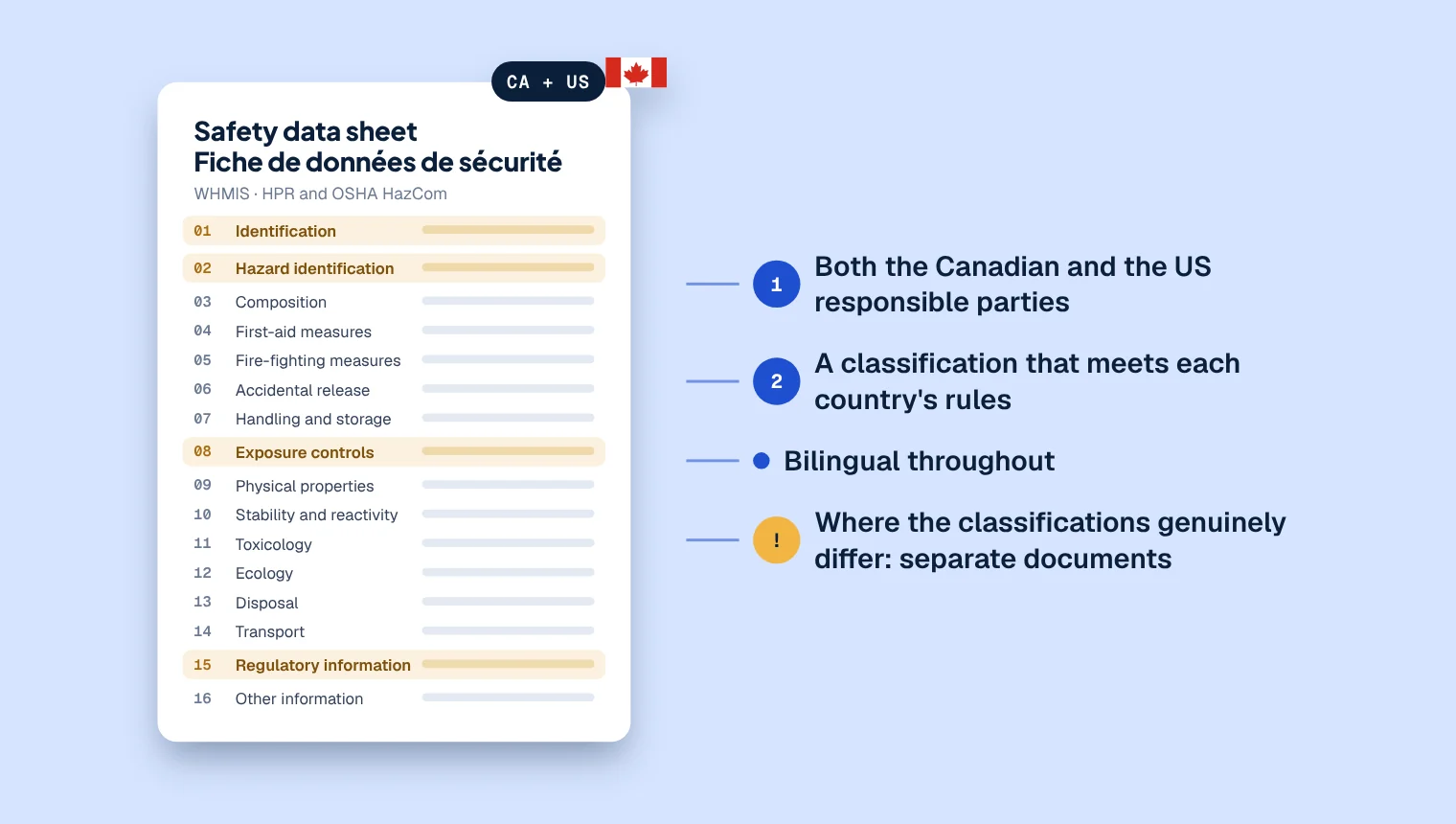
Yes, and many companies do this, but only if the document is written deliberately to satisfy both systems: bilingual, naming both the Canadian and the US responsible parties, with a classification that meets each country's rules. Where the classifications genuinely differ, separate documents are usually cleaner. We write both kinds; the page on one SDS for the US and Canada explains how we choose for each product.
Importing into Canada? Quick checklist
- Is there a French version, and does it match the English?
- Is a Canadian supplier, or your company as importer, identified?
- Has the SDS been updated for the amended Hazardous Products Regulations, mandatory since December 2025?
- Do the label and the SDS match the classification?
Sources
General information, not legal advice. Checked against the official sources above on 7 October 2026. Rules change: for your own products, ask for a spot-check.