US manufacturers selling in Canada
Your OSHA SDS turned into one sheet that also meets WHMIS, in English and French.
Yes, one safety data sheet can cover both the US and Canada, but only if it is written on purpose to meet OSHA's Hazard Communication Standard and Canada's Hazardous Products Regulations at the same time. Hazline Regulatory, an SDS consultancy in Ottawa, writes these dual US/Canada SDSs in English and French, for a single product or a full range, and tells you when two separate sheets would be clearer. Every SDS is signed off by a regulatory specialist.
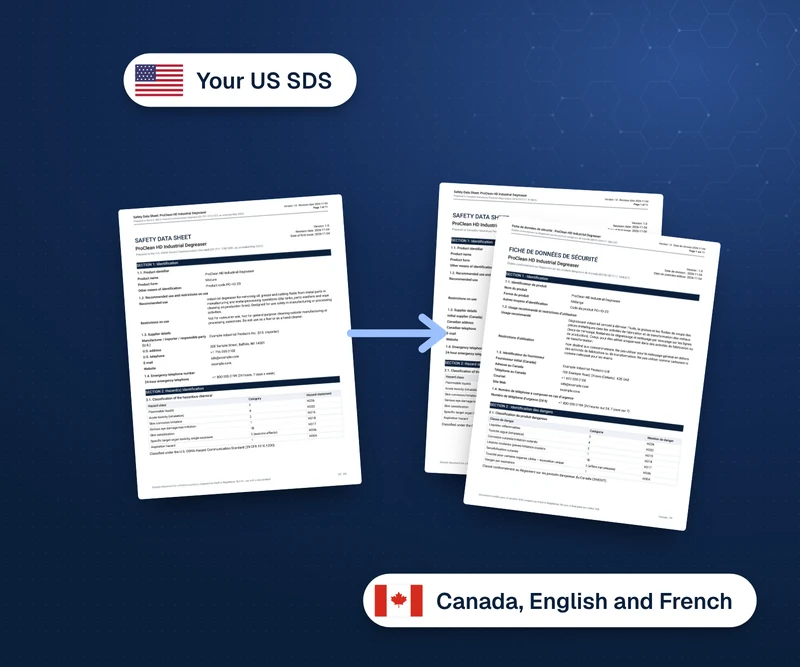
A dual sheet has to satisfy each country wherever the two rules part ways. These are the points we check and write for every product.
Canada requires the SDS and label in both official languages, as one bilingual document or two unilingual parts that together form one. OSHA requires English and allows other languages as well. A dual sheet is therefore bilingual.
Learn moreCanada asks for the initial supplier identifier: the name, address and phone number of the manufacturer, or of the importer who operates in Canada. The US asks for the name, address and phone number of the manufacturer, importer or other responsible party. A dual sheet names both.
Learn moreA few hazard classes differ. Canada has a class for biohazardous infectious materials; the US does not. The US classifies explosives and desensitized explosives, while explosives fall outside Canada's Hazardous Products Act. A mixture with a Category 2 carcinogen at 0.1 to 1 percent needs label elements in Canada; in the US the label warning is optional.
Learn moreCanada accepts a prescribed concentration range or a narrower range inside one. The US allows prescribed ranges when the exact figure is a trade secret, using the narrowest range possible. After significant new information, Canada works to 90 days for the SDS and 180 days for the label, the US to three and six months, so a dual sheet follows the shorter clock.
Learn moreWhere the US and Canadian SDS rules agree and where they differ, in one table.
| Requirement | United States (OSHA HazCom 2024) | Canada (WHMIS) |
|---|---|---|
| Rules for the SDS | Hazard Communication Standard, 29 CFR 1910.1200 | Hazardous Products Act and Hazardous Products Regulations (HPR) |
| Language | English | English and French, in every province |
| Who is named on the SDS and label | The manufacturer, importer or other responsible party, with a US address and phone number | The Canadian supplier: the manufacturer or importer in Canada |
| Environmental hazard classes | Not used | Not used |
| Flammable liquids category 4 (flash point above 60 °C up to 93 °C) | Yes | Yes |
| Endocrine disruption, PBT/vPvB and PMT/vPvM classes | No | No |
| Keeping an exact concentration confidential | The same 13 prescribed ranges, using the narrowest that fits, with the same statement | One of 13 prescribed ranges, with a statement that the concentration is withheld as a trade secret |
| Keeping a chemical name confidential | Nothing is filed, but the claim must be supportable and the SDS must say the name is withheld | A claim filed with Health Canada under the Hazardous Materials Information Review Act |
| Updating the SDS | Within three months of new information about the hazards | Within 90 days of significant new data |
A summary of the main differences. What applies to one product depends on its formula and where it is sold; a free check of one SDS shows what yours needs.
We classify the product under OSHA HazCom 2024 and the Hazardous Products Regulations first and show you the result. If one of the differences changes the classification or the label, one combined document can be harder to read than two clear ones, so we recommend one sheet or two for each product. You then receive a dual US/Canada SDS in English and French, or a US SDS and a bilingual WHMIS SDS, with matching label text, as Word and PDF files in your portal, signed off by a regulatory specialist. A written, fixed quote comes within two business days; from complete formula and raw-material SDSs it takes about 10 business days on the standard route and about 5 on the fast track.
Your OSHA SDS turned into one sheet that also meets WHMIS, in English and French.
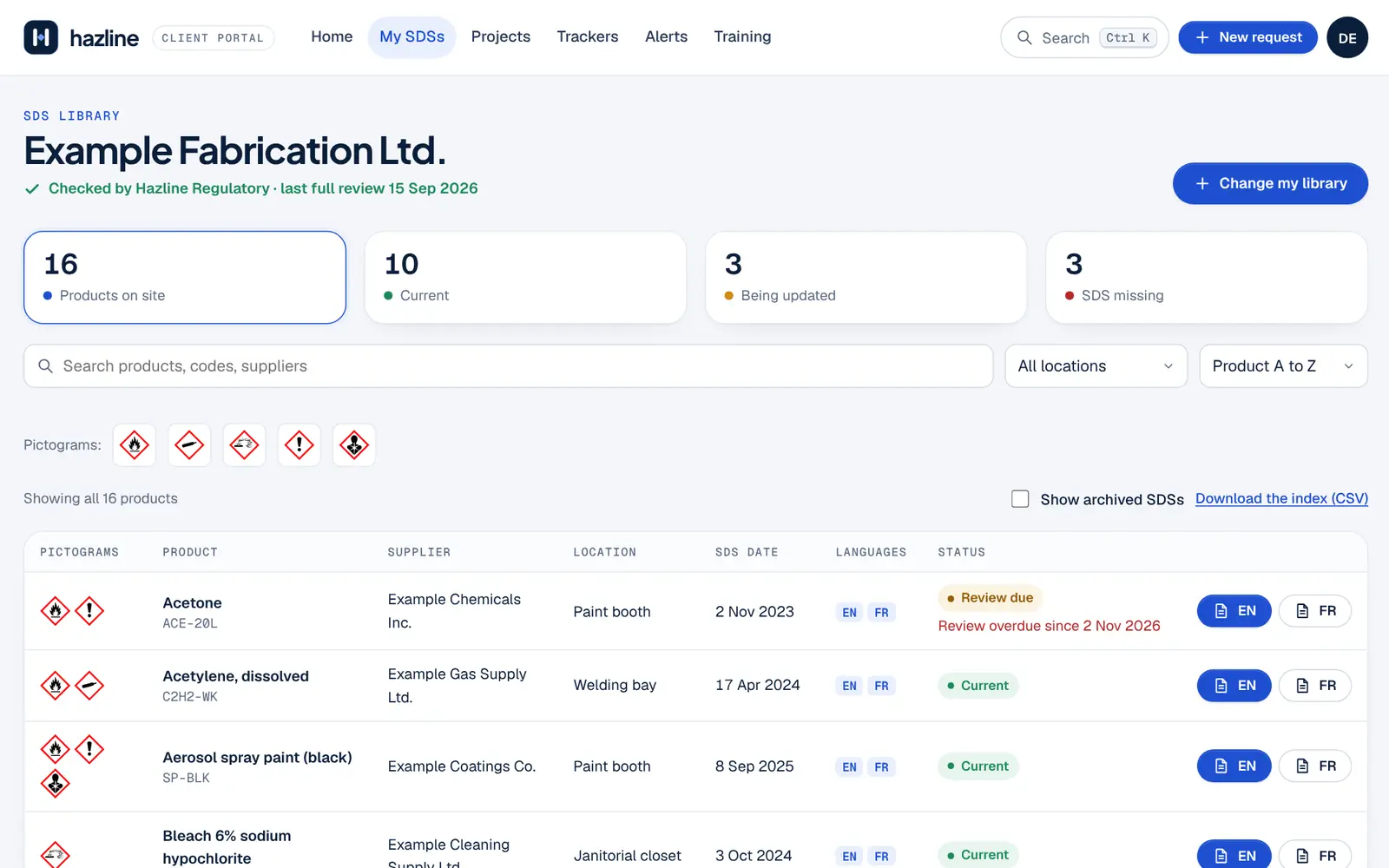
Your WHMIS SDS checked against HazCom 2024 so one sheet serves both markets.
One sheet per product for customers in both countries, with both companies named.
A dual sheet in your brand's name, with the formula sent to us under NDA.
Illustrative scopes, not client results; every project is quoted on its own.
Starting point. Twelve OSHA SDSs and a distributor in Ontario that needs WHMIS documents.
What we do. Each product classified under the Hazardous Products Regulations, the Canadian supplier added, the French written and the sections that differ adjusted, with two sheets recommended for the one product that classifies differently.
What you receive. Eleven dual US/Canada SDSs, one US SDS and one bilingual WHMIS SDS, with label text, signed off in the portal.
Starting point. Bilingual WHMIS SDSs for a coatings range and a first US customer.
What we do. Each classification checked against HazCom 2024, the US responsible party added to section 1 and the concentration ranges reviewed against the US trade-secret rules.
What you receive. One sheet per product that serves both markets, with the next review dates in the portal.
Yes, as long as the sheet meets each country's requirements wherever they differ. Both use the same 16 sections in the same order, so one bilingual document can satisfy OSHA's Hazard Communication Standard and Canada's Hazardous Products Regulations.
Yes, for any product sold or imported into Canada for use in a workplace. The French can be on the same document or in a second unilingual part supplied with it.
Both: your US manufacturer, importer or responsible party, and the Canadian manufacturer or importer. If your Canadian customer imports only for use in its own workplace, it may keep your name, address and phone number on the SDS instead of its own.
Usually, yes. We check the classification against the Canadian rules, add the Canadian supplier, write the French and adjust the sections that differ. If the product classifies differently in Canada, we tell you before writing.
The full formula with CAS numbers and percentages, your current SDS, the raw-material SDSs, and the US and Canadian company details to print.
Yes. You can also send one SDS for a free spot-check first.
Both systems are based on the GHS, but a US SDS is rarely enough on its own for WHMIS. The differences that matter, and how to cover both markets.
Read article
Yes. WHMIS requires every SDS and supplier label to be in both official languages. What counts as bilingual, how the two versions must be delivered, and how to keep the French accurate.
Read article
Canada and the US now use the same 13 concentration ranges when a supplier withholds an exact percentage as a trade secret. The ranges, the rules for narrower and combined ranges, and how withholding a chemical name differs.
Read articleSend one SDS for a free spot-check. A specialist replies with a short written summary within one business day of what a dual sheet would need.