- An EU safety data sheet written for CLP and REACH is a good starting point but is not compliant in Canada as it stands.
- A WHMIS SDS must name a Canadian manufacturer or importer, be in English and French, and classify the product under the Hazardous Products Regulations, not CLP.
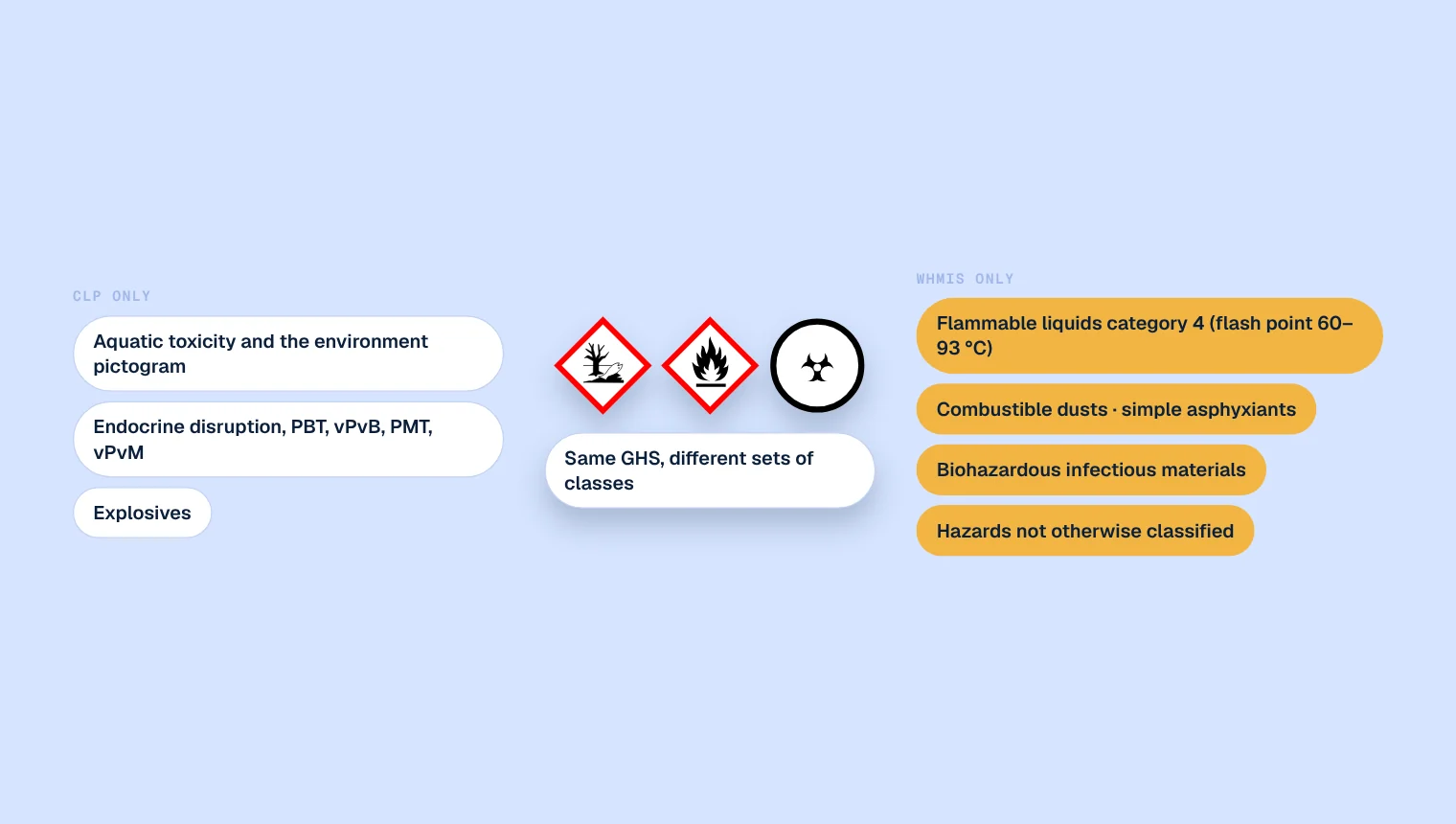
- The classifications can differ: WHMIS has no environmental hazard classes but adds classes such as combustible dusts, simple asphyxiants and flammable liquids category 4.
- WHMIS is not the only gate. Canada's VOC concentration limits and the new substances rules can stop a product that is legal in the EU, whatever its SDS says.
Not as it stands. A safety data sheet (SDS) written for the EU under REACH and the CLP Regulation has the same 16 sections as a Canadian one and is a good starting point, but Canada has its own rules: WHMIS, set by the Hazardous Products Act (HPA) and the Hazardous Products Regulations (HPR). Before a hazardous product is sold or imported for use in a Canadian workplace, the SDS has to name a Canadian supplier, be in English and French, and show a classification made under the HPR. Getting the SDS right is also not the whole job: some products that are legal in the EU cannot be imported into Canada without being reformulated.
Who is responsible for the Canadian SDS?
The Canadian supplier. Under the HPA, a supplier is anyone who, in the course of business, sells or imports a hazardous product. Section 13 requires a supplier who sells a hazardous product intended for use in a workplace to have a compliant SDS, to provide it to the buyer, and to label the product, and section 14 prohibits importing one unless the importer obtains or prepares a compliant SDS on or before importation and the product is labelled. So the legal duty sits with the Canadian importer or distributor, not with the European manufacturer.
In practice, the Canadian partner asks the manufacturer for a WHMIS SDS, because the manufacturer has the formula and the test data. Often the manufacturer prepares the Canadian SDS for its importer, with the importer's details in section 1. If a Canadian company imports a product only for use in its own workplace, it may keep the foreign supplier's name, address and phone number on the SDS and label instead of its own (HPR section 5.9), but the rest of the WHMIS requirements still apply, including English and French.
What has to change on the SDS?
| Item | EU SDS (REACH Annex II, CLP) | Canadian SDS (WHMIS, HPR) |
|---|---|---|
| Language | An official language of each EU country where the product is placed, unless that country provides otherwise (REACH Article 31(5)) | English and French, as one bilingual document or two versions that together form one (HPR section 6.2) |
| Section 1: supplier | The EU supplier, often with the UFI code and REACH registration numbers | The "initial supplier identifier": name, address and phone number of the Canadian manufacturer or importer |
| Section 1: emergency number | Often a European poison centre or an EU-based service | An emergency telephone number, with any restrictions on its use (such as hours or languages) stated |
| Section 2: classification | CLP criteria; harmonised classifications in CLP Annex VI are binding for the hazard classes they cover | HPR criteria, applied by the supplier to the available data; Canada has no list of mandatory classifications |
| Section 3: ingredients | Ingredients listed under REACH Annex II rules, often with EU concentration ranges | Every ingredient classified in a health hazard class and present above its cut-off; withheld concentrations must use the prescribed ranges with a trade-secret statement |
| Sections 12 to 15 | Content required | Headings required; the content is optional |
| Section 16 | Revision information | Date of the latest revision |
Two smaller points catch people out. Section 8 of an EU SDS usually lists EU and national exposure limits, such as Belgian or German values; the HPR asks for exposure guidelines and their source, and Canadian customers expect the limits that apply in their province. And after the HPR amendments, which every supplier has had to follow since the transition period ended on 14 December 2025, section 3 must list every ingredient classified in a health hazard class above its cut-off, whether or not it changes the mixture's classification.
Which hazard classes are different?
Canada and the EU both took their classes from the UN Globally Harmonized System (GHS), but each adopted a different set:
- Environmental hazards. WHMIS did not adopt the GHS environmental hazard group. Aquatic toxicity, which drives many EU classifications and the environment pictogram, is not a WHMIS class. Environmental information may still be given on the SDS.
- EU-only classes. The classes the EU added in 2023 (endocrine disruption, PBT and vPvB, PMT and vPvM) and the EUH statements have no equivalent in WHMIS.
- Canada-only classes. WHMIS includes combustible dusts, simple asphyxiants, biohazardous infectious materials, and physical and health hazards not otherwise classified, which CLP does not have.
- Flammable liquids. CLP has three categories, up to a flash point of 60 °C. WHMIS has four: category 4 covers liquids with a flash point above 60 °C and up to 93 °C. A liquid that is not flammable under CLP can therefore be "Flammable liquid, category 4" in Canada, with the signal word "Warning" and the hazard statement "Combustible liquid".
- Explosives. CLP covers explosives; WHMIS does not currently include the explosives hazard class.
So the classification cannot simply be copied across. It has to be redone from the composition and data under the HPR criteria. The EU classification is useful evidence, but the Canadian result can come out differently, and so can the pictograms and statements.
What about the label?
The supplier label changes too. A WHMIS label must be in English and French, show the Canadian supplier, and use the pictograms, signal word and hazard and precautionary statements that follow from the Canadian classification. EU-only elements, such as EUH statements and the UFI code, play no part in WHMIS. See WHMIS label requirements.
Which other Canadian rules can stop the product?
A correct SDS does not make a product legal to sell. Check these before the first shipment, because each one can mean reformulation rather than paperwork:
- VOC concentration limits. The Volatile Organic Compound Concentration Limits for Certain Products Regulations (SOR/2021-268) set VOC limits for about 130 categories and subcategories of consumer, commercial and institutional products, such as cleaners, degreasers, adhesives, sealants and disinfectants. Since 1 January 2024 (1 January 2025 for disinfectants), a product above its limit may not be manufactured in or imported into Canada unless an exception or alternative compliance option applies. The container must show the date of manufacture or a code for it, and manufacturers and importers must keep records for five years. EU products are not built to these limits, so a product that sells freely in Europe can be over the Canadian limit.
- New substances. Every substance in the product must be on the Domestic Substances List (DSL), or the Canadian importer may have to notify it under the New Substances Notification Regulations before importing it above the thresholds, which start at 100 kg a year for a substance on neither the DSL nor the NDSL. Being registered under REACH does not count. See new substances notification in Canada.
- Consumer products. WHMIS covers products for workplace use. Chemical products sold to consumers fall under the Consumer Chemicals and Containers Regulations, 2001 instead, with their own labelling rules. Many ranges need both.
- Transport. Dangerous goods shipped within Canada follow the Transportation of Dangerous Goods Regulations. Section 14 of the SDS is optional under WHMIS, but your carrier will still need the classification.
Checklist before the first shipment to Canada
- Who is the Canadian importer, and are their name, address and phone number in section 1 and on the label?
- Has the product been classified under the HPR, including flammable liquids category 4 and the Canada-only classes?
- Are the SDS and label in English and French, and do the two versions match?
- Does section 3 list every ingredient classified for a health hazard above its cut-off, with prescribed ranges where concentrations are withheld?
- Is the product in a category covered by the VOC regulations, and is it under the limit?
- Is every substance on the DSL?
- Is the product sold to workplaces, to consumers, or both?
Health Canada enforces the supplier rules. For the 2022 amendments, it has said it will focus on compliance promotion until 19 November 2027, but it may still act to compel compliance where warranted, and the rules themselves apply now. Provincial inspectors can also find supplier problems first, at your customer's site.
How Hazline can help
Hazline prepares bilingual WHMIS safety data sheets and labels for European and other foreign manufacturers selling into Canada, from your formula and your EU SDS, with your Canadian importer named. Selling in the US too? One dual US/Canada SDS can cover both markets when it is written for both; see one SDS for the US and Canada. Before we write anything, we check the formula against the VOC limits and the substances against the Domestic Substances List, so you know early if a product needs to change. The fee is fixed and quoted in writing within two business days. Send us one EU SDS for a free spot-check, or book a free call.
Sources
- Justice Laws: Hazardous Products Act (R.S.C. 1985, c. H-3), sections 13 and 14 and Schedule 1
- Justice Laws: Hazardous Products Regulations (SOR/2015-17)
- CCOHS: WHMIS, safety data sheets
- CCOHS: WHMIS, hazard classes and categories
- CCOHS: WHMIS, pictograms
- Health Canada: amendments to the Hazardous Products Regulations
- Health Canada: hazardous substance assessments (guidance; suppliers classify their own products)
- EUR-Lex: Regulation (EC) No 1272/2008 (CLP), Annex I
- ECHA: new hazard classes 2023
- EUR-Lex: Regulation (EC) No 1907/2006 (REACH), Article 31 and Annex II
- Justice Laws: Volatile Organic Compound Concentration Limits for Certain Products Regulations (SOR/2021-268)
- Justice Laws: New Substances Notification Regulations (Chemicals and Polymers), SOR/2005-247
- Justice Laws: Consumer Chemicals and Containers Regulations, 2001 (SOR/2001-269)
General information, not legal advice. Checked against the official sources above on 28 October 2026. Rules change: for your own products, ask for a spot-check.