European manufacturers and formulators
A first US or Canadian distributor asking for local SDSs.
Your REACH SDS is the right starting point, but it is not compliant in North America as it stands. The US needs an English SDS under OSHA HazCom with a US responsible party. Canada needs an English and French SDS under WHMIS with a Canadian supplier. Both need the classification redone under their own criteria. We do the conversion from your EU SDS and formula, and a regulatory specialist signs off every document.
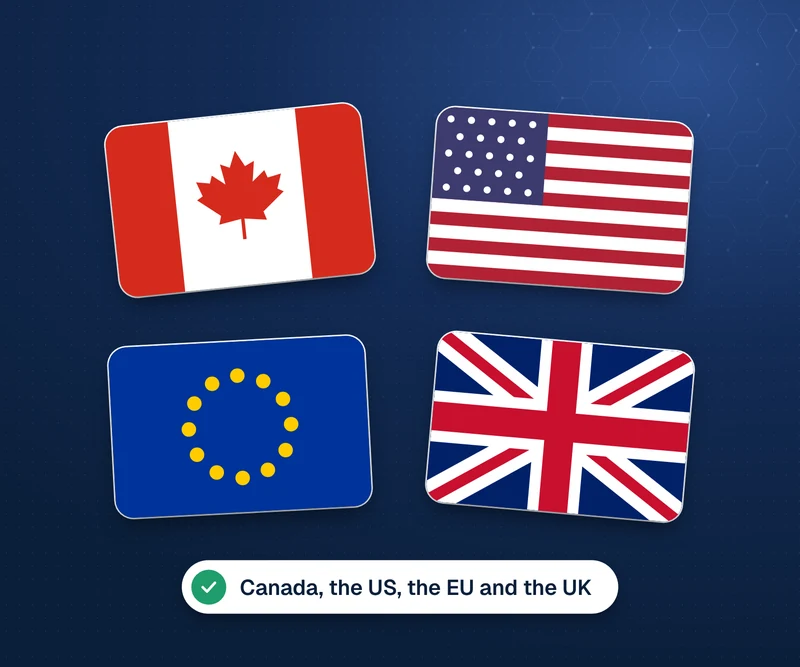
The US, Canada and the EU all build on the GHS and use 16 sections, so this is a conversion, not a rewrite from zero. These are the points where an EU SDS fails in North America.
The US SDS and label give the name, US address and US phone number of the manufacturer, importer or other responsible party. The Canadian SDS and label name the Canadian supplier, the importer or distributor who sells the product there.
Learn moreNeither country uses the GHS environmental classes, and the EU-only classes and EUH statements have no place. Both have a flammable liquids category 4 (flash point above 60 °C up to 93 °C), so a product that is not flammable in the EU can carry "Combustible liquid" there.
Learn moreThe US SDS must be in English. In Canada every element of the SDS and label must be in English and French, as one bilingual document or two versions supplied together, in every province.
Learn moreSection 8 of the US SDS gives OSHA PELs and ACGIH TLVs, and section 11 the NTP, IARC and OSHA carcinogen status. The Canadian SDS lists every ingredient classified for a health hazard above its cut-off.
Learn moreAll four follow the GHS and use a 16-section SDS, but an EU SDS is not valid in the US or Canada as it stands. The US needs English, a US responsible party and an OSHA HazCom classification. Canada needs English and French, a Canadian supplier and a classification under the Hazardous Products Regulations.
| Requirement | European Union (CLP and REACH) | United States (OSHA HazCom 2024) | Canada (WHMIS) | Great Britain (GB CLP and UK REACH) |
|---|---|---|---|---|
| Rules for the SDS | REACH Article 31 and Annex II; CLP Regulation | Hazard Communication Standard, 29 CFR 1910.1200 | Hazardous Products Act and Hazardous Products Regulations (HPR) | UK REACH Article 31 and Annex II; GB CLP |
| Language | An official language of each country where the product is sold, unless that country allows otherwise | English | English and French, in every province | English |
| Who is named on the SDS and label | A supplier established in the EU | The manufacturer, importer or other responsible party, with a US address and phone number | The Canadian supplier: the manufacturer or importer in Canada | A supplier based in Great Britain |
| Environmental hazard classes | Used | Not used | Not used | Used |
| Flammable liquids category 4 (flash point above 60 °C up to 93 °C) | No | Yes | Yes | No |
| Endocrine disruption, PBT/vPvB and PMT/vPvM classes | Yes, since 2023 | No | No | Not adopted |
| Keeping an exact concentration confidential | Section 3 may give a concentration range | The same 13 prescribed ranges, using the narrowest that fits, with the same statement | One of 13 prescribed ranges, with a statement that the concentration is withheld as a trade secret | Section 3 may give a concentration range |
| Keeping a chemical name confidential | For some lower-hazard ingredients in a mixture, a request to ECHA to use an alternative chemical name; a fee applies | Nothing is filed, but the claim must be supportable and the SDS must say the name is withheld | A claim filed with Health Canada under the Hazardous Materials Information Review Act | For some lower-hazard ingredients in a mixture, a request to HSE to use an alternative chemical name |
| Updating the SDS | Without delay | Within three months of new information about the hazards | Within 90 days of significant new data | Without delay |
A summary of the main differences. What applies to one product depends on its formula and where it is sold; a free check of one SDS shows what yours needs.
Send your EU SDS and the full formula, under your non-disclosure agreement if you prefer. We redo the classification under OSHA HazCom and the Hazardous Products Regulations, name your US responsible party and Canadian supplier, complete the sections that differ, write the French version for Canada and the matching label text for each country, and flag substances to check against the TSCA Inventory. A regulatory specialist signs off each SDS, and you receive Word and PDF files in your portal. Written, fixed quote within two business days; the SDSs in about 10 business days once we have your complete data.
A first US or Canadian distributor asking for local SDSs.
GB or other GHS SDSs brought to US and Canadian rules the same way.
Your company named as the US responsible party or Canadian supplier.
SDSs and labels in your name, ready for North American buyers.
Illustrative scopes, not client results; every project is quoted on its own.
Starting point. Eight products with REACH SDSs in German and English, and a distributor serving both countries.
What we do. Each product reclassified under OSHA HazCom and the HPR, the distributor named for each country, sections 8, 11 and 15 completed with US and Canadian content, French written for Canada, and the substances flagged for a TSCA Inventory check.
What you receive. A US SDS and a bilingual Canadian SDS for each product, with label text, signed off and in your portal.
Starting point. Two products, a GB SDS for each, and a US customer who needs an OSHA SDS before the first order.
What we do. Both products reclassified under OSHA criteria, including flammable liquids category 4 and any hazards not otherwise classified, with the US importer named and US exposure limits added.
What you receive. Two OSHA HazCom SDSs and their label text, on the fast track.
Not as it stands. All three follow the GHS with 16 sections, but the US needs a US responsible party and OSHA classification, and Canada needs English and French, a Canadian supplier and a classification under the Hazardous Products Regulations. A free check of one SDS tells you what yours needs.
In the US, the manufacturer, importer or other responsible party with a US address and phone number; in practice usually your US importer or distributor. In Canada, the Canadian supplier who sells or imports the product. A Canadian company importing only for use in its own workplace may keep your name, address and phone number instead.
Sometimes: written on purpose for both, bilingual, naming the responsible party for each country, with a classification that satisfies both systems. Where the classifications differ, two documents are clearer. We tell you which suits your products.
SDSs and labels for substances had to be updated by 19 May 2026, and for mixtures must be by 19 November 2027. Any US SDS we write now follows the 2024 rules.
Not on its own. In the US every chemical substance imported must be on the TSCA Inventory or exempt, and the importer certifies this to Customs. In Canada, rules such as the VOC limits for consumer and commercial products can mean reformulation. We flag what we see while writing the SDS.
About 10 business days on the standard route and about 5 on the fast track, once we have the formula and raw-material SDSs. Each SDS has a fixed fee per product and country, set by the number of products and languages and how complete your data are, quoted in writing within two business days.
An EU (CLP/REACH) SDS is not an OSHA SDS. What changes for the US: a US responsible party, OSHA classification, sections 8 and 11, labels and TSCA.
Read article
An EU (CLP/REACH) SDS is not a WHMIS SDS. What changes for Canada: Canadian supplier, English and French, classification, and the VOC and new-substance rules.
Read article
Both systems are based on the GHS, but a US SDS is rarely enough on its own for WHMIS. The differences that matter, and how to cover both markets.
Read articleSend one SDS for a free check. A specialist replies with a short written summary within one business day.