- An EU safety data sheet is not compliant in the US as it stands: OSHA's Hazard Communication Standard (HCS) sets its own content in Appendix D.
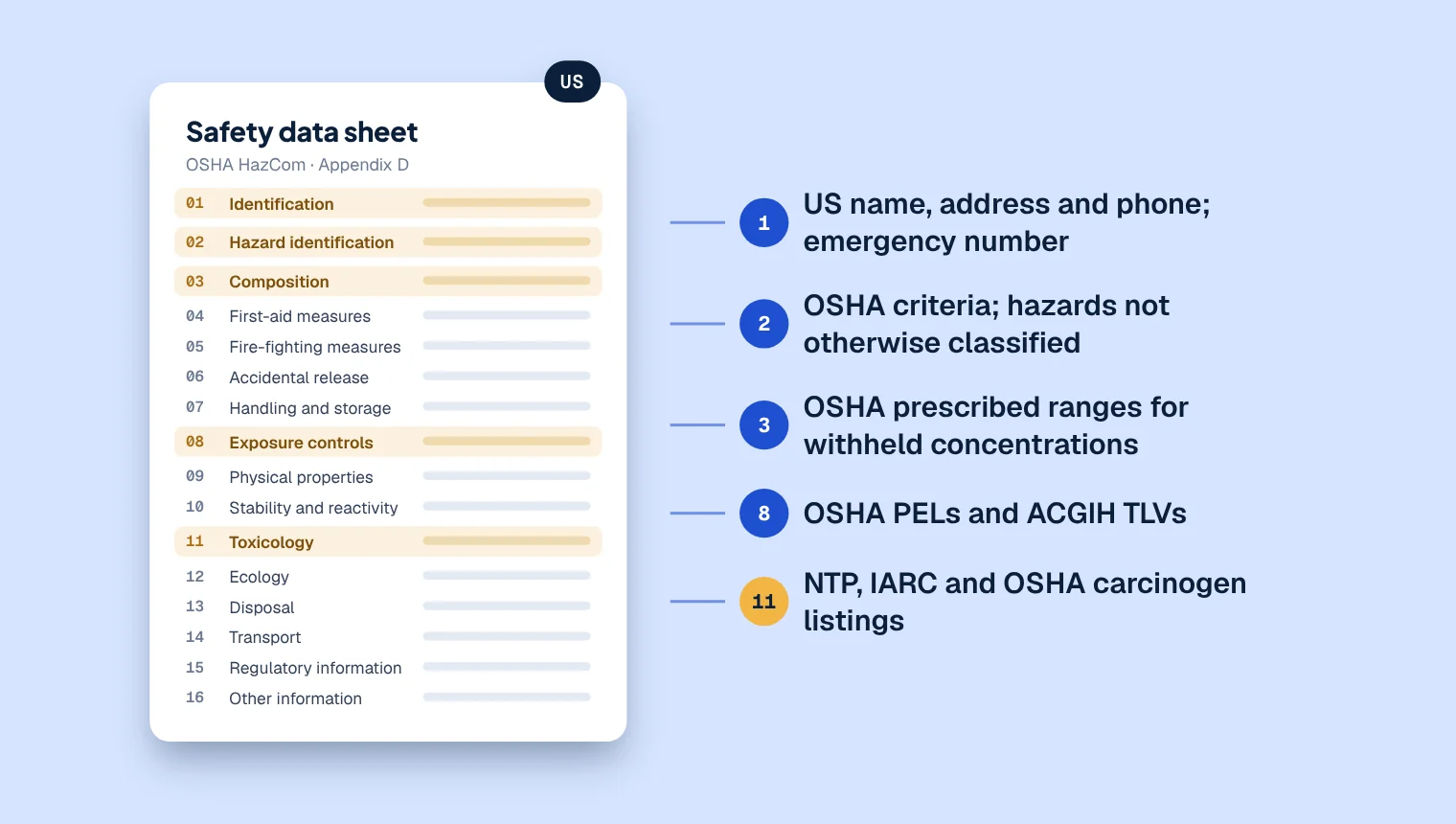
- Since the 2024 update, section 1 and the label must give a US address and US phone number for the manufacturer, importer or other responsible party.
- OSHA has no environmental hazard classes but adds combustible dust, simple asphyxiants, hazards not otherwise classified and flammable liquids category 4.
- Section 8 must give OSHA PELs and ACGIH TLVs, and section 11 must say whether ingredients are listed as carcinogens by NTP, IARC or OSHA.
Not as it stands. An SDS written for the EU under REACH and CLP has the same 16 sections as a US one, but the US rule is OSHA's Hazard Communication Standard (HCS), 29 CFR 1910.1200, and its Appendix D sets what each section must contain. The main changes are a US responsible party with a US address and phone number, a classification made under OSHA's criteria, US exposure limits in section 8, the US carcinogen lists in section 11, and an English-language document.
Who is responsible for the US SDS?
Under the HCS, chemical manufacturers and importers must obtain or develop an SDS for each hazardous chemical they produce or import, and give it to distributors and employers with the first shipment and with the first shipment after the SDS is updated (paragraph (g)). A European manufacturer is not an OSHA-regulated importer, but its US importer is. In practice the importer often asks the manufacturer for an OSHA SDS, because the manufacturer has the formula and the data.
What has to change on the SDS?
| Item | EU SDS (REACH Annex II, CLP) | US SDS (OSHA HCS, Appendix D) |
|---|---|---|
| Language | An official language of each EU country where the product is placed, unless that country provides otherwise | English (other languages may be added) |
| Section 1: supplier | The EU supplier, often with the UFI code | Name, U.S. address and U.S. telephone number of the chemical manufacturer, importer or other responsible party, plus an emergency phone number |
| Section 2: classification | CLP criteria, including environmental hazards and EUH statements | OSHA criteria (Appendices A and B); hazards not otherwise classified are described here |
| Section 3: ingredients | REACH Annex II rules, often with EU ranges | Withheld concentrations must use OSHA's prescribed ranges, the narrowest that fits, with a trade-secret statement |
| Section 8: exposure limits | EU and national limits | The OSHA permissible exposure limit (PEL), the ACGIH Threshold Limit Value (TLV) and any other limit the preparer uses or recommends |
| Section 11: toxicology | EU toxicological information | Whether the chemical is listed in the NTP Report on Carcinogens or found to be a potential carcinogen by IARC or OSHA |
| Sections 12 to 15 | Content required | Headings must be included, in order; the content is not mandatory and OSHA does not enforce it |
Which hazard classes are different?
- Environmental hazards. OSHA regulates workplace safety and did not adopt the GHS environmental classes. Aquatic toxicity can be shown in section 12, but it does not drive the US classification or label.
- EU-only classes. The EU's 2023 classes (endocrine disruption, PBT and vPvB, PMT and vPvM) and the EUH statements have no OSHA equivalent.
- US-only hazards. The HCS covers combustible dust, simple asphyxiants and hazards not otherwise classified (HNOC). HNOC must be described in section 2 of the SDS but do not have to appear on the label.
- Flammable liquids. OSHA has four categories; category 4 covers a flash point above 60 °C and up to 93 °C. CLP stops at category 3, so a liquid that is not flammable in the EU can be "Flammable liquid, category 4" in the US, with "Warning" and "Combustible liquid" on the label.
As in Canada, the classification has to be redone from the composition and data under the US criteria. The EU result is useful evidence, not a substitute.
What about the label?
The shipped container label needs six elements: product identifier, signal word, hazard statements, pictograms, precautionary statements, and the name, U.S. address and U.S. phone number of the manufacturer, importer or other responsible party. It must be in English. EU-only elements, such as EUH statements and the UFI code, have no role. See OSHA HazCom label requirements.
What are the deadlines?
OSHA's 2024 update aligned the HCS with GHS Revision 7, and the compliance dates were extended in January 2026. Manufacturers, importers and distributors had to update SDSs and labels for substances by 19 May 2026 and must update them for mixtures by 19 November 2027. If you are writing a US SDS now, write it to the 2024 rules.
What else applies in the US?
- TSCA. Every chemical substance imported into the US, on its own or in a mixture, must be on the TSCA Inventory (as an active substance) or covered by an exemption, unless it is outside TSCA altogether (for example pesticides, food, drugs and cosmetics), and the importer certifies TSCA compliance to US Customs and Border Protection. Being registered under REACH does not count. See TSCA import certification.
- Transport. Hazardous materials shipped in the US follow the Department of Transportation's Hazardous Materials Regulations (49 CFR Parts 171 to 180). Section 14 of the SDS is optional for OSHA, but your carrier will need the classification.
- Canada too? One SDS can cover the US and Canada if it is written for both, but a US SDS is still not a Canadian one. See can you use a US SDS in Canada? and selling in Canada with an EU SDS.
Checklist before the first shipment to the US
- Is a US responsible party, with a US address and phone number, named in section 1 and on the label?
- Has the product been reclassified under OSHA's criteria, including flammable liquids category 4 and any hazards not otherwise classified?
- Does section 8 give OSHA PELs and ACGIH TLVs for the listed ingredients?
- Does section 11 state the NTP, IARC and OSHA carcinogen status?
- Are withheld concentrations given as the narrowest prescribed range, with a trade-secret statement?
- Is every substance on the TSCA Inventory, and who will sign the import certification?
How Hazline can help
Hazline prepares OSHA HazCom safety data sheets and labels for European and other foreign manufacturers selling into the US, from your formula and your EU SDS, with your US importer or responsible party named. We can also check the substances against the TSCA Inventory and, if you sell in Canada too, write the bilingual WHMIS version at the same time. The fee is fixed and quoted in writing within two business days. Send us one EU SDS for a free spot-check, or book a free call.
Sources
- OSHA: 29 CFR 1910.1200, Hazard Communication
- OSHA: 29 CFR 1910.1200 Appendix D, Safety Data Sheets
- OSHA: 29 CFR 1910.1200 Appendix B, Physical Criteria
- OSHA: 29 CFR 1910.1200 Appendix C, Allocation of label elements
- Federal Register, 15 January 2026: HCS compliance date extension
- EUR-Lex: Regulation (EC) No 1272/2008 (CLP), Annex I
- ECHA: new hazard classes 2023
- EUR-Lex: Regulation (EC) No 1907/2006 (REACH), Article 31 and Annex II
- EPA: TSCA Chemical Substance Inventory
- EPA: TSCA requirements for importing chemicals
General information, not legal advice. Checked against the official sources above on 28 October 2026. Rules change: for your own products, ask for a spot-check.