Format and completeness
All 16 sections and required subsections present, in the order and format each market requires.
We check your existing safety data sheets and labels, or your suppliers', against the current rules in each market, and rank every finding by risk with the fix.
 Every section checked
Every finding is confirmed by a specialist reading your SDS against current law, so you get real problems ranked by risk, not a list of automated flags.
All 16 sections and required subsections present, in the order and format each market requires.
Section 2 checked against the ingredients in section 3, the data in sections 9 and 11, and the current cut-offs.
Pictograms, signal word and statements on the label compared with section 2, including the precedence rules.
French and English versions compared line by line for products sold in Canada.
Checked against the amended HPR, HazCom 2024, the EU's new hazard classes and recent harmonised classifications.
For importers and distributors: whether a supplier's SDS can be passed on as it is, or needs local changes.
Most non-compliant safety data sheets fail for the same handful of reasons. Each one is quick to spot and straightforward to fix.
Old MSDSs in the pre-GHS format are still in circulation. Every market now expects the 16-section format.
In Canada the SDS and the label must both be available in English and French.
A corrosive ingredient above its limit, or a pH above 11.5, while section 2 says "not classified".
Each market expects the local supplier on the SDS and label: the Canadian, US, EU or GB company placing the product on that market.
Pictograms, signal word or statements on the label differ from the SDS they should match.
Classifications, formats and deadlines changed in Canada, the US and the EU between 2022 and 2026.
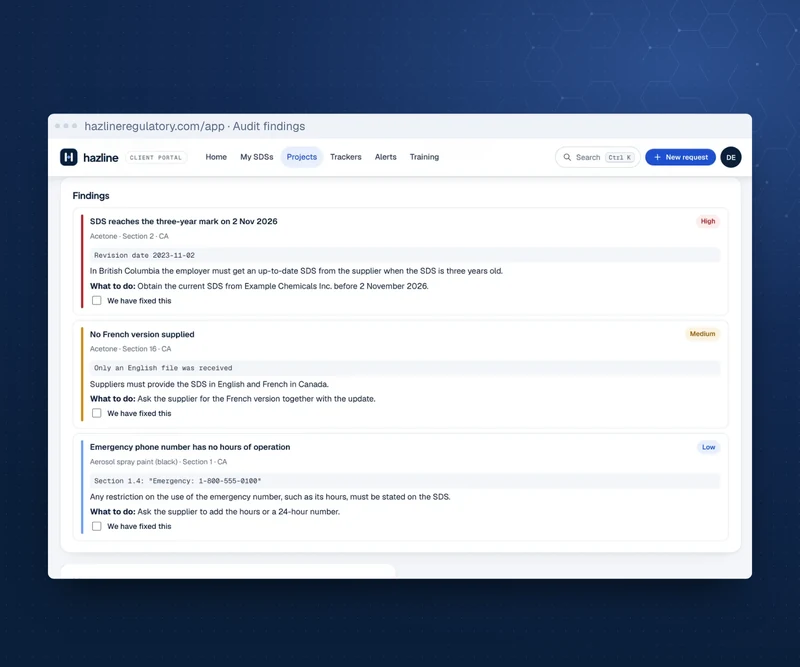
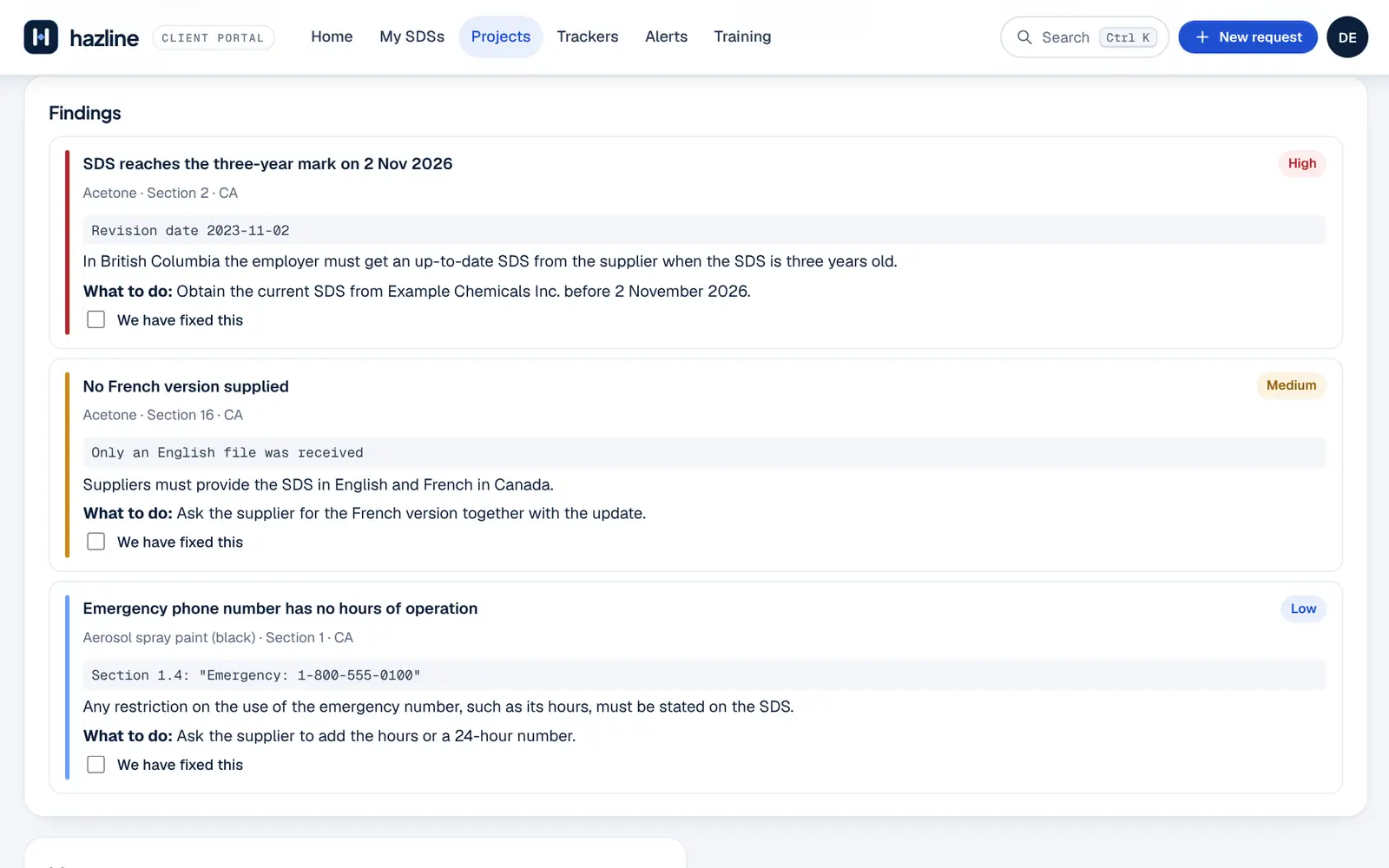
The report opens with the overall picture, then lists each finding with the section concerned, why it matters and what to change.
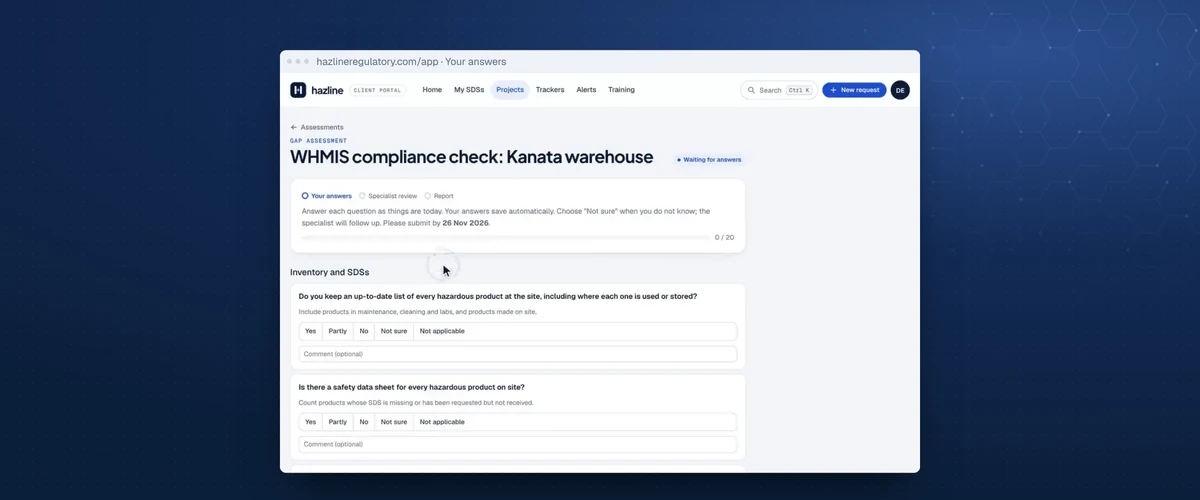
Real screens from the Hazline client portal, shown with a fictitious company.
 Fictitious example company
You send the SDSs, or a product list, and tell us where each product is sold.
Every SDS gets a first pass for format, date, language and supplier details, so the riskiest are reviewed first.
Classification, composition, label elements and market-specific requirements are checked section by section.
You receive a status for every SDS, findings ranked by severity, and the fix for each one.
We can update the SDSs under a separate fixed quote, or your team can work from the report.
The amended HPR, bilingual requirements and Canadian supplier details.
The HazCom 2024 changes and the extended compliance dates.
REACH Annex II format, the new CLP hazard classes and recent ATPs.
GB CLP and the GB mandatory classification list.
Start with five quick checks: all 16 sections are there in the right order; the sheet is in the language the market requires, which means English and French in Canada; the supplier named is the one the market requires; the classification in section 2 matches the ingredients in section 3 and the current rules, including HazCom 2024 in the US and the amended HPR in Canada; and the label says the same as section 2. If any of these fail, or you cannot tell, the audit checks every section for you.
Not for a format and consistency check. To confirm that the classification matches the composition, we need the formula, and it is treated as confidential.
Yes. Importers and distributors often need to know whether a supplier's SDS can be passed on as it is. The audit tells you which ones can, and what to change in the others.
Yes. Send one SDS for a free spot-check: a specialist replies with a short written summary within one business day. A full audit is quoted at a fixed fee, set by the number of SDSs, within two business days.
A summary of every SDS with its status, a list of findings ranked by severity with the section concerned and the fix, and a spreadsheet you can use to track the work.
You decide. We can update the SDSs under a separate fixed quote, or your team can work from the report.
Hazard Communication was OSHA's #2 most cited standard in FY2026 with 1,961 citations. OSHA penalties, HazCom 2024 deadlines and EU SDS compliance rates, with sources.
Read article
One table of the safety data sheet rules under OSHA HazCom 2024, WHMIS, EU REACH and CLP, and GB: format, language, updates, concentrations, trade secrets and dates.
Read article
What drives the cost of writing an SDS: products, markets and languages, formula complexity, missing data and speed, and how to get a quote you can compare.
Read articleUse these before you call anyone. When you want the work done for you, we quote it in writing.
Send one SDS and get a short written summary within one business day.
FreeEight warning signs that an SDS needs work, in one minute.
FreeOne product written for the US, Canada (English and French) and the EU.
FreeWhat you receive from an SDS audit, page by page.
FreeThe acute toxicity estimate of a mixture under OSHA, WHMIS, EU and GB rules, side by side.
FreeAll our articles on this
Send one SDS for a free spot-check. You get a short written summary within one business day.
Take this service on its own, or every SDS service as one package, under one agreement and one fixed quote. For manufacturers, importers and workplaces that want every SDS and label handled.