- Start with the frame: 16 numbered headings in the set order, the right supplier and emergency number, and in Canada both English and French.
- Check that the classification follows the current rules: the amended Hazardous Products Regulations in Canada, and OSHA's 2024 update in the US on its phased dates.
- Section 2 must match the label, and sections 3, 8, 9 and 14 must hold data that supports it and fits the market.
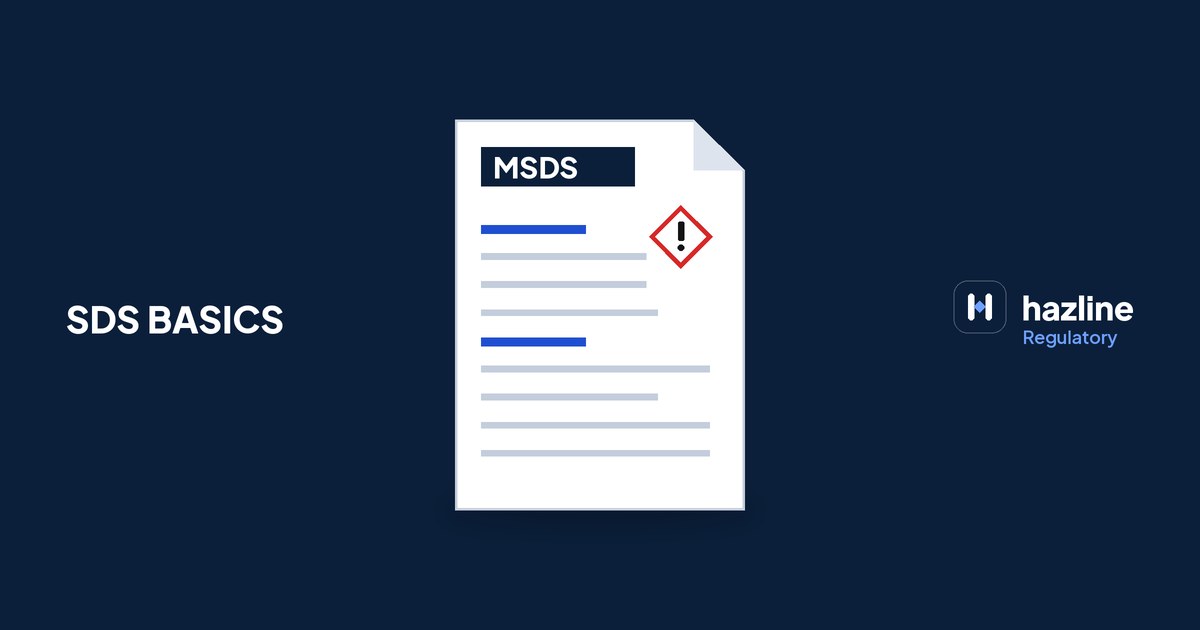
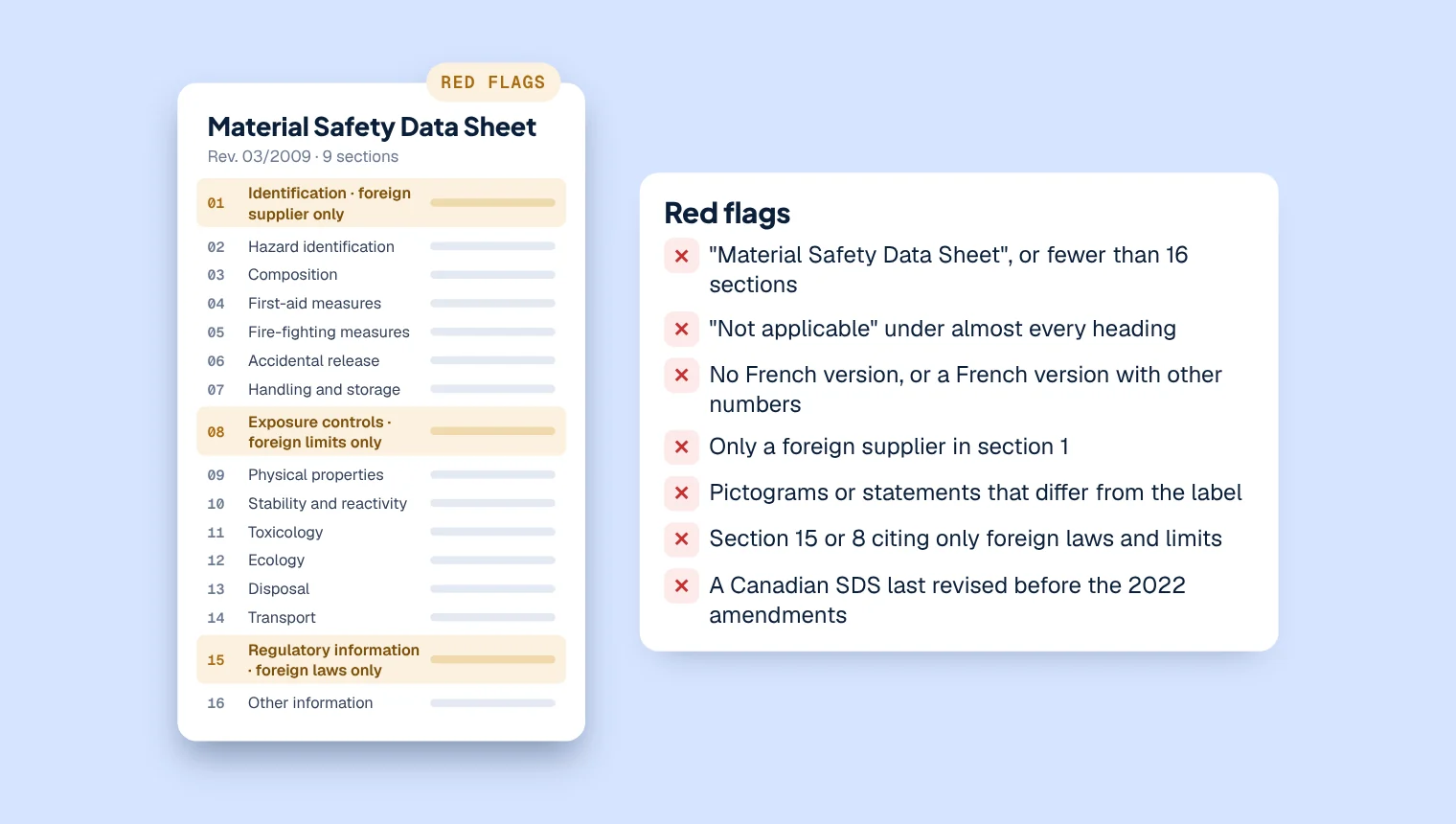
- An MSDS layout, a missing French version, blanket "not applicable" entries and no revision date are the quickest signs that an SDS needs work.
To check whether a safety data sheet (SDS) is compliant, compare it with the rules of the market where the product is sold: the Hazardous Products Regulations (HPR) for workplace products in Canada, and OSHA's Hazard Communication Standard (29 CFR 1910.1200) in the US. Both require the same 16 headings in the same order, so the format check is quick. The real work is in the detail: who is named as the supplier, whether the classification follows the current rules, whether the SDS matches the label, and whether the data supports the hazards claimed.
The 12 checks below follow the order of the document, so you can work through an SDS from top to bottom.
- Canadian amendments in forceThe amended Hazardous Products Regulations came into force, with a three-year transition.
- HazCom 2024 in effectOSHA's updated Hazard Communication Standard took effect.
- Canadian transition endsSDSs and labels for Canadian workplace products must now meet the amended regulations.
- US substancesManufacturers, importers and distributors must apply the 2024 rules to substances.
- US mixturesThe same deadline for mixtures.
What makes an SDS compliant in Canada and the US?
The right structure, the right content under each heading for that market, and content that is accurate. A single SDS can serve both countries, but only if it meets both texts at once. An SDS written for the US or for Europe rarely passes in Canada as it stands.
Is the frame right? (checks 1 to 4)
1. Sixteen numbered headings, in order
Both countries require all 16 headings, from Identification to Other information, in the order set by the rules: HPR section 4(1)(a) wants each heading preceded by its item number, and OSHA paragraph (g)(2) lists the section numbers and headings in order. In Canada the content under sections 12 to 15 may be omitted (HPR section 4(2)), and OSHA does not enforce sections 12 to 15, but the headings themselves stay.
2. The right supplier in section 1
A Canadian SDS gives the initial supplier identifier: the name, address and telephone number of the Canadian manufacturer, or of the importer operating in Canada. An importer buying only for use in its own workplace may keep the foreign supplier's details instead (HPR section 5.9). A US SDS gives the name, a US address and a US telephone number of the manufacturer, importer or other responsible party. A foreign address on its own fails in both countries.
3. An emergency telephone number
Both countries require one in section 1. Canada also asks for any restrictions on its use, for example if the line only answers during office hours.
4. The language
In Canada, every information element must be in English and French, either on one bilingual SDS or in two unilingual parts that together make one (HPR section 6.2). In the US, the SDS must be in English; employers may keep copies in other languages as well.
Does the classification follow the current rules? (checks 5 to 7)
5. Classified under the rules in force
In Canada, the amended HPR came into force on 15 December 2022 and the transition ended on 14 December 2025. They added a hazard class for chemicals under pressure, a category for non-flammable aerosols and subcategories for flammable gases. A Canadian SDS last revised before 2023 should be checked against the amended rules.
In the US, OSHA's 2024 update took effect on 19 July 2024. Manufacturers, importers and distributors had to apply it to substances by 19 May 2026, and have until 19 November 2027 for mixtures. Until those dates, either the old or the new version of the standard may be followed, so a US mixture SDS on the earlier rules is acceptable today but not after November 2027.
6. Section 2 matches the label
Section 2 gives the classification and the label elements that follow from it: pictograms, signal word, hazard statements and precautionary statements. Put the SDS next to the label and compare them line by line. In Canada, the product identifier and the initial supplier identifier must also be identical on both (HPR section 4.2). A US SDS must also state any hazards not otherwise classified, and, where 1% or more of a mixture is made up of ingredients of unknown acute toxicity and the mixture was not tested as a whole, that percentage.
7. Section 3: ingredients and concentration ranges
Look for chemical names, CAS numbers and concentrations. A concentration withheld as a trade secret must be given as one of the prescribed ranges, or a narrower range inside one, with a statement that the actual figure is withheld (HPR sections 4.4.1 and 4.5; OSHA paragraph (i)(1)). Entries such as "<5%" or "20 to 50%" do not fit those rules. In Canada, a chemical name can only be withheld under a claim filed with Health Canada, and the SDS must show the filing date and the registry number of the claim.
Does the data back up the hazards? (checks 8 to 10)
8. Section 8: exposure limits for the market
The Canadian SDS lists occupational exposure limit values or biological limit values together with their source. The US SDS lists the OSHA permissible exposure limit, the ACGIH threshold limit value and any other limit the preparer uses or recommends, where available. If the only limits shown come from another country, the document was written for another market.
9. Sections 9 and 11 support the classification
Physical data such as flash point should support the physical hazard classes in section 2, and the toxicology in section 11 should support the health classes. The US list of physical and chemical properties also includes particle characteristics. A classification next to "no data available" under the properties it depends on is a finding.
10. Section 14 agrees with how the product ships
The Canadian list covers the UN number, proper shipping name, transport hazard class, packing group, environmental hazards and special precautions; the US appendix sets out much the same items. Compare them with the shipping documents. "Not regulated" in section 14 for a product that ships as dangerous goods is a contradiction to fix first.
Is the SDS current? (checks 11 and 12)
11. A revision date
Section 16 must give the date of the latest revision in Canada, and the date of preparation or last change in the US. No date is a failure. The English and French versions should carry the same date.
12. Updated after new information
Neither country sets a fixed expiry date for a supplier SDS. Both set a deadline once there is new information:
- Canada: significant new data are new data that change the product's classification, put it in another hazard class, or change how to protect against the hazard. A supplier may sell for up to 90 days (180 days for the label) without updating the SDS only if it gives buyers a written document setting out the changes and the date the data became available (HPR section 5.12).
- US: significant new information on the hazards, or on ways to protect against them, must be added to the SDS within three months, and labels revised within six months. The updated SDS goes out with the first shipment after the change.
What are the red flags of a non-compliant SDS?
- "Material Safety Data Sheet" in the title, or fewer than 16 sections: the document predates the GHS-based rules.
- "Not applicable" or "no data available" under almost every heading.
- No French version for Canada, or a French version with a different date or different numbers.
- Only a foreign supplier in section 1.
- Pictograms, signal word or hazard statements that differ from the label.
- Section 15 citing only foreign laws, or section 8 listing only foreign exposure limits.
- A Canadian SDS last revised before the 2022 amendments.
How Hazline can help
Our SDS audit runs these checks against the rules of each market you sell in and lists every finding with the provision behind it. Where an SDS needs more than corrections, our SDS authoring service rewrites it, in English and French for Canada. The work is done by one regulatory specialist, for a fixed fee quoted in writing within two business days. Start with the free SDS spot-check: send us one SDS and we will tell you what we would fix.
Sources
- Justice Laws: Hazardous Products Regulations (SOR/2015-17)
- Justice Laws: Hazardous Products Regulations, Schedule 1 (information elements on safety data sheet)
- Health Canada: Amended Hazardous Products Regulations
- OSHA: 29 CFR 1910.1200, Hazard Communication
- OSHA: 29 CFR 1910.1200 Appendix D, Safety Data Sheets
General information, not legal advice. Checked against the official sources above on 19 October 2026. Rules change: for your own products, ask for a spot-check.