- There are three ways to get a safety data sheet written: software you operate yourself, an authoring service or consultant, or an in-house specialist. Each is right for a different company.
- A compliant SDS starts with a classification done for each market from the full composition and data. Translating or reformatting an existing SDS is not enough.
- The questions that matter most: who classifies and signs off, which rules and languages are covered, whether the provider is current with OSHA HazCom 2024 and the amended Canadian rules, and what happens when data are missing.
- Ask for a sample SDS, a written fixed quote and the name of the person who signs off before you send a formula under NDA.
Choose the provider that classifies your product for each market from the full composition, covers the languages and rules of every country you sell in, is current with OSHA HazCom 2024 and the amended Canadian Hazardous Products Regulations, names the specialist who signs each sheet off, and gives you a written fixed fee before anything starts. Those are the points this article turns into 12 questions. They apply whether you are comparing SDS software, an authoring service or a consultant, and they take about an hour to put to three providers.
Three ways to get an SDS written
A safety data sheet has 16 sections in the same order in Canada, the United States, the European Union and the United Kingdom, and each market sets what goes in them: OSHA's Hazard Communication Standard (29 CFR 1910.1200 and its Appendix D) in the US, the Hazardous Products Regulations (HPR) under WHMIS in Canada, REACH Annex II with CLP classification in the EU, and the GB versions of both in the UK. Whoever writes the sheet has to classify the product under each set of criteria, complete the sections that differ by country, and keep the sheet current. There are three ways to get that done.
| Route | How it works | Suits | Watch for |
|---|---|---|---|
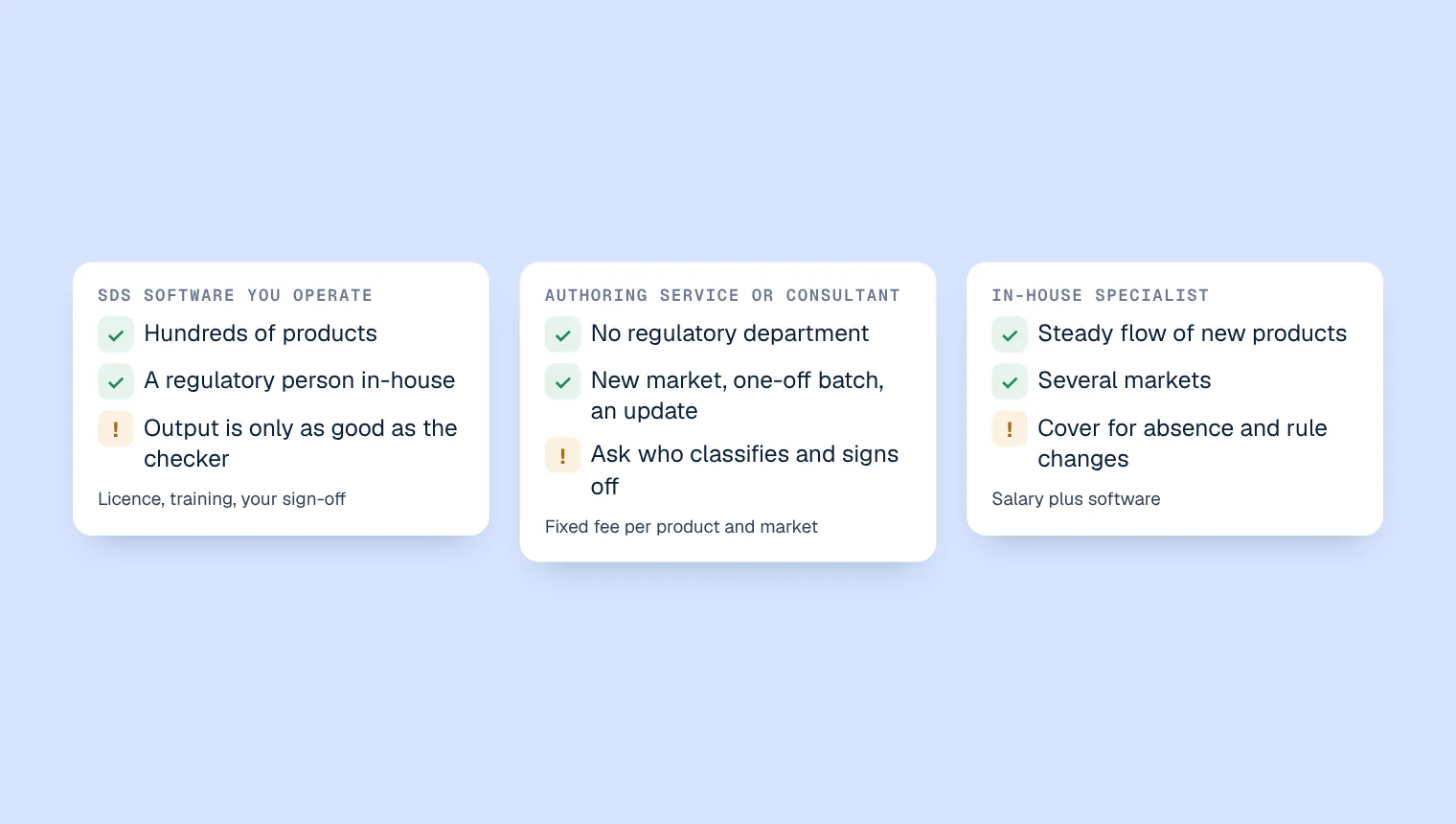
| SDS software you operate | You enter the composition and data; the software proposes a classification and generates the sheet in each format and language it supports. Your own staff check and approve it. | Companies with hundreds of products, a regulatory person in-house and frequent changes. | Licence cost, training, and the fact that the output is only as good as the person checking it. The duty to get the classification right stays with you. |
| Authoring service or consultant | You send the formula, raw-material SDSs and test data; a regulatory specialist classifies the product, writes the sheets and labels, and signs them off. You approve and receive the files. | Small and mid-size manufacturers, blenders and importers without a regulatory department; foreign manufacturers entering a new market; one-off batches and updates. | Whether a named specialist classifies and signs off, or the service is software with a sales desk in front of it. |
| In-house specialist | A chemist or regulatory affairs person on your payroll, usually with software, writes and maintains the sheets. | Larger companies with a steady flow of new products and several markets. | Keeping up with rule changes in every market, and cover when that person is away or leaves. |
Most small and mid-size companies end up with the second route, sometimes with software for the simple reorders, and the questions below are written with that in mind.
The 12 questions to ask
1. Do you classify the product yourself, from the full composition?
This is the question that separates a compliant SDS from a formatted one. Hazard classification is worked out from the ingredients, their concentrations and the data available, under the criteria of each market. A provider who asks only for your existing SDS and "updates" it is reformatting, not classifying. Ask what data they need (the full formula with CAS numbers and percentages, current raw-material SDSs, measured properties such as flash point and pH) and what they do when a value is missing: estimate it from the ingredients, test it, or state the assumption in the sheet. The honest answer names all three.
2. Is the classification redone for each market, or copied across?
Canada, the US, the EU and the UK all build on the GHS, but each adopted a different set of hazard classes and cut-offs. WHMIS and OSHA have no environmental hazard classes but add classes such as combustible dusts and flammable liquids category 4; the EU added endocrine disruption and PBT classes in 2023 and has binding harmonised classifications for many substances. A classification that is right in one market can be wrong in another. A good provider shows you the classification for each market side by side before writing the sheet, with the reasoning.
3. Which markets and languages do you cover, in-house?
Ask for the list and for who does the translation. A Canadian SDS and supplier label must be in English and French, as one bilingual document or two versions that together form one (HPR section 6.2). An EU SDS must be in an official language of each country where the product is placed on the market, unless that country provides otherwise (REACH Article 31(5)). French written by someone who does not understand the classification produces sheets whose two versions say different things, which is a finding in its own right.
4. Are you current with OSHA HazCom 2024 and the amended Canadian rules?
Both North American systems changed recently. OSHA's 2024 update of the Hazard Communication Standard applies to SDSs and labels for substances since 19 May 2026 and for mixtures from 19 November 2027, after the four-month extension published in January 2026. Canada's amended HPR has applied to every supplier since the transition period ended on 14 December 2025. Look at the provider's own pages: if they still describe HazCom 2012 or the WHMIS transition as the current state, ask what else is out of date. Then ask what changes on your sheets, for example the reorganised section 9 and the new aerosol category for chemicals under pressure in the US.
5. Who signs off each sheet, and what are their qualifications?
Ask for the name of the person who approves the classification and the final sheet, and what they have done before. Software and AI tools draft quickly; what they cannot do is notice what is missing, decide the hard cases or stand behind the result. The person who signs off should be named on the sheet or in the delivery record, and should be reachable if a customer or an inspector asks a question later.
6. Can we see a sample SDS and label before we order?
A provider who writes good sheets can show you one, with a fictitious or redacted product, for each market you sell in. Read section 2 against the label, section 3 against the cut-offs, section 8 for the right exposure limits, and section 16 for sources and a revision history. If no sample is available without a sales call, that tells you something too.
7. What exactly is in the price, and is it fixed?
Ask for a written quote per product and market before anything starts, and for what it includes: the classification, the SDS, the label text, the languages, and how many rounds of changes. Ask what is extra (transport classification, a rush, a reformulation halfway through) and whether there is a minimum order. Hourly billing on a job whose scope you cannot see is the usual source of surprises. The article what sets the cost of an SDS goes through each cost driver.
8. How long does it take, and from when?
A turnaround is only meaningful if it says what it is counted from. The useful answer is "from the day we have your complete formula and raw-material SDSs", with your own approval time stated separately. If you have a firm date, such as a first shipment, a retailer deadline or a marketplace review, say so and ask for a timeline that works back from it.
9. How do you protect our formula?
Ask whether they will sign your non-disclosure agreement before you send anything, who inside the provider sees the composition, where the files are stored, and whether section 3 can use the permitted concentration ranges where you need to protect a composition. Canada and the US both allow a withheld concentration to be shown as a prescribed range with a trade-secret statement, and since OSHA's 2024 update the two countries use the same set of ranges; the EU has its own rules.
10. Do you write the label text from the same classification?
The supplier label follows from section 2 of the SDS: product identifier, pictograms, signal word, hazard and precautionary statements and supplier details, in English and French for Canada. If the label is written by someone else, or later, the two drift apart, and a label that does not match its SDS is one of the first things an inspector or a customer's receiving department notices. Ask for the label text with the sheet, in a file your designer can copy from.
11. What do we receive, and can we edit it?
Ask for the file formats (an editable Word file and a PDF is the usual answer), who owns the files, and whether you can take them to another provider later. A sheet that lives only inside someone else's software is a sheet you may have to pay for again.
12. What happens after delivery?
Rules change and so do raw materials. Ask how you are told when a rule change affects your sheets, what an update costs, and whether there is a maintenance option. Canada requires a supplier to update the SDS within 90 days of becoming aware of significant new data, and the US within three months of new information about the hazards; the EU asks for an update without delay and for the new version to be sent to everyone supplied in the previous 12 months.
Red flags
- The provider asks only for your old SDS, not the formula, and quotes within minutes.
- No named person signs off; "our system" or "our team" is the only answer to question 5.
- The provider's own site still presents HazCom 2012 or the WHMIS transition as current.
- French, or any other language, is "machine translated and checked" without saying by whom.
- No sample is available, or the sample has "not applicable" under most headings.
- The quote is hourly, open-ended, or silent about rounds of changes.
What to send with a quote request
You get comparable quotes if every provider receives the same package: the number of products and markets, the languages you need, your current SDSs if you have them, whether the full formula is available under NDA, what measured data you have, and your deadline. Send the same 12 questions to three providers and compare the answers, not just the price per sheet. The article what to send for a new SDS lists the data a classification is built on.
How Hazline answers these questions
Hazline Regulatory is an authoring service, not software: a regulatory specialist classifies each product for each market from your full formula and raw-material SDSs, shows you the classification report first, writes the SDS and the matching label text, and signs each sheet off by name. Markets and languages: OSHA HazCom 2024 (HCS 2024) in English, WHMIS under the amended HPR in English and French, EU CLP and REACH Annex II in the languages of the countries you sell in, and GB CLP, with dual US/Canada SDSs on request. Four sample SDSs for one fictitious product are on the SDS authoring page. Every project has a fixed fee per product and market, quoted in writing within two business days, with one round of changes at each approval; turnaround is about 10 business days on the standard route and about 5 on the fast track, counted from complete data. We sign your NDA first, deliver Word and PDF files you own, and offer a yearly maintenance plan for the updates that rule changes bring. You can start with a single product, or send one SDS for a free spot-check.
Sources
- OSHA: 29 CFR 1910.1200, Hazard Communication
- OSHA: 29 CFR 1910.1200 Appendix D, Safety Data Sheets
- Federal Register, 15 January 2026: HCS compliance date extension
- Justice Laws: Hazardous Products Act (R.S.C. 1985, c. H-3), sections 13 and 14 and Schedule 1
- Justice Laws: Hazardous Products Regulations (SOR/2015-17)
- Health Canada: amendments to the Hazardous Products Regulations
- CCOHS: WHMIS, safety data sheets
- EUR-Lex: Regulation (EC) No 1907/2006 (REACH), Article 31 and Annex II
- EUR-Lex: Regulation (EC) No 1272/2008 (CLP), Annex I
General information, not legal advice. Checked against the official sources above on 6 November 2026. Rules change: for your own products, ask for a spot-check.