- There is no single price for a safety data sheet. The cost is set mostly by the number of products, the markets and languages each one needs, how complex the formula is, how complete your data are and how fast you need it.
- A new market is new work: the product has to be classified again under that market's rules, and some sections are rewritten, so a converted SDS is not a copy.
- The cheapest sheet can be the most expensive one if a customer, a marketplace or an inspector rejects it and it has to be written again.
- Ask every provider for a fixed fee per product and market, in writing, and for what it includes: classification, label text, languages and rounds of changes.
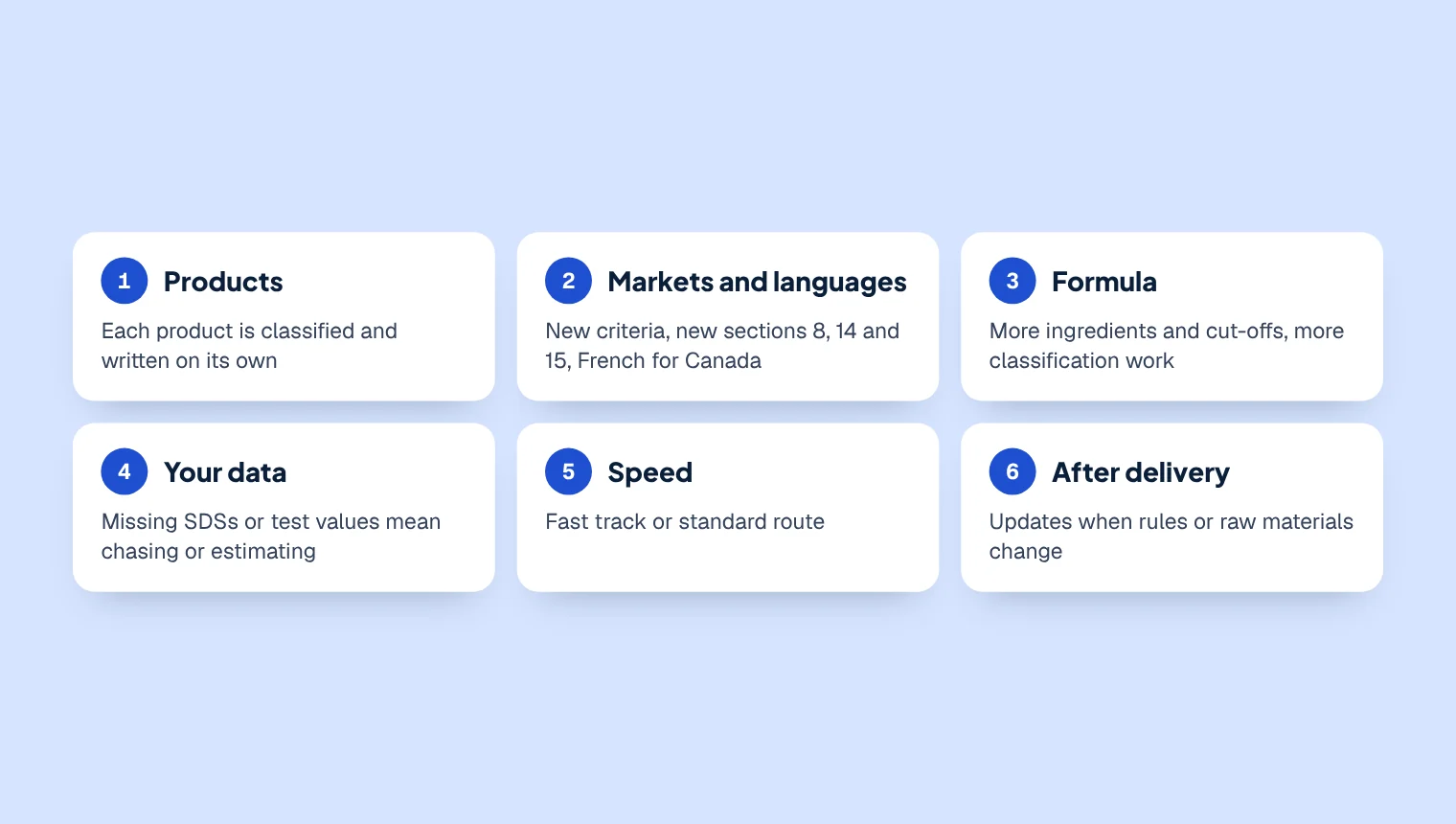
The cost of SDS authoring depends on the work behind each sheet, not on the page count. Six things set it: how many products you have, how many markets and languages each one needs, how complex the formula is, how complete your data are, how fast you need the sheets, and whether you want them kept current afterwards. A good provider asks about all six before quoting and then gives you a fixed fee per product and market, in writing. If a quote arrives before anyone has asked about your formula, it is a price for formatting, not for a compliant SDS.
What you are paying for
A safety data sheet has 16 sections in a set order in the United States, Canada, the European Union and the United Kingdom. In the US, OSHA's Hazard Communication Standard (29 CFR 1910.1200(g) and Appendix D) sets the content; in Canada, the Hazardous Products Regulations (HPR) do, and require the SDS in English and French (section 6.2); in the EU, REACH Annex II sets the format and Article 31(5) the language. Behind those sections sit four pieces of work, and they are what the fee pays for:
- Classification. Working out the hazard classes of the product from its ingredients, their concentrations and the data available, under the criteria of each market. This is the expert part and the one that varies most from product to product.
- Writing the sheet. Turning the classification and data into 16 sections that agree with each other: section 2 with section 3, section 8 with the ingredients, section 14 with the transport classification.
- Languages and label text. The French version for Canada, other languages for the EU, and the supplier label text that follows from section 2.
- Review and sign-off. A specialist checking the whole sheet against the formula and the current rules before it is issued.
The six things that set the cost
| What drives it | Why it changes the work | How to keep it down |
|---|---|---|
| Number of products | Each product is classified and written on its own. Variants that differ only in colour or fragrance can sometimes share most of the work. | Group similar products in one request and say which ones are variants of the same base. |
| Markets and languages | Each market has its own classification criteria and its own sections 8, 14 and 15. Canada adds French; each EU country can add a language. | Start with the markets you actually ship to this year. |
| Formula complexity | A product with three ingredients is quicker to classify than one with thirty, several hazardous substances or ingredients near a cut-off. | Nothing to do here, except to send the full formula rather than a partial one. |
| Completeness of your data | Missing raw-material SDSs, CAS numbers or measured values such as flash point mean the provider has to chase, estimate or ask for testing. | Send the full package at the start (see what to send for a new SDS). |
| Speed | A rush moves your job ahead of others and usually means fewer approval steps. | Plan around your launch or shipment date, and say what it is when you ask for a quote. |
| After delivery | Rules, raw materials and suppliers change. The sheet has to be updated when they do. | Ask what an update costs and whether there is a yearly maintenance option before you choose. |
Is converting an existing SDS cheaper than writing a new one?
Usually somewhat, but less than people expect. Converting an EU SDS for the US or Canada, or a US SDS for Canada, is not a translation. The product has to be classified again under the target market's rules, because each market adopted a different set of GHS hazard classes and cut-offs, and sections 8 (exposure limits), 14 (transport) and 15 (regulatory information) are rewritten for that market. What the existing sheet saves is the data gathering, provided its composition and test data are complete and current. A conversion quoted at a fraction of a new SDS, without anyone asking for the formula, is a reformatting job.
Software, a service or in-house: three ways the cost adds up
| Route | What you pay | Hidden cost |
|---|---|---|
| SDS software you operate | A licence, usually yearly, plus setup and training. | The time of the person who enters the data and checks every classification. The responsibility for the result stays with you. |
| Authoring service or consultant | A fee per product and market, or per hour. | Hourly billing on a scope you cannot see; extras that were not in the quote. |
| In-house specialist | A salary, usually with software as well. | Keeping up with rule changes in every market, and cover when that person is away. |
For a company with a handful of products and two or three markets, a fixed fee per product is usually the cheapest route overall. Software starts to pay off when you have hundreds of products, frequent changes and someone in-house who can check the output. The article how to choose an SDS authoring service goes through the questions to ask each kind of provider.
What a cheap SDS can end up costing
A sheet that is rejected has to be written again, and the delay is often the bigger cost. Amazon, for example, reviews a dangerous goods document within two business days and needs another two business days for each resubmission. A customer's receiving department may hold a shipment until the SDS is right. In Canada a supplier has to update the SDS within 90 days of becoming aware of significant new data, and in the US within three months of new information about the hazards, so a sheet built on a guessed classification may need paying for twice. Ask what happens, and who pays, if the sheet is rejected because of an error in it.
How to get a quote you can compare
Send every provider the same package: the number of products and markets, the languages you need, your current SDSs if you have them, whether the full formula is available under NDA, what measured data you have, and your deadline. Then compare what each quote includes:
- Is the fee fixed per product and market, or hourly?
- Does it include the classification, the label text and every language you need?
- How many rounds of changes are included, and what does another round cost?
- What is the turnaround, and is it counted from the day your data are complete?
- What does a later update cost, and is there a minimum order?
- Who signs off the sheet, by name?
How Hazline prices SDS work
Hazline does not publish prices, because the six points above decide the work. Every SDS project gets a written, fixed quote within two business days of the first call or email: a fee per product and market, set by the number of products, markets and languages, how complex the formulas are and how complete your data are. There is no hourly billing. One round of changes is included at each approval, the standard route takes about 10 business days and the fast track about 5, counted from complete data, and SDS projects are paid half when you approve the master SDS and half when the sheets are issued. If you are unsure whether a product needs reformulating for a market, a classification report comes first, at its own fixed fee, credited in full if you order the SDSs within 60 days. The packages page explains how each option is priced, and a free spot-check of one SDS is the quickest way to see the work before you ask for a quote.
Sources
- OSHA: 29 CFR 1910.1200, Hazard Communication
- OSHA: 29 CFR 1910.1200 Appendix D, Safety Data Sheets
- Justice Laws: Hazardous Products Regulations (SOR/2015-17)
- CCOHS: WHMIS, safety data sheets
- EUR-Lex: Regulation (EC) No 1907/2006 (REACH), Article 31 and Annex II
- Amazon Seller Central: Dangerous goods review process (hazmat)
General information, not legal advice. Checked against the official sources above on 7 November 2026. Rules change: for your own products, ask for a spot-check.