- Amazon reviews FBA listings that look like possible dangerous goods and may ask for a safety data sheet (SDS) or an exemption sheet before the product can be sold through FBA.
- Amazon's help pages say an accepted SDS has all 16 sections, current GHS hazard information, a date within the past five years, and the same product name and brand as the detail page.
- Exemption sheets are only for battery products and products without harmful chemicals; anything else is rejected and needs an SDS.
- From 26 October 2026, new or edited listings of refrigerant appliances, shock absorbers, markers and pool chemicals must answer extra dangerous goods questions.
Amazon's dangerous goods (hazmat) review is a check its Dangerous Goods team runs on Fulfillment by Amazon (FBA) products that might be hazardous to store or ship. If your listing is flagged, Amazon may ask for a safety data sheet (SDS) or an exemption sheet, and the product can be blocked for sale through FBA until a document is accepted. Most rejections come down to a few fixable problems: the SDS is too old, is missing sections, lacks GHS hazard information, or names a different product or brand from your detail page.
We quote Amazon's US Seller Central help pages as we read them on 25 October 2026. Other marketplaces, including Amazon.ca, may word things differently, and Amazon can change its rules at any time.
What is Amazon's dangerous goods (hazmat) review?
Amazon defines dangerous goods as substances or materials that "might pose a risk to health, safety, property or the environment while storing, handling or transporting" because they are flammable, pressurized, corrosive or otherwise harmful. Its guide warns that everyday products such as household cleaners, spray paints and cosmetics may be regulated as dangerous goods, and that a product with no warning label can still be one.
Amazon says catalogue information is the main way it spots a possible dangerous good: your title, description, bullet points and images. A review can be triggered when you create a listing or convert it to FBA, when the catalogue information changes, or when a product already in a fulfilment centre is identified as a possible dangerous good. When you list, Amazon also asks for dangerous goods details such as a UN number, GHS pictograms and, if available, an SDS link and flash point.
Amazon's help pages give these timelines:
| Situation | What Amazon says |
|---|---|
| Complete and correct information | Reviewed and classified within two business days |
| Rejected document, resubmitted | Another two business days for each new submission |
| Inventory already in a fulfilment centre | Email notice and 14 business days to provide documents, or the inventory is disposed of at your expense |
Does Amazon want an SDS or an exemption sheet?
It depends on the product. Amazon accepts an exemption sheet only for two groups: batteries and battery-powered products, and products without harmful chemicals. It says an exemption sheet submitted for anything else will be rejected. If your product contains chemicals that could be hazardous, or is sold with one (Amazon gives screen cleaner and aerosols as examples), you need an SDS. A bundle or kit with several chemical products needs an SDS for each product in it.
Exemption sheets are Amazon's own Excel templates. Every cell highlighted in red must be filled in, and the file must be uploaded as Excel or it may be rejected.
Amazon asks for documents "even if your product is not regulated as a dangerous good", so a product that needs no SDS by law can still need one to pass review.
What does Amazon require of a safety data sheet?
Amazon's documentation page says that, to be compliant, an SDS must:
- be created or updated within the past five years;
- include GHS/CLP hazard identification information;
- match your listing: the product name on the SDS is the same as the listing title, and the manufacturer or brand name is the same as on the detail page;
- include all 16 standard SDS sections.
Amazon tells sellers to obtain the SDS from the manufacturer or supplier.
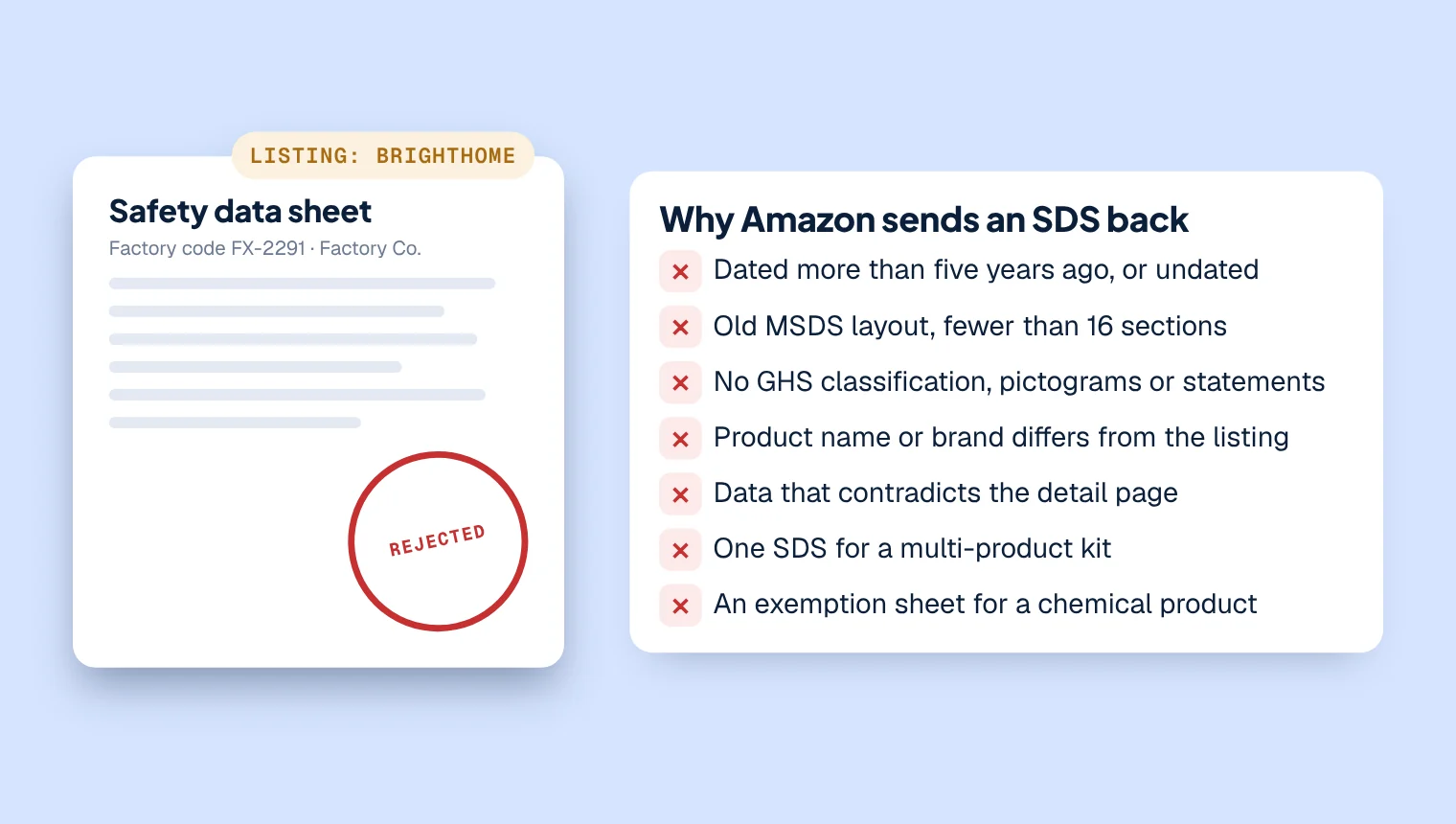
Why does Amazon reject an SDS?
Amazon does not publish a full list of rejection reasons, but its own requirements point to the usual problems:
| Problem | Why it fails |
|---|---|
| SDS dated more than five years ago, or undated | Must be created or updated within the past five years |
| Old MSDS layout, or fewer than 16 sections | All 16 standard sections are required |
| No GHS hazard classification, pictograms or statements | GHS/CLP hazard identification is required |
| Factory product name or brand differs from the detail page | Name and brand must match the listing |
| Data that contradicts the listing | Amazon asks for a new SDS when the information "is contradictory" |
| One SDS for a multi-product kit | Each chemical product needs its own SDS |
| Exemption sheet for a chemical product | Exemption sheets cover batteries and products without harmful chemicals only |
The name and brand match catches many private-label sellers. The factory's SDS often uses an internal product code and the factory's own name, while the listing uses your brand. Editing the name on the PDF is not the fix: the SDS must be prepared from the real formula and data, with the identifiers on your listing.
What makes an SDS compliant under OSHA and WHMIS?
Amazon's checklist is a marketplace rule. The law comes from OSHA's Hazard Communication Standard in the US and WHMIS in Canada:
- United States. Under 29 CFR 1910.1200(g), chemical manufacturers and importers must obtain or develop an SDS for each hazardous chemical they produce or import, with the 16 headings in the set order and the content listed in Appendix D, and must provide it to distributors and employers with the first shipment.
- Canada. Under section 13 of the Hazardous Products Act, a supplier who sells a hazardous product for use in a workplace must have a compliant SDS, provide it to the buyer and label the product. The Hazardous Products Regulations set the 16 sections and require the SDS in both English and French.
Both laws are about workplace products. Consumer products are listed in Schedule 1 to the Hazardous Products Act, so WHMIS does not apply to them, and OSHA exempts consumer products used at work in the way a consumer would use them (1910.1200(b)(6)(ix)). So a shampoo or a household cleaner sold to shoppers may fall outside WHMIS altogether, and its users at work may be covered by OSHA's consumer-product exemption, yet Amazon can still ask for an SDS. An SDS in the OSHA or WHMIS format is then the safest document to give Amazon, or the exemption sheet if the product truly contains no harmful chemicals. See also SDSs for non-hazardous products.
What changes on 26 October 2026?
According to the seller agencies My Amazon Guy and GOAT Consulting, Amazon announced in Seller Central that from 26 October 2026, new or edited listings in four categories must answer extra dangerous goods compliance questions before they can go ahead. Existing listings need no action until their next edit. Amazon's own documentation page already lists the new fields:
| Category | Questions Amazon lists |
|---|---|
| Refrigerators, freezers and air conditioners | Pre-charged refrigerant, refrigerant type and code, volume and mass |
| Shock absorbers and lift supports | Shock absorber type, and a certification that the product meets a dangerous goods exemption or exception |
| Markers and writing instruments | Ink base, marker type, and an exemption or exception certification |
| Pool and spa chemicals | Whether it contains more than 80% trichloroisocyanuric acid, net mass over 1 kg, and individual wrapping |
Make sure your answers agree with Sections 3 and 14 of your SDS.
Does Walmart Marketplace require an SDS?
For items fulfilled by Walmart Fulfillment Services (WFS), yes. Walmart's Marketplace Learn guides say an SDS is required for chemical, aerosol and pesticide items and for certain battery types, and that possible hazardous items are put on hold for a compliance review of up to three business days. The SDS must be a PDF in English with all 16 sections, specific to your product and brand, and shared through a publicly accessible link. Walmart lists inaccessible links, missing pages or blank sections, and mismatches such as a different UN number or physical state as reasons for rejection. These guides sit under WFS; we did not find the same rule stated for seller-fulfilled items.
How Hazline can help
Hazline writes and reviews safety data sheets for online sellers. Our SDS authoring service prepares an OSHA HazCom SDS for the US and a bilingual English and French WHMIS SDS for Canada, built from your formula, with the product name and brand that appear on your listing. If you already have an SDS from your supplier, our SDS audit checks it against the law and against Amazon's published checklist before you upload it. Amazon's Dangerous Goods team makes the final decision, so no one can promise approval, but a complete, current and matching SDS removes the most common reasons for rejection. The fee is fixed and quoted in writing within two business days. Our page for Amazon and marketplace sellers explains how it works on the fast track. Send us your SDS for a free spot-check, or book a free call.
Sources
- Amazon Seller Central: Dangerous goods (hazmat) required information and documentation
- Amazon Seller Central: Dangerous goods review process (hazmat)
- Amazon Seller Central: Dangerous goods identification guide (hazmat)
- My Amazon Guy: Amazon dangerous goods compliance changes start October 26 (30 September 2026)
- GOAT Consulting: Amazon refrigerant questions for dangerous goods listings (28 September 2026)
- Walmart Marketplace Learn: WFS compliance, safety data sheets
- Walmart Marketplace Learn: WFS hazmat item setup
- eCFR: 29 CFR 1910.1200, Hazard Communication, paragraphs (b)(6) and (g)
- OSHA: 29 CFR 1910.1200 Appendix D, Safety Data Sheets
- Justice Laws: Hazardous Products Act, sections 12 and 13 and Schedule 1
- Justice Laws: Hazardous Products Regulations (SOR/2015-17)
General information, not legal advice. Checked against the official sources above on 26 October 2026. Rules change: for your own products, ask for a spot-check.