Private-label brands
The factory's SDS names the factory and an internal code, not your brand and product.
Hazline Regulatory, an SDS consultancy in Ottawa, Canada, writes safety data sheets that pass Amazon's dangerous goods (hazmat) review, for one product or a whole range. When Amazon holds a listing for that review, it asks for a safety data sheet created or updated within the past five years, with GHS hazard information, all 16 sections, and the same product name and brand as your detail page. We write that SDS from your formula on the fast track, about 5 business days once we have your complete data, and a regulatory specialist signs it off.
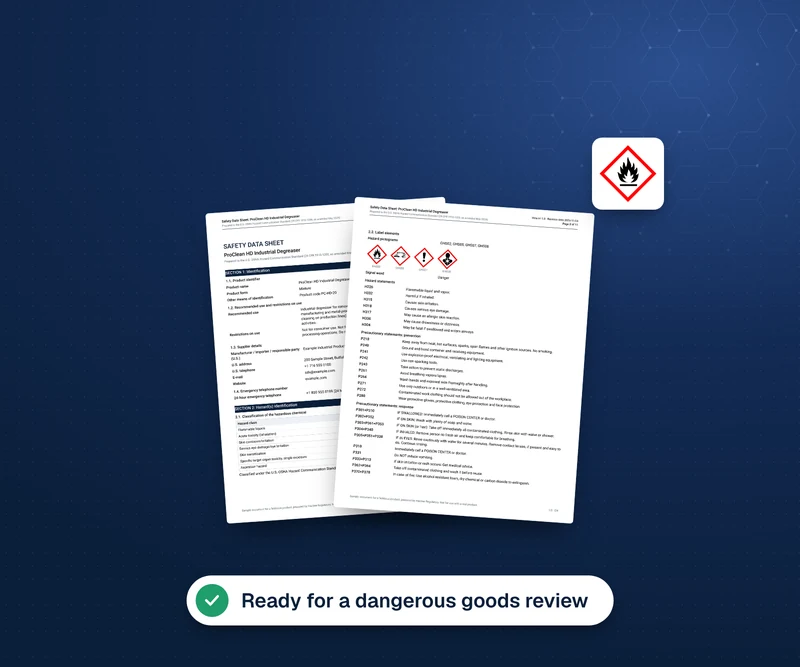
Amazon's Dangerous Goods team reviews a document within two business days, and every resubmission takes another two. A sheet that fails once costs you at least four days of sales, so it pays to get these right the first time.
An undated sheet, or an old MSDS the factory wrote years ago, is rejected. A new SDS written from the formula carries today's date and a revision history.
Learn moreSection 2 must give the GHS hazard identification: the classification, pictograms, signal word and hazard statements, worked out from the ingredients and their concentrations.
Learn moreThe product name on the SDS must match the listing title, and the brand or manufacturer must match the detail page. Factory SDSs with an internal product code and the factory's name fail here.
Learn moreEvery standard section has to be there. A bundle or kit with several chemical products needs an SDS for each one. Exemption sheets are accepted only for batteries and battery-powered products, and for products without harmful chemicals.
Learn moreSend us the SDS Amazon rejected, or the one your factory supplied, with the full formula and the raw-material SDSs. We classify the product from the formula, then write a 16-section SDS with the product name and brand exactly as they appear on your listing. A regulatory specialist signs it off, and you receive an editable Word file and a PDF ready to upload. If the product turns out to contain no harmful chemicals, we tell you, because an exemption sheet may be the right document instead.
The factory's SDS names the factory and an internal code, not your brand and product.
Supplier SDSs that are years old, in the old MSDS layout or missing sections.
Cleaners, coatings, car care and other chemical products listed on Amazon and other marketplaces.
Several chemical products sold together, each needing its own SDS.
Illustrative scopes, not client results; every project is quoted on its own.
Starting point. A listing held in dangerous goods review. The only SDS is the factory's, dated five years ago, with the factory's product code and name.
What we do. The formula obtained from the factory under NDA, the product classified from it, and a new SDS written with the listing's product name and the brand shown on the detail page, on the fast track.
What you receive. A signed-off SDS in Word and PDF, ready to upload, and the label text if the product needs a hazard label.
Starting point. One SDS submitted for the whole kit, and rejected.
What we do. A separate SDS for each chemical product in the kit, each named as it appears in the listing, all from one classification pass.
What you receive. Three signed-off SDSs, one per product, ready to submit together.
Amazon's help pages list four requirements: the SDS was created or updated within the past five years, it includes GHS hazard identification, the product name and brand match your detail page, and all 16 sections are there. A kit needs an SDS for each chemical product in it. An exemption sheet sent for anything other than a battery product or a product without harmful chemicals is rejected too.
No. An SDS has to describe the real product, from its real formula and data. Editing the name on someone else's PDF gives you a document you cannot stand behind if Amazon, a customer or an inspector asks a question. We write the SDS from the formula, with your listing's product name and brand.
A free check of the rejected SDS comes back within one business day. The fast track takes about 5 business days from the day we have the complete formula and raw-material SDSs, and Amazon then reviews within two business days. If your inventory is already in a fulfilment centre, Amazon gives you 14 business days to provide the documents before it disposes of the stock, so send us the files the day the notice arrives.
Amazon can ask for a document even when the product is not regulated as a dangerous good. If it truly contains no harmful chemicals, an exemption sheet may be enough; otherwise Amazon wants an SDS. The free check tells you which applies.
Yes. We write it to OSHA's Hazard Communication Standard (HazCom 2024), which uses the same 16 sections and GHS classification that Amazon asks for. If you also sell to Canadian businesses, we can write the bilingual WHMIS version from the same classification.
The full formula with CAS numbers and percentages, the raw-material SDSs, any measured data such as flash point or pH, and the listing title and brand exactly as they appear on Amazon. The fee is fixed per product, set by how complex the formula is and how complete your data are, and quoted in writing within two business days.
Usually, yes. Walmart's seller help asks for an SDS in English, as a PDF at a publicly accessible link, with all 16 sections, and specific to the item you submit: the item name, brand and manufacturer have to match. Walmart says its review can take up to three business days, and an SDS that is incomplete or does not match the item is rejected. Tell us the listing details for each marketplace and we write the SDS to match them. You host the PDF and add the link to your item.
With the documents, yes. Walmart asks suppliers of chemicals, aerosols, pesticides and certain batteries to register each product in WERCSmart, with every ingredient listed, percentages that add up to 100 and an SDS where the product type needs one. We write the SDS and prepare the formula breakdown in that form. You complete the registration and pay its fee yourself; we do not register products on your behalf.
Why Amazon holds listings for dangerous goods review, what it asks of an SDS or exemption sheet, the usual reasons for rejection, and how to fix them.
Read article
In Canada and the US, the SDS duty applies to products classified as hazardous. What counts as non-hazardous, which products are excluded, when the EU still asks for an SDS, and what to send customers who insist.
Read article
Every GHS safety data sheet follows the same 16 headings in the same order. What goes in each section, which ones get checked first, and where the markets differ.
Read articleSend the SDS Amazon rejected for a free check. A specialist tells you what to fix within one business day.