- Employers must have a supplier SDS for each hazardous product and keep it readily available to exposed workers and the health and safety committee or representative.
- Electronic SDSs are allowed, but they must be reachable at all times, and some jurisdictions add conditions such as a back-up or a printable copy.
- A workplace label is needed when a product is decanted, made on site, or its supplier label is lost or illegible.
- Federal workplaces, British Columbia, Nova Scotia, Newfoundland and Labrador and Yukon still require a newer supplier SDS once the one on file is three years old.
Yes, employers have to keep safety data sheets. Under WHMIS, an employer must have a current supplier SDS for every hazardous product in the workplace, keep it readily available to the workers who may be exposed and to the health and safety committee or representative, label any product that leaves its supplier container, and keep SDSs and labels up to date when new hazard information arrives.
These duties come from provincial and territorial health and safety law, and from Part X of the Canada Occupational Health and Safety Regulations (COHSR) for federally regulated workplaces. The core is the same everywhere; the details, especially on electronic SDSs and on how often to ask suppliers for a new version, are not.
- HPR amendments in forceAmendments to the Hazardous Products Regulations took effect, with a three-year transition.
- Transition endedSupplier labels and SDSs must now meet the amended regulations.
- Compliance promotion period endsHealth Canada focuses on compliance promotion until the end of the US transition period, now 19 November 2027.
What are an employer's WHMIS responsibilities?
- Make sure every hazardous product received has a supplier label and an SDS.
- Keep the SDSs readily available to workers and to the committee or representative.
- Apply workplace labels, or post placards or signs, where the rules require them.
- Prepare labels and SDSs for hazardous products made in the workplace.
- Keep labels and SDSs current when significant new information becomes available.
- Educate and train workers, and review that program.
Do employers have to keep SDSs?
Yes. When a hazardous product arrives, the employer must hold the supplier's SDS for it; the federal rules say to obtain it without delay (COHSR section 10.32(1)). The SDS must then be readily available to every worker who may be exposed to the product and to the joint committee or health and safety representative. Most of the jurisdictions we checked also ask the employer to consult the committee or representative on how best to make SDSs available. In federal workplaces, copies are kept in English and in French (section 10.34).
Can SDSs be electronic instead of a binder?
Yes, everywhere we checked, but "readily available" carries conditions. As of October 2026:
| Jurisdiction | What an electronic SDS system must allow |
|---|---|
| Federally regulated workplaces | Any form, as decided in consultation with the policy or workplace committee or the representative (COHSR s. 10.34(2)) |
| British Columbia | An electronic copy accessible to the worker at all times (OHS Regulation s. 5.1) |
| Alberta | Quick access at all times, with a plan for power failures and for places without service (provincial guidance) |
| Ontario | Electronic access is acceptable if it is close to workers and available on every shift (ministry guide to OHS Act s. 38) |
| Nova Scotia | An electronic copy for which a back-up version is available (s. 3.1) |
| Newfoundland and Labrador | An electronic copy that is easily available in hard copy, in a place known to workers (s. 2) |
| New Brunswick and Prince Edward Island | A physical or electronic copy, accessible at all times |
In every case, workers must know how to get to the SDS. A shared drive that only the office can open, or a tablet locked away on the night shift, does not meet the rule.
When is a workplace label required?
Supplier labels must stay on supplier containers. A workplace label is required when:
- a hazardous product is decanted into another container;
- a hazardous product is made in the workplace and placed in a container;
- the supplier label is lost or can no longer be read.
There is a narrow exception for portable containers filled from a labelled container. In Ontario and British Columbia, no workplace label is needed if all the product is for immediate use, or if it stays under the control of the worker who filled it, is used only during that shift, and its contents are clearly identified. The federal rules are similar but expect a workplace label showing at least the product identifier in the second case (COHSR section 10.37).
What must a workplace label show?
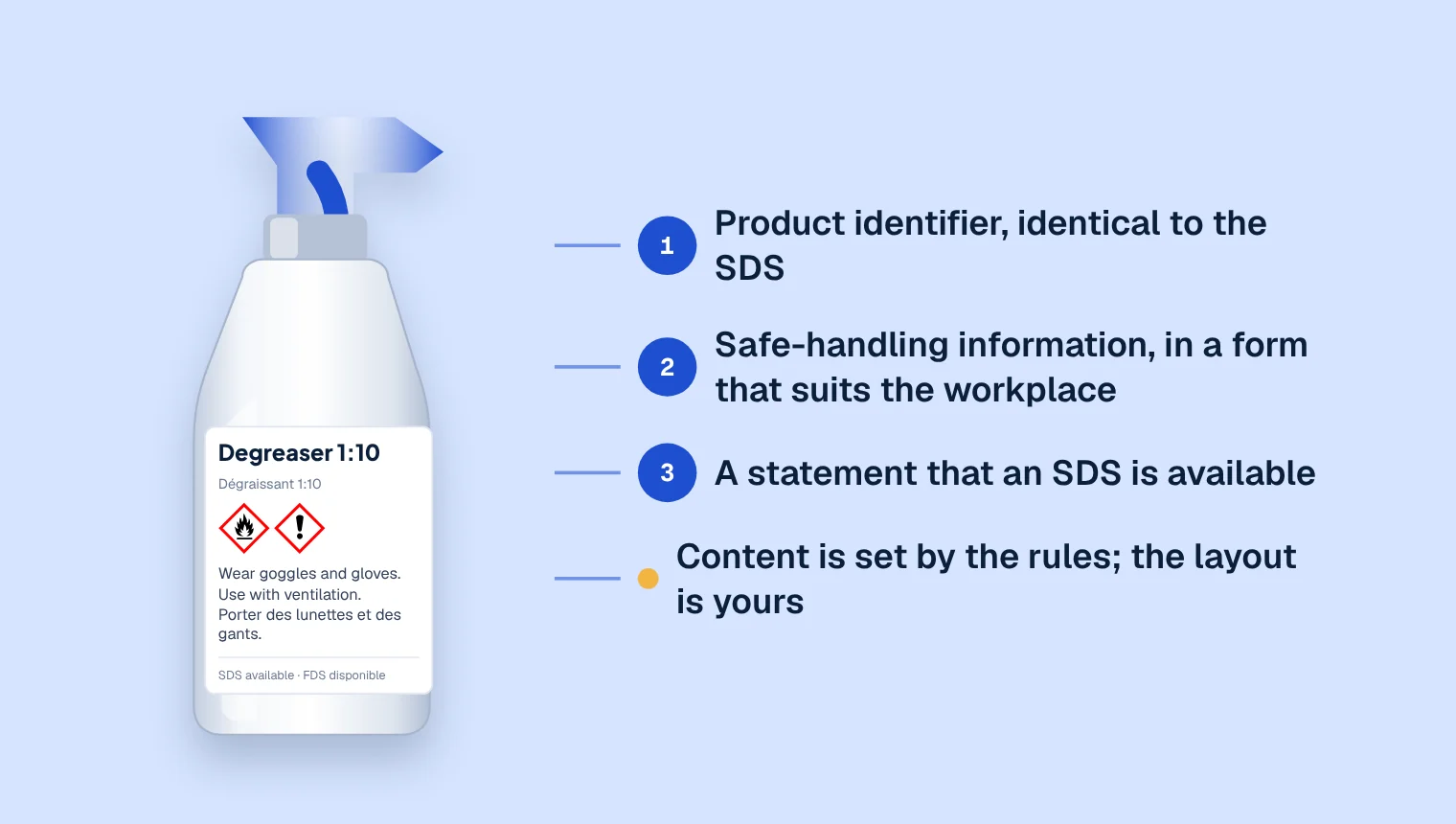
In the provinces and territories we checked, a workplace label shows three things:
- a product identifier identical to the one on the SDS;
- information for safe handling, given in a way that suits the workplace, which can include pictograms or other information from the supplier label;
- a statement that an SDS is available, where one has been supplied or prepared.
The federal rules ask for the product identifier, hazard information and a statement that an SDS is available in the workplace. The rules we checked set the content of a workplace label, not a layout, which is why many employers use a simple template.
When are placards or signs used instead of labels?
For products that are not in a container, or are stored in bulk, a label is not practical. British Columbia (section 5.12) and Ontario (Regulation 860, section 12) allow a placard showing the workplace label information, large enough and placed so that workers can read it. In federal workplaces, a sign with the product identifier must be posted near products in process, reaction or storage vessels, in continuous-run containers, and in bulk (COHSR section 10.38).
When must you get a new SDS from the supplier?
A supplier that learns of significant new data has 90 days to update the SDS (180 days for the label), and in the meantime must give buyers the changes in writing with the date the data became available. So the main trigger for a new SDS is new hazard information. The employer's side has two parts:
- New information. Every jurisdiction expects the SDS on file to be current. Ontario requires the employer to update the supplier SDS as soon as practicable after significant new data become available (Regulation 860, section 17(2)). Federally and in New Brunswick, if an updated supplier SDS cannot be obtained, the employer adds the significant new data to the most recent one (COHSR section 10.32(3); New Brunswick section 14(3)).
- The three-year check. Some jurisdictions still treat a supplier SDS as due for replacement once it reaches three years old.
| Jurisdiction | Three-year rule |
|---|---|
| Federally regulated workplaces | SDS three years old or more: obtain a current one if feasible (COHSR s. 10.32(2)) |
| British Columbia | SDS 3 years old: obtain an up-to-date one, unless the supplier confirms in writing that nothing has changed or it is not practicable (s. 5.14) |
| Nova Scotia | SDS 3 or more years old: obtain an up-to-date one if possible, unless the supplier advises nothing has changed (s. 3.12) |
| Newfoundland and Labrador | SDS 3 or more years old: obtain an up-to-date one where possible, with exceptions including written confirmation of no change (s. 13) |
| Yukon | Product in use is three years old: obtain an up-to-date supplier SDS if possible (s. 12(2)) |
| Ontario, Alberta, New Brunswick, Prince Edward Island | No three-year rule: update when significant new information becomes available |
Saskatchewan, Manitoba, Quebec, the Northwest Territories and Nunavut set their own rules; check the current text before relying on either answer.
The 2022 amendments to the Hazardous Products Regulations add a reason to look now. Suppliers had until 14 December 2025 to bring labels and SDSs into line, so many products have a revised SDS. If your binder still holds versions from before 2023, ask the supplier whether a newer one exists.
Do employers need a chemical inventory under WHMIS?
Not as a WHMIS element in the provincial rules we checked; Ontario's ministry guide, for example, describes no separate inventory duty. Federally regulated employers are different: COHSR section 10.3 requires a record of all hazardous substances used, produced, handled or stored in the workplace, which can be kept centrally for several workplaces. Even where it is not required, a product list is the simplest way to prove that every product on site has a current SDS and a label.
How Hazline can help
Our SDS library service collects the SDS for every product on your site, chases suppliers for missing or outdated versions, and keeps the library current for the rules of your jurisdiction. If you already have a binder, an SDS audit checks it against the current rules: Canadian format, English and French, and whether each version is the one the law expects. The fee is fixed and quoted in writing within two business days. Start with the free SDS spot-check or a free call.
Sources
- Justice Laws: Canada Occupational Health and Safety Regulations (SOR/86-304), Part X
- Ontario: WHMIS and the employer (guide to the legislation)
- WorkSafeBC: OHS Regulation, Part 5 (chemical and biological substances)
- Newfoundland and Labrador: WHMIS Regulations, 2018 (NLR 34/18)
- Health Canada: Amended Hazardous Products Regulations
- Health Canada: Workplace Hazardous Products Program newsletter, March 2026
General information, not legal advice. Checked against the official sources above on 19 October 2026. Rules change: for your own products, ask for a spot-check.