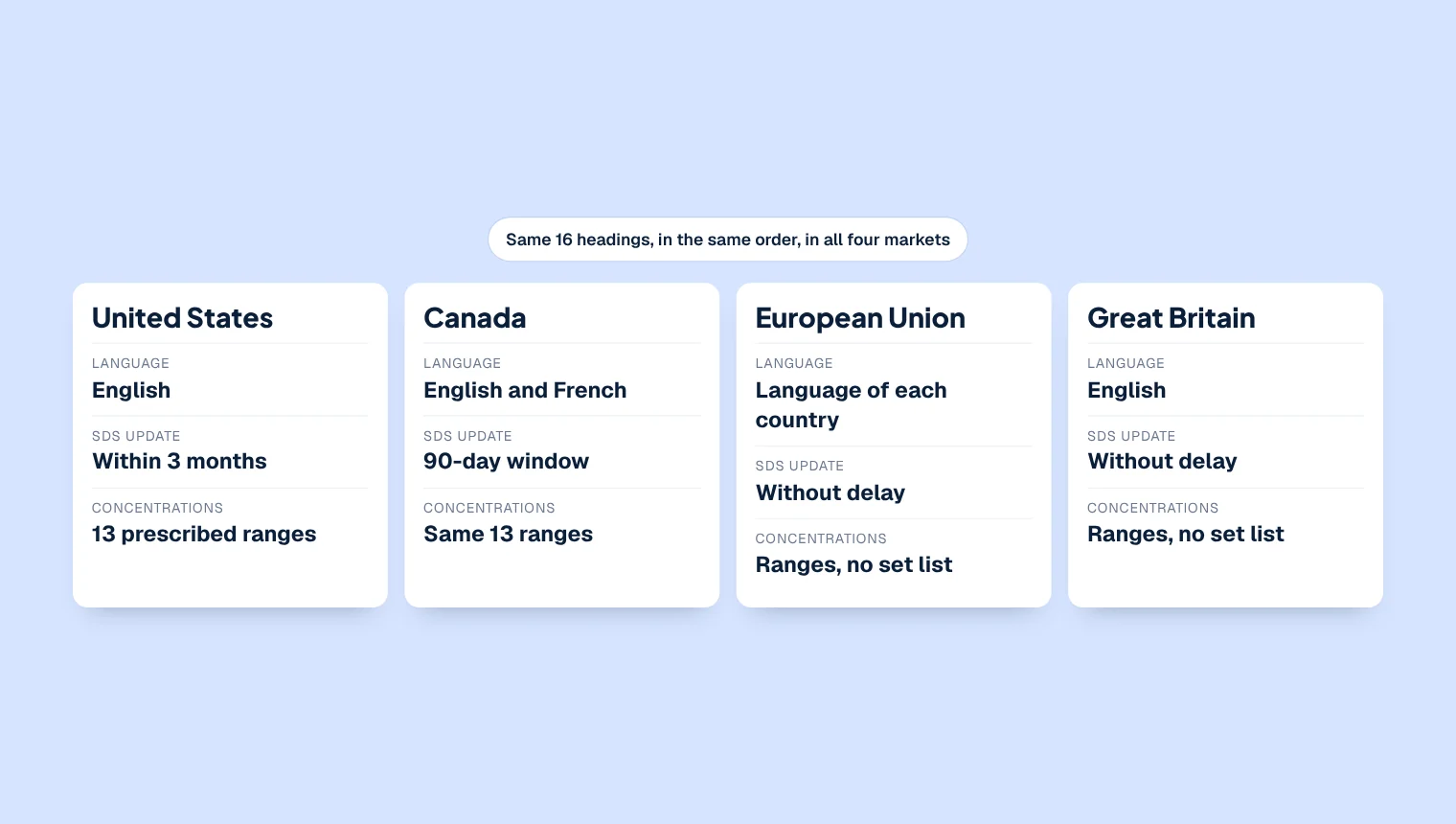
- All four markets use a safety data sheet with the same 16 headings in the same order.
- They differ on language (English in the US and GB; English and French in Canada; the official language of each EU country), on how fast an SDS must be updated, and on how ingredient concentrations are shown.
- The US and Canada share the same 13 trade-secret concentration ranges; the EU and GB allow ranges of percentages without a prescribed list.
- The same mixture can classify differently for acute toxicity: the US and Canada count ingredients with an oral or dermal LD50 between 2,000 and 5,000 mg/kg, the EU and GB do not.
Canada, the United States, the European Union and Great Britain all use a safety data sheet with the same 16 headings, but they differ on language, on how fast you must update, on how you show ingredient concentrations and protect a trade secret, and on how some mixtures are classified. The table below puts the rules side by side, each cell with the provision it comes from. It is free to cite with a link.
The rules side by side
| United States | Canada | European Union | Great Britain | |
|---|---|---|---|---|
| Main rule | OSHA Hazard Communication Standard (HazCom 2024), 29 CFR 1910.1200 | WHMIS: Hazardous Products Act and Hazardous Products Regulations (HPR), SOR/2015-17 | REACH Article 31 and Annex II (SDS); CLP (classification and labels) | UK REACH Article 31 and Annex II; GB CLP |
| Who supplies the SDS | Chemical manufacturers and importers obtain or develop one for each hazardous chemical; distributors pass it on ((g)(1), (g)(6), (g)(7)) | Suppliers who sell or import a hazardous product (HPR s. 4(1)) | The supplier of a substance or mixture classified as hazardous, PBT or vPvB, or on the candidate list (Art. 31(1)) | Same as the EU (Art. 31(1)) |
| SDS on request for some unclassified mixtures | Not in the standard | Not in the regulations | Yes, for example 1 % or more of a substance with a health or environmental hazard, 0.1 % or more of certain sensitisers, reproductive toxicants or PBTs, or a substance with an EU workplace exposure limit (Art. 31(3)) | Yes, same triggers, with GB workplace exposure limits (Art. 31(3)) |
| Format | 16 numbered sections in a set order ((g)(2)) | 16 headings from Schedule 1, in order, each with its item number (HPR s. 4(1)(a)) | 16 headings, dated (Art. 31(6), Annex II) | 16 headings, dated (Art. 31(6), Annex II) |
| Sections 12 to 15 | Headings required; OSHA does not enforce their content ((g)(2), Notes 1 and 2) | Headings required; their specific content may be omitted (HPR s. 4(2)) | Required in full (Annex II) | Required in full (Annex II) |
| Language | English; other languages may be added ((g)(2)) | English and French, on one bilingual SDS or two unilingual parts (HPR s. 6.2) | An official language of each country where it is placed on the market, unless that country provides otherwise (Art. 31(5)) | English; other languages may be added (Art. 31(5)) |
| Updating after new hazard information | Within 3 months of becoming newly aware of significant information ((g)(5)) | The SDS must be current at sale; for up to 90 days after significant new data, the old SDS may be used with a document listing the changes (HPR ss. 5.11, 5.12(2)) | Without delay; the revised SDS, marked "Revision: (date)", goes to everyone supplied in the past 12 months (Art. 31(9)) | Same as the EU (Art. 31(9)) |
| Updating the label | Within 6 months of becoming newly aware of significant information ((f)(11)) | For up to 180 days after significant new data, the old label may be used with a document listing the changes (HPR s. 5.12(4)) | Not compared here | |
| Showing ingredient concentrations | Exact concentration or, as a trade secret, one of 13 prescribed ranges, the narrowest possible ((i)(1)(iv) and (v)) | Exact concentration, or one of the same 13 ranges followed by a statement that the actual concentration is withheld as a trade secret (HPR ss. 4.4.1, 4.5) | Exact percentages or ranges of percentages, in descending order; no prescribed list of ranges. With a range, the hazards reflect the highest concentration (Annex II, 3.2) | Same as the EU (Annex II, section 3) |
| Protecting an ingredient's identity | Trade secret claim, disclosed to health professionals on request ((i)) | Claim under the Hazardous Materials Information Review Act, with the registry number on the SDS (HPR s. 5.7) | Request to use an alternative chemical name (CLP Art. 24) | |
| Mixture acute toxicity: ingredients with an LD50 of 2,000 to 5,000 mg/kg | Counted in the ATEmix formula (App. A, A.1.3.6.1(a)) | Counted in the ATEmix formula (HPR s. 8.1.5) | Not counted (Annex I, 3.1.3.6.1(a)) | Not counted (Annex I, 3.1.3.6.1(a)) |
| Ingredients of unknown acute toxicity (1 % or more) | Statement on the label and SDS (App. A, A.1.3.6.2.3) | Statement on the label (HPR s. 3(1)(e)) | Statement on the label and SDS (Annex I, 3.1.3.6.2.2) | Statement on the label and SDS (Annex I, 3.1.3.6.2.2) |
| Current transition dates | Mixtures: suppliers by 19 Nov 2027, employers by 19 May 2028 ((j)(3)) | Not compared here | ||
Texts read on 22 November 2026: 29 CFR 1910.1200 and Appendix A (eCFR, up to date as of 12 Nov 2026); HPR (Justice Laws, current to 19 Oct 2026); REACH (EUR-Lex consolidated version of 22 Jun 2026) and CLP (1 Jul 2026); UK REACH and GB CLP (legislation.gov.uk revised texts, 16 Nov 2026).
What trips companies up most
- One SDS for the US and Canada. The format lines up, but the Canadian sheet must be bilingual and the two markets differ on some details. See how a dual US/Canada SDS works.
- Converting an EU SDS. The same mixture can classify differently: ingredients with an LD50 between 2,000 and 5,000 mg/kg count toward acute toxicity in the US and Canada but not in the EU or GB. Try it in the GHS mixture calculator, or see EU SDS conversion for the US and Canada.
- Concentration ranges. The US and Canada share the same list of 13 trade-secret ranges. The EU and GB allow ranges of percentages without a prescribed list, and protect an ingredient's identity through an alternative chemical name instead.
- Update clocks. Three months in the US, a 90-day window in Canada, "without delay" in the EU and GB. A sheet sold in several markets has to meet the fastest one.
More numbers on enforcement and deadlines: HazCom and SDS statistics 2026.
Sources
- OSHA: 29 CFR 1910.1200, Hazard Communication
- Justice Laws: Hazardous Products Regulations (SOR/2015-17)
- EUR-Lex: Regulation (EC) No 1907/2006 (REACH), Article 31 and Annex II
- EUR-Lex: Regulation (EC) No 1272/2008 (CLP), Annex I
- legislation.gov.uk: UK REACH Article 31 and Annex II
- legislation.gov.uk: GB CLP, Annex I
General information, not legal advice. Checked against the official sources above on 22 November 2026. Rules change: for your own products, ask for a spot-check.