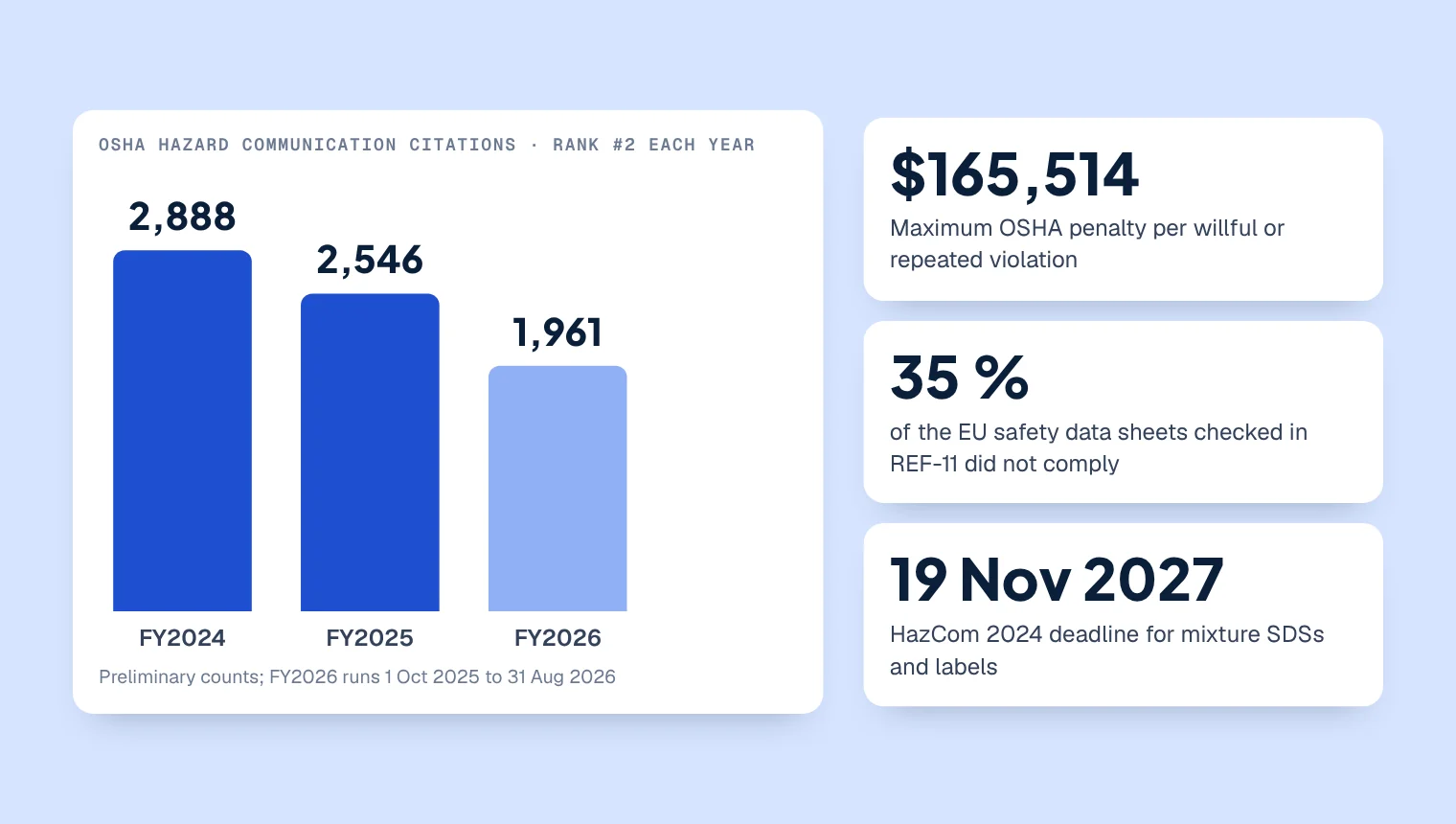
- Hazard Communication (29 CFR 1910.1200) was OSHA's second most cited standard in the preliminary FY2026 count, with 1,961 citations, as in FY2025 (2,546) and FY2024 (2,888).
- The maximum OSHA penalty is $16,550 per serious violation and $165,514 per willful or repeated violation; there was no inflation increase for 2026.
- US manufacturers, importers and distributors must bring mixtures into line with HazCom 2024 by 19 November 2027.
- In the EU-wide REF-11 project, 35 % of the more than 2,500 safety data sheets checked did not comply.
Hazard Communication was OSHA's second most cited standard again in fiscal year 2026, with 1,961 citations in the preliminary count for 1 October 2025 to 31 August 2026. In the European Union, inspectors in 28 countries found that 35 % of the safety data sheets they checked did not comply. Below are the numbers, the penalty amounts and the deadlines, each with its source. This page is free to cite with a link.
OSHA Hazard Communication citations by year
Hazard Communication has held second place on OSHA's top 10 in each of the last three fiscal years. Only fall protection in construction (29 CFR 1926.501) is cited more often.
| Fiscal year | Rank | Hazard Communication citations | Status |
|---|---|---|---|
| FY2024 | 2 | 2,888 | Preliminary, as reported by Safety+Health |
| FY2025 | 2 | 2,546 | Preliminary, announced at the 2025 NSC Safety Congress |
| FY2026 | 2 | 1,961 | Preliminary, 1 October 2025 to 31 August 2026 |
OSHA's own top 10 page lists the ranking; the counts come from the National Safety Council and trade press reporting of OSHA's announcement. All three years are preliminary counts. Fewer citations does not mean fewer problems: citations across the whole top 10 fell by about a quarter in the preliminary FY2026 count (17,701, down from 23,537), so the drop is not specific to Hazard Communication.
OSHA penalty amounts in 2026
| Type of violation | Maximum penalty |
|---|---|
| Serious | $16,550 per violation |
| Other-than-serious | $16,550 per violation |
| Posting requirements | $16,550 per violation |
| Failure to abate | $16,550 per day beyond the abatement date |
| Willful or repeated | $165,514 per violation |
There was no inflation increase for 2026: OSHA kept the 2025 amounts (OSHA memorandum of 21 May 2026). States with their own OSHA-approved plans set their own amounts.
HazCom 2024 deadlines
| Date | Who | What |
|---|---|---|
| 19 Jul 2024 | Everyone | HazCom 2024 took effect |
| 19 May 2026 | Manufacturers, importers, distributors | Substances in line with all modified provisions |
| 20 Nov 2026 | Employers | Workplace labels, written program and training updated for substances |
| 19 Nov 2027 | Manufacturers, importers, distributors | Mixtures in line with all modified provisions |
| 19 May 2028 | Employers | Workplace labels, written program and training updated for mixtures |
Source: 29 CFR 1910.1200(j). Until these dates, suppliers and employers may comply with either the 2024 standard or the version revised as of 1 July 2023, or both (paragraph (j)(4)). If your mixture SDSs still need the update, see HazCom 2024 SDS updates.
Safety data sheet compliance in the EU
| Project | What was checked | Result |
|---|---|---|
| REF-11 (inspections in 2023, published December 2024) | Over 2,500 SDSs in 28 EEA countries | 35 % non-compliant: the content did not meet the requirements or no SDS was provided |
| REF-6 (inspections in 2018, report 2019) | 3,391 mixtures at 1,620 companies in 29 countries | 33 % of checked SDSs non-compliant; 44 % of hazardous mixtures not compliant with classification and labelling obligations; 33 % of reported mixtures had incorrect labelling |
| REF-6, in ECHA's 2021 report | Classification of the inspected mixtures | 17 % classified incorrectly |
Rules worth knowing, in numbers
- 16 numbered sections, in a fixed order, on every SDS in the US, Canada, the EU and Great Britain. See the four sets of rules side by side.
- 13 prescribed concentration ranges a US or Canadian supplier may use instead of the exact concentration when it is a trade secret, from 0.1 to 1 % up to 80 to 100 % (29 CFR 1910.1200(i)(1)(iv); HPR s. 4.4.1(3)).
- 3 months in the US to add significant new hazard information to an SDS, and 6 months for the label (29 CFR 1910.1200(g)(5) and (f)(11)).
- 90 days in Canada: after significant new data, a supplier may keep selling with the previous SDS for up to 90 days if it hands over a document listing the changes. Labels: 180 days (HPR s. 5.12).
- 12 months in the EU and GB: a revised SDS goes free of charge to everyone supplied in the past 12 months (REACH Article 31(9)).
- 2 languages on every Canadian SDS and label: English and French (HPR s. 6.2).
Want to see how one mixture classifies in each market? Try the free GHS mixture calculator.
Sources
- OSHA: Top 10 most frequently cited standards, FY2026 (preliminary)
- Business Insurance: Fall protection tops OSHA violations as citations decline (Sept 2026)
- National Safety Council: OSHA's Top 10 safety violations, FY2025 (16 Sept 2025)
- Safety+Health: OSHA's Top 10, FY2025 (with FY2024 counts)
- OSHA: Penalties
- OSHA memorandum: 2026 annual adjustments to OSHA civil penalties (21 May 2026)
- OSHA: 29 CFR 1910.1200, Hazard Communication
- ECHA: Compliance of safety data sheets, still room for improvement (REF-11, 3 Dec 2024)
- ECHA: 44 % of hazardous mixtures not compliant with classification and labelling obligations (REF-6)
- ECHA: Report on the operation of REACH and CLP 2021
- Justice Laws: Hazardous Products Regulations (SOR/2015-17)
- EUR-Lex: Regulation (EC) No 1907/2006 (REACH), Article 31 and Annex II
General information, not legal advice. Checked against the official sources above on 22 November 2026. Rules change: for your own products, ask for a spot-check.