US manufacturers and formulators
Mixture SDSs written years ago and now due for the 2024 rules.
If you make, import or distribute mixtures in the US, your safety data sheets and labels must meet the 2024 Hazard Communication Standard by 19 November 2027; for substances the date was 19 May 2026. We check your current SDSs first, then update them in batches, and a regulatory specialist signs off every sheet.
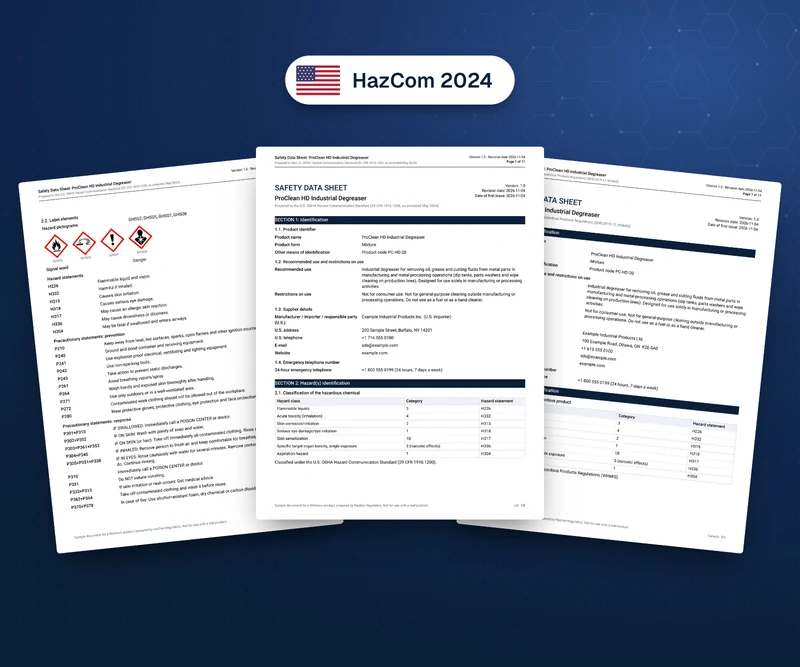
The 16 sections stay. What changes is how some products are classified, what section 3 may say about a withheld concentration, and a few label rules. These are the points we check first.
Manufacturers, importers and distributors: substances by 19 May 2026, mixtures by 19 November 2027. OSHA moved every date by four months in January 2026. Until your date you may follow either the earlier version of the standard or the 2024 one.
Learn moreAerosols now fall into three categories based on their flammable properties, and chemicals under pressure are a new class: liquids or solids pressurised with a gas at 200 kPa or more in containers other than aerosol cans. Products like these often need a new classification, not just a new date.
Learn moreIf you keep the exact percentage of an ingredient as a trade secret, the SDS must now give it as one of the concentration ranges set out in the standard.
Learn moreContainers of 100 mL or less may carry a shorter label when a full, fold-back or pull-out label is not feasible, with the full label on the outer package. New hazard information must reach the label within six months, and containers already released for shipment may travel with the updated label instead of being relabelled.
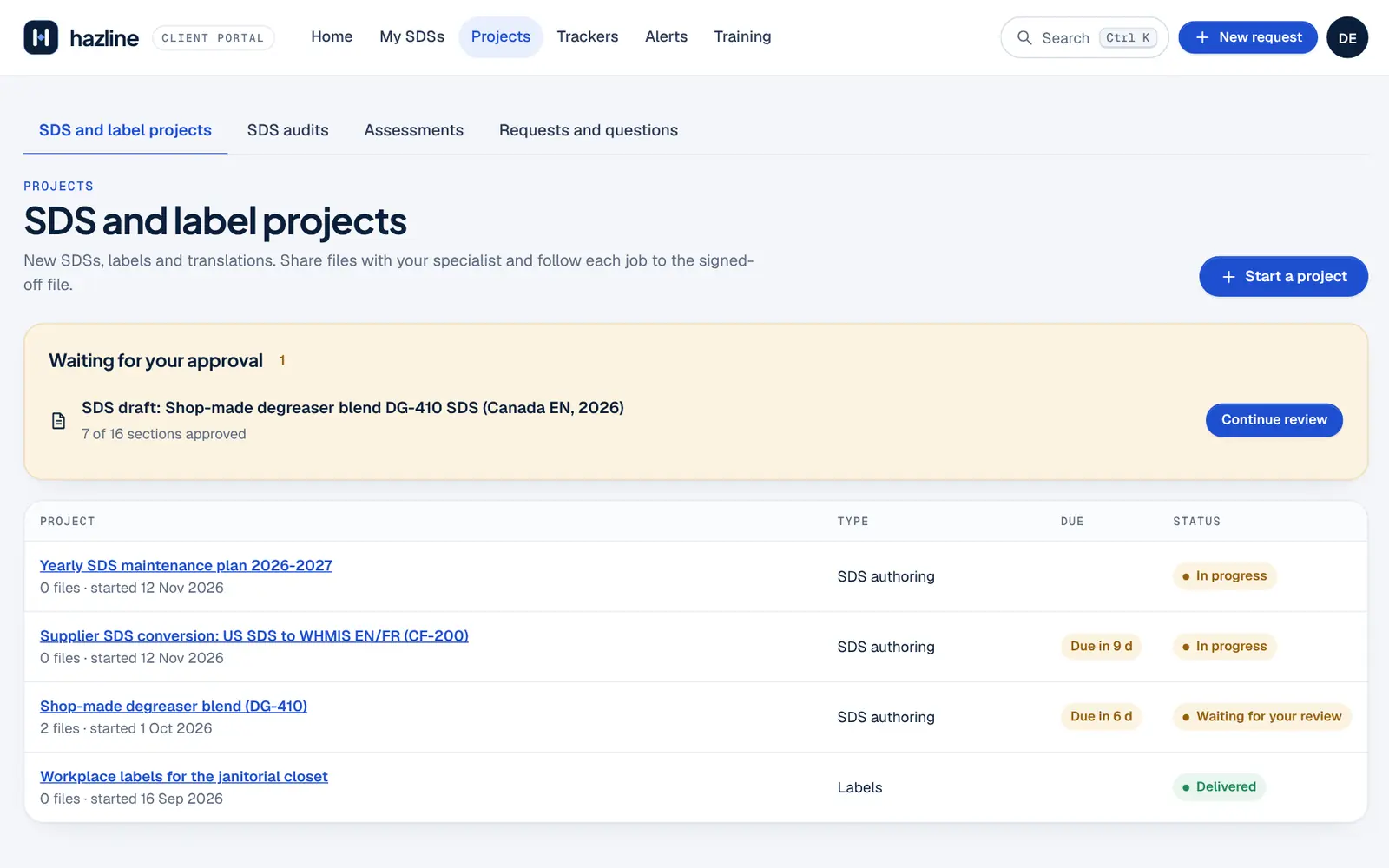
Learn moreWe start with the SDSs you already have. Each one is checked against the 2024 standard and its appendices, and the findings go into one report, ranked by risk, so you can see which products need a new classification and which only need edits. Then we update the sheets in batches, highest risk first, from your formula and raw-material SDSs. A regulatory specialist signs off every SDS and its label text, and you receive them in your portal. If a product needs a revision for another reason, such as a new raw material or a new market, it goes into the same pass, so each sheet is reissued once.
Mixture SDSs written years ago and now due for the 2024 rules.
Supplier SDSs from overseas checked against the 2024 rules and brought up to date.
Making sure the SDSs you pass on to your customers are current.
WHMIS SDSs turned into HazCom 2024 SDSs, often in the same project.
Illustrative scopes, not client results; every project is quoted on its own.
Starting point. Forty mixture SDSs last revised before 2024, and a distributor asking when the updates are coming.
What we do. An audit of all forty against the 2024 standard, findings ranked by risk, then updates in four batches, starting with the aerosols and the products with withheld concentrations.
What you receive. Signed-off HazCom 2024 SDSs and label text for every product, a change log for each, and every issued version in your portal.
Starting point. EU SDSs from the manufacturer and US SDSs nobody has checked since they were first written.
What we do. Each US SDS checked against the 2024 rules and the EU data, the classification redone where needed, and section 3 brought in line with the prescribed ranges.
What you receive. Updated US SDSs and label text, signed off, well ahead of 19 November 2027.
Every SDS for a mixture you make, import or distribute has to meet the 2024 standard by 19 November 2027. Not every sheet changes much: some need a new classification, others only edits to a few sections. The audit tells you which is which before you spend anything on updates.
Not necessarily. Until your compliance date you may follow either the earlier version of the standard or the 2024 one, so a sheet revised in 2025 may still follow the old rules. The audit shows which version each sheet was written to.
Manufacturers, importers and distributors must have substances done by 19 May 2026 and mixtures by 19 November 2027. Employers then have until 20 November 2026 for substances and 19 May 2028 for mixtures to update, as necessary, their workplace labels, written program and training. Our work is the supplier side: the SDSs and labels you ship.
Yes. Send them as PDF or Word with the formula and raw-material SDSs. We check them and issue updated sheets as editable Word and PDF files.
Within three months of becoming aware of significant new information about the hazards or how to protect against them. The label has to follow within six months.
Your current SDSs, the full formula of each product with CAS numbers and percentages, the raw-material SDSs and any test data such as flash point. The fee is fixed, set by the number of products, how complex the formulas are and how complete your data are, and quoted in writing within two business days. From complete data, it takes about 10 business days on the standard route and about 5 on the fast track; a large range is split into batches.
OSHA aligned HazCom with GHS Revision 7 in 2024, then pushed every compliance date back four months. Here is the current timeline.
Read article
A supplier's SDS has no fixed expiry date in Canada, the US or the EU, but several Canadian provinces still set a 3-year check for employers, and every market sets a deadline once you learn something new.
Read article
The six elements OSHA requires on a shipped container label, the new U.S. address rule, small-container options, bulk shipments and when a label has to be updated.
Read articleSend your oldest SDS for a free spot-check. A specialist replies with a short written summary within one business day.