- Every chemical substance imported into the US, on its own or in a mixture, must be on the TSCA Inventory or covered by an exemption.
- Before release, the importer or its agent certifies to CBP that the shipment complies with TSCA (positive) or is not subject to TSCA (negative).
- Chemicals that are part of articles need no certification unless a specific TSCA rule requires one.
- A substance that is not on the Inventory needs a premanufacture notice or an exemption, such as the low volume exemption, before it is imported.
To import a chemical into the US under the Toxic Substances Control Act (TSCA), each chemical substance in the shipment, whether on its own or in a mixture, must be on the TSCA Inventory or covered by an exemption. Before US Customs and Border Protection (CBP) releases the shipment, the importer or its authorised agent must certify either that it complies with TSCA (a positive certification) or that it is not subject to TSCA (a negative certification). Chemicals that are part of articles need no certification unless a specific TSCA rule requires one.
A substance that is not on the Inventory is a "new chemical substance". It cannot be imported for a commercial purpose until EPA has reviewed a premanufacture notice (PMN) or an exemption applies.
- Active-Inactive ruleEPA published the rule that splits the Inventory into active and inactive substances.
- Form B requiredA Notice of Activity must be filed before an inactive substance is made, imported or processed again.
- New chemicals rule in forcePFAS became ineligible for the LVE and LoREX exemptions, and exemptions now need EPA approval first.
- CDR period opensThe next Chemical Data Reporting submission period runs until 30 September 2028.
What does TSCA cover, and what is excluded?
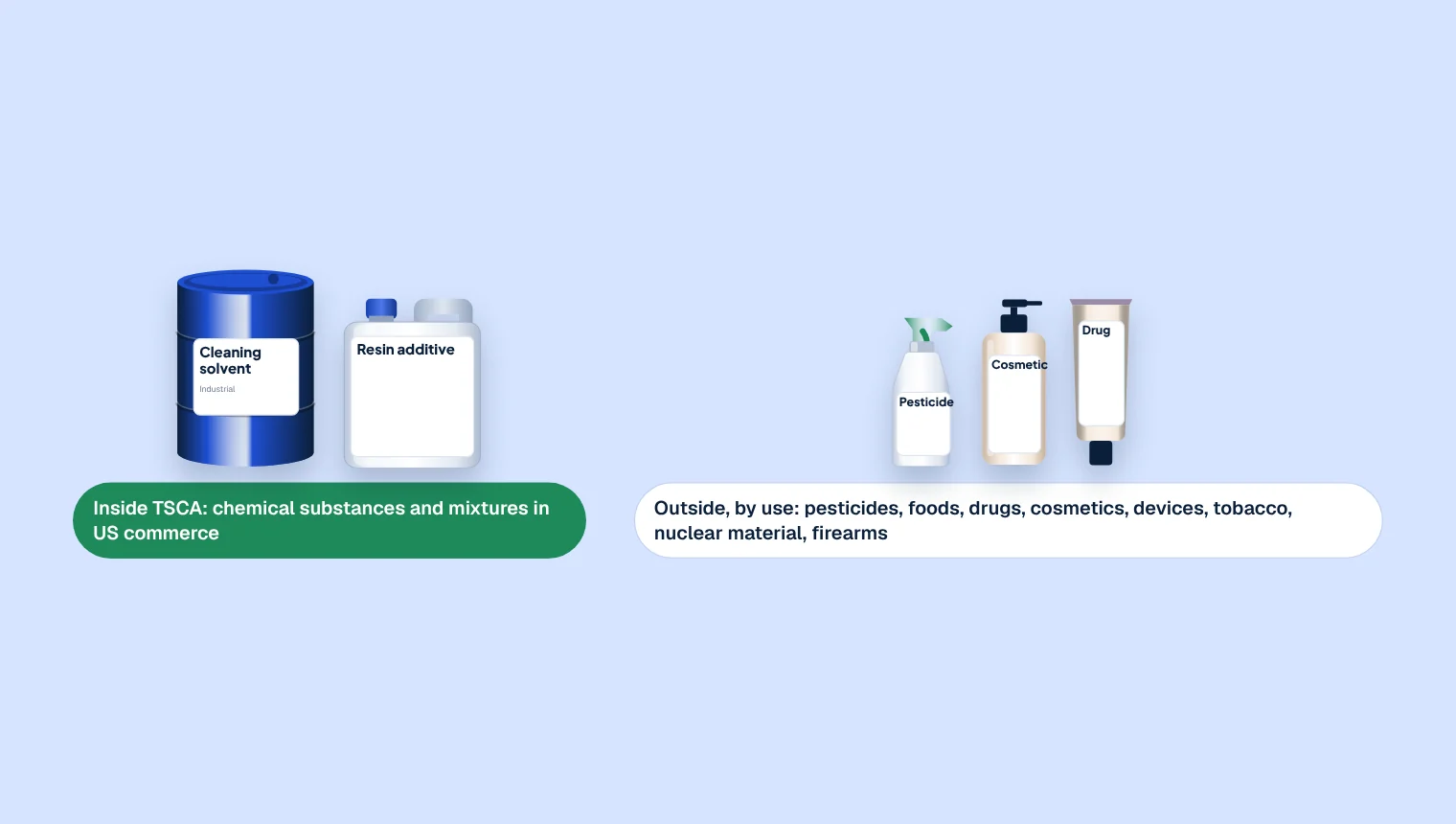
TSCA covers chemical substances and mixtures in US commerce. Under TSCA, "manufacture" includes import, so an importer carries most of the duties of a manufacturer. EPA's rules (40 CFR 720.3) exclude from the definition of chemical substance:
- pesticides, when made or distributed for use as pesticides;
- foods, food additives, drugs, cosmetics and devices, when made or distributed for use as such;
- tobacco and tobacco products;
- source, special nuclear and byproduct material;
- pistols, firearms, revolvers, shells and cartridges.
Several of these exclusions depend on the use. A substance sold for use in cosmetics is outside TSCA for that use; the same substance sold for industrial cleaning is inside it.
Is my chemical on the TSCA Inventory?
The TSCA Chemical Substance Inventory is EPA's list of the substances made or imported in the US. EPA publishes a non-confidential version that can be downloaded or searched through its Substance Registry Services, and updates it about every six months. The July 2026 release lists 42,698 active and 44,043 inactive substances.
Mixtures are not listed as such: check each component. Match on the exact chemical identity and CAS number, not only a trade name.
Active or inactive?
Under the Inventory Notification (Active-Inactive) rule, published on 11 August 2017, companies reported the substances they had made, imported or processed in the ten years ending 21 June 2016. EPA used those reports to designate each substance as active or inactive.
Since 5 August 2019, anyone who intends to make, import or process an inactive substance must first file a Notice of Activity Form B through EPA's Central Data Exchange (CDX), no more than 90 days before the expected start date. EPA then changes the designation to active. For 329 inactive PFAS, a Form B is not enough: a significant new use rule in force since 11 March 2024 requires a notice at least 90 days ahead and EPA review before they come back into use. Imported articles containing them are carved out of that rule.
What if the identity is confidential?
Some substances sit in the confidential portion of the Inventory, which the public version shows only by a generic name and an accession number. To learn whether a specific substance is on it, you file a bona fide intent notice through CDX, showing that you intend to manufacture or import it for a commercial purpose, with its identity, intended use and spectral data. EPA replies within 30 days of a complete submission. If your foreign supplier will not disclose the identity to you, it can send that information directly to EPA.
What is TSCA import certification?
CBP's rules at 19 CFR 12.118 to 12.127, with EPA's import policy at 40 CFR Part 707 subpart B, require a certification for chemical shipments. As of October 2026:
| Positive certification | Negative certification | |
|---|---|---|
| When | Chemical substances subject to TSCA, in bulk or in a mixture | Chemicals excluded from TSCA, such as pesticides, foods, drugs and cosmetics |
| What it states | All chemical substances in the shipment comply with all applicable TSCA rules and orders | "all chemicals in this shipment are not subject to TSCA" |
| Covers | PMN rules, significant new use rules, section 5(e) and 5(f) orders, section 6 rules and orders, section 7 actions and Title IV | Not needed where the product is clearly identified through another agency's documents |
- Who signs. The importer or its authorised agent, such as the customs broker, with the certifier's name, phone number and email address.
- How and when. Electronically through CBP's ACE system, or in writing on the entry document or commercial invoice, before the shipment is released.
- Mixtures. If you do not know the composition, EPA expects you to ask the foreign manufacturer. Good-faith efforts to verify can reduce a penalty.
- Samples. Research and development quantities sent by mail or courier also need a certification.
- Articles. No certification unless a rule requires one. Composite wood products are one example: they carry a TSCA Title VI import certification for imports since 22 March 2019.
Rules under TSCA sections 4 and 8, such as testing and reporting, do not affect the certification, but importers must still comply with them.
If CBP detains a shipment, the importer has 20 days from the notice of detention to show why entry should not be refused, and EPA decides within 30 days of that notice. A shipment that does not comply is refused entry.
What if my substance is not on the Inventory?
Premanufacture notice (PMN)
A PMN is submitted through CDX at least 90 days before import begins. For imports, it comes from the principal importer. EPA must reach a determination on the substance before you can start; the 90-day review can be suspended, and fees apply. Within 30 calendar days of the first commercial import, you file a notice of commencement.
Low volume and LoREX exemptions
- Low volume exemption (LVE): 10,000 kg a year or less.
- Low releases and low exposures (LoREX): no volume limit, but strict conditions, including no dermal or inhalation exposure for workers and consumers.
Both are submitted at least 30 days before import, and EPA reviews them for 30 days. Since 17 January 2025, you need EPA's approval before starting, and PFAS and certain persistent, bioaccumulative and toxic substances are not eligible. Other routes include the polymer, test marketing and research and development exemptions.
Significant new use rules (SNURs)
Being on the Inventory is not always enough. A SNUR names uses, volumes or conditions that need a significant new use notice (SNUN) at least 90 days before they begin, followed by EPA review. A positive certification covers SNURs, so check the intended use before you sign.
What else does TSCA ask of importers?
- Export notification (section 12(b)). Exporting a chemical subject to certain TSCA actions needs a notice to EPA within seven days of forming the intent to export, or on the export date if earlier.
- Chemical Data Reporting (CDR). If a site made or imported 25,000 lb or more of a chemical substance in any year from 2024 to 2027 (2,500 lb for substances subject to certain TSCA actions), it reports from 1 June to 30 September 2028.
- PFAS reporting. A separate one-time report under section 8(a)(7) covers PFAS made or imported from 2011 to 2022. See our article on TSCA PFAS reporting.
How Hazline can help
Hazline's core work is safety data sheets and labels. A TSCA question like this one we take on as a custom project: a gap assessment that checks each substance against the TSCA Inventory, including active or inactive status and any SNUR, and gives you and your customs broker a written basis for positive or negative certification. Any filing is made by you, from your own CDX account. Each project is scoped on a call and quoted in writing within two business days. Book a free call to start.
Sources
- EPA: TSCA requirements for importing chemicals
- eCFR: 19 CFR 12.121, TSCA certification requirements for imports
- EPA: TSCA Inventory Notification (Active-Inactive) rule
- EPA: Filing a pre-manufacture notice with EPA
- eCFR: 40 CFR 723.50, low volume and low release and exposure exemptions
- EPA: Basic information about Chemical Data Reporting
General information, not legal advice. Checked against the official sources above on 19 October 2026. Rules change: for your own products, ask for a spot-check.