- A chemical is new in Canada when it is not on the Domestic Substances List (DSL). Being on the US TSCA inventory does not make it Canadian; it makes it eligible for the NDSL, which only raises the thresholds.
- The duty falls on the Canadian manufacturer or importer, per notifier and per calendar year; someone else's notification does not cover you.
- For a substance on neither list, notification starts at 100 kg a year (Schedule 4, 5 days); larger volumes trigger Schedules 5 and 6 with 60- and 75-day assessment periods. NDSL substances start at 1,000 kg.
- After the assessment, the substance may be added to the DSL, or a condition, a prohibition or a significant new activity notice may attach to it.
Canada controls new chemicals through the Canadian Environmental Protection Act, 1999 (CEPA) and the New Substances Notification Regulations (Chemicals and Polymers), SOR/2005-247. The logic is an inventory: the Domestic Substances List (DSL) records the substances that were in Canadian commerce between 1984 and 1986 and those added since, and anything not on it is a new substance that must be assessed for risks to human health and the environment before it is manufactured or imported above a threshold. Environment and Climate Change Canada (ECCC) and Health Canada run the assessment jointly. The duty falls on the person who manufactures or imports the substance in Canada, which, for a foreign supplier shipping to a Canadian customer, usually means the importer.
- NSNR in forceThe current Chemicals and Polymers regulations replaced the 1994 rules.
- CheckedSchedules and thresholds as consolidated on Justice Laws.
Which list is it on?
Three answers are possible. If the substance is on the DSL, it is not new and no notification is needed (though a significant new activity notice, a "SNAc", can still apply to a listed substance for a new use). If it is on the Non-Domestic Substances List (NDSL), which is drawn largely from the US TSCA inventory, it is still new, but the thresholds are higher and the information required is lighter. If it is on neither list, the full regime applies. The lists are searched by CAS number and name, and confidential substances are handled through masked names and accession numbers, so the search itself takes some care; a wrong "it is on the DSL" is the most expensive mistake in this field.
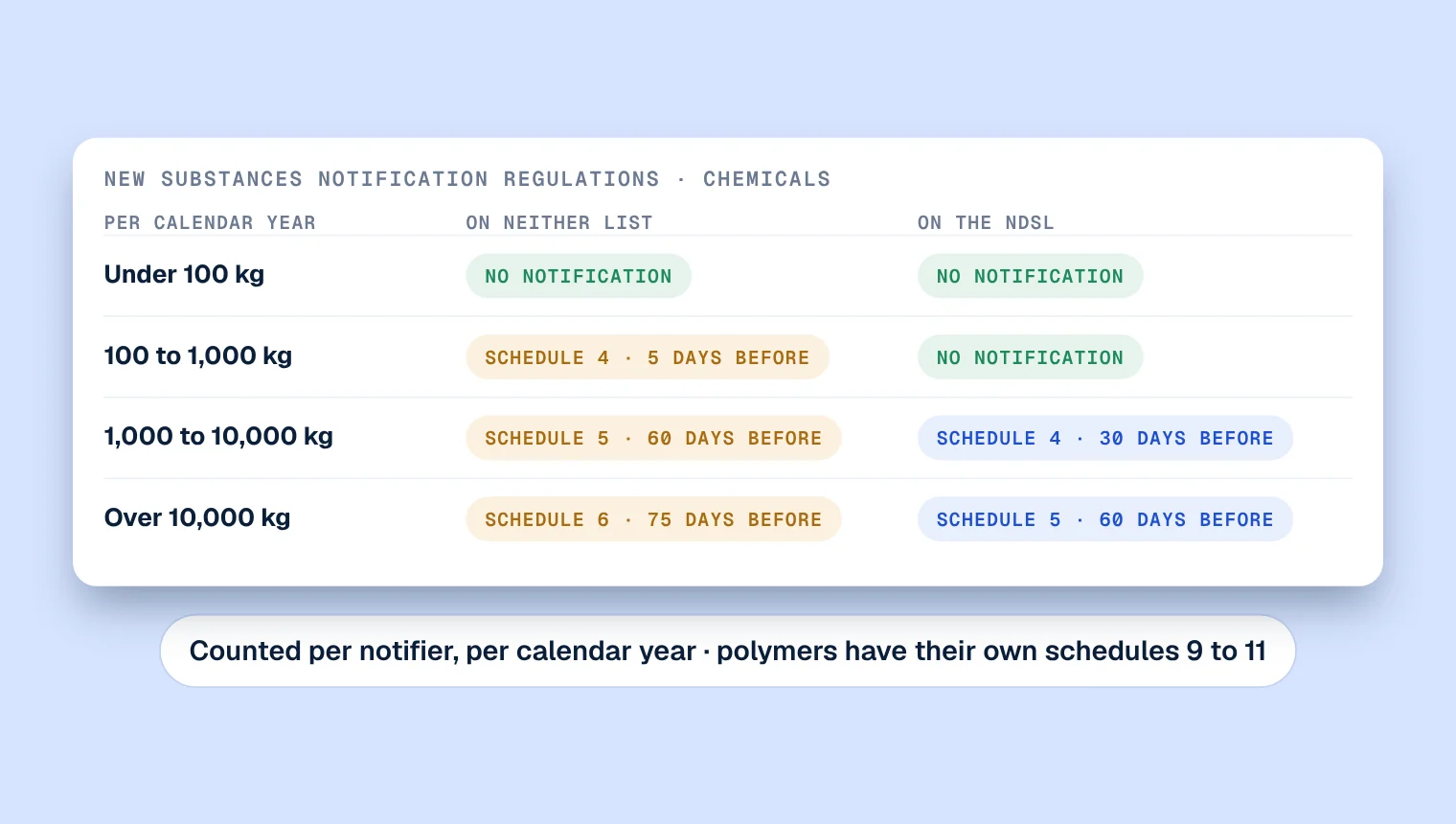
The thresholds and schedules for chemicals
| Quantity per calendar year | On neither list | On the NDSL |
|---|---|---|
| Under 100 kg | No notification | No notification |
| 100 kg to 1,000 kg | Schedule 4, 5 days before | No notification |
| 1,000 kg to 10,000 kg | Schedule 5, 60 days before | Schedule 4, 30 days before |
| Over 10,000 kg | Schedule 6, 75 days before | Schedule 5, 60 days before (over 50,000 kg: 75 days, with supplementary data) |
The quantities are counted per notifier and per calendar year, not on a rolling basis, and a company that expects to cross the next threshold notifies again at the higher schedule. Polymers follow their own schedules (9 to 11), and a polymer that meets the reduced regulatory requirement criteria (a low-concern polymer by molecular weight and composition) needs much less information. Substances regulated under other federal laws listed in Schedule 2 of CEPA, such as pesticides and food additives, are outside these regulations, and research and development, site-limited intermediates and export-only substances have their own exemptions and reduced requirements.
What goes in the notification
The schedules escalate from identity and intended use at Schedule 4 to physical and chemical data, toxicity, ecotoxicity, degradation and environmental fate at Schedule 6, with the SDS, the manufacturing or import details and a declaration that the information is correct. Data can be waived where it is technically impossible or not needed, and test data already generated for another jurisdiction (an EU REACH dossier, a US premanufacture notice) is often reusable. A fee is payable on filing, based on the schedule and the notifier's sales.
After the assessment
If the assessment period ends with no action, you may proceed. The substance is added to the DSL once the notifier confirms that it has been manufactured or imported above a set quantity within a window after the assessment, and from then on anyone may use it. Where the assessment identifies a concern, the Minister can impose conditions, prohibit the substance, or publish a significant new activity notice that requires a new notification before the substance is used in a way that was not assessed. Those outcomes bind every subsequent user, so a quick check of the DSL entry is part of due diligence on any substance.
WHMIS still applies
A notification under the NSNR has nothing to do with the SDS and label: a new hazardous substance sold to a workplace needs a compliant SDS in English and French from the first sale. See importing hazardous products into Canada.
Sources
General information, not legal advice. Checked against the official sources above on 18 October 2026. Rules change: for your own products, ask for a spot-check.