European and UK manufacturers
A first Canadian distributor or partner, and EU SDSs that need a WHMIS version.
Hazline Regulatory, an SDS consultancy in Ottawa, checks chemical products made in Europe, the UK, Asia or the US before they are sold in Canada, and writes the bilingual (English and French) WHMIS SDSs and labels your Canadian partner needs. A product that is fully compliant at home is often held up here by details: the classification, the French text, the Canadian supplier on the label, a VOC limit or an ingredient that is not on Canada's inventory. We tell you plainly what has to change, and every SDS is signed off by a regulatory specialist.
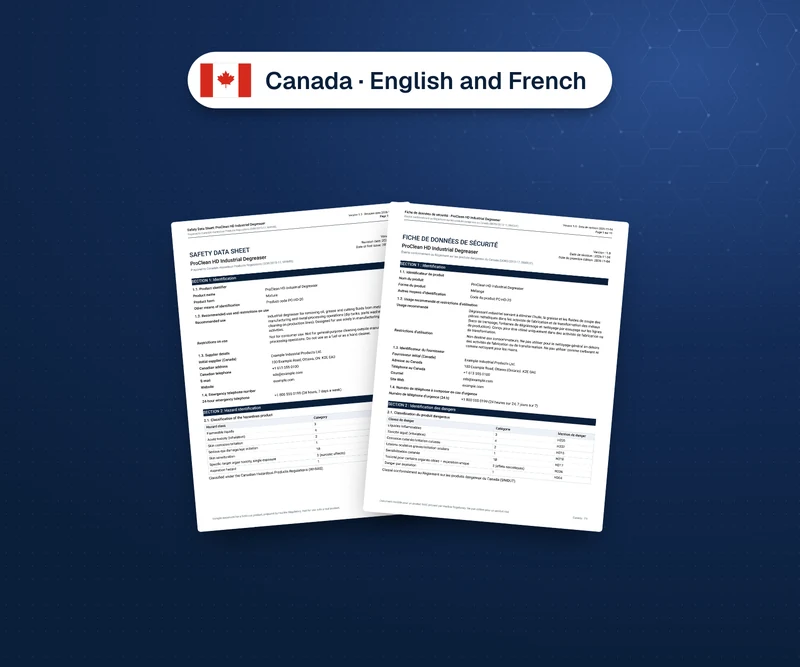
WHMIS follows the GHS, like EU CLP and OSHA HazCom, but not line for line. These are the points where a product that is compliant at home most often needs work for Canada.
Canada's Hazardous Products Regulations use their own hazard classes and cut-offs. A product can need a different signal word, pictogram or hazard statement here than in Europe or the US, so the classification is redone from the formula.
Learn moreThe SDS and the supplier label must be in both official languages, as one bilingual document or two parts supplied together, in every province, not only Quebec.
Learn moreThe SDS and label name the Canadian manufacturer or importer. A foreign manufacturer's details can stay only when a Canadian company imports the product for use in its own workplace.
Learn moreSubstances that are not on Canada's Domestic Substances List are new to Canada and must be notified and assessed before they are imported or made here. We check every ingredient in the formula against the list.
Learn moreCanada caps the VOC content of many maintenance products, adhesives, sealants and personal care products. A product that is fine in Europe or the US can be over the limit for its category here, so we check it before it ships.
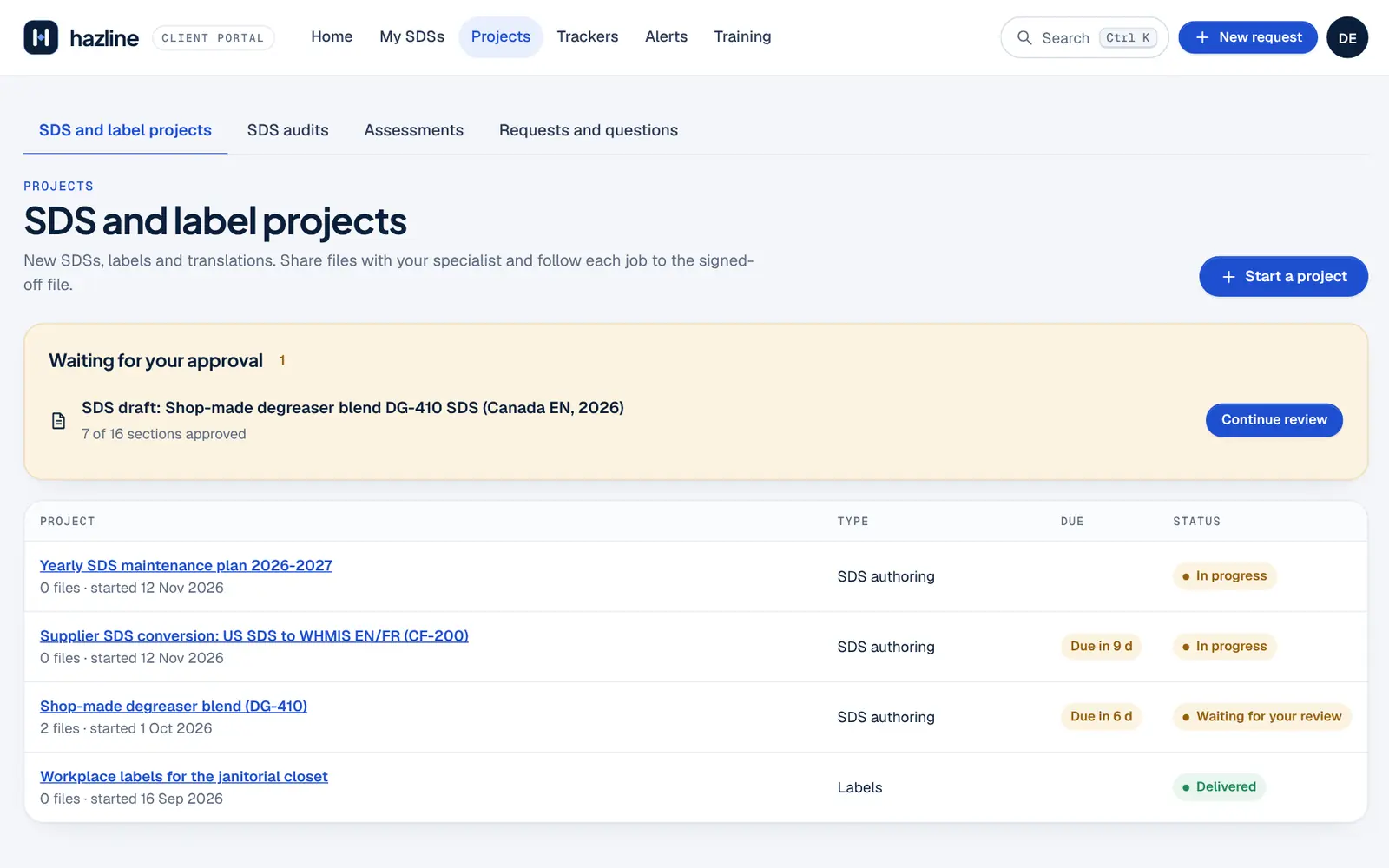
Learn moreSend your current SDS, from Europe, the US or anywhere else, and tell us who will sell the product in Canada and to whom. Under a non-disclosure agreement if you prefer, we screen the full formula and give you a written result for each product: fine for Canada as it is, fine once the SDS and label are redone, or held up by an ingredient or a limit, with the reason. Then we write the bilingual WHMIS SDSs and label text with your Canadian partner named, a regulatory specialist signs off each one, and you receive Word and PDF files in your portal. You get a written, fixed quote within two business days of the first call or spot-check.
A first Canadian distributor or partner, and EU SDSs that need a WHMIS version.
Products made for Canadian buyers, with SDSs that have never been checked against WHMIS.
Your company named as the Canadian supplier on every SDS and label.
OSHA SDSs brought up to WHMIS, or one dual US/Canada SDS.
Illustrative scopes, not client results; every project is quoted on its own.
Starting point. Six industrial products with EU SDSs, and a Canadian partner who wants to start selling them in the new year.
What we do. Each formula screened for Canada: WHMIS classification, every ingredient against the Domestic Substances List, and the VOC limit for the product category where one applies. A written result per product, then bilingual SDSs and label text for the products that are ready.
What you receive. A clear list of what can ship, what needs a new SDS and what needs a formula decision, and signed-off bilingual SDSs and labels in your portal.
Starting point. A new line of cleaning and maintenance products from an overseas maker, with English-only SDSs in a non-Canadian format.
What we do. The supplier's data checked, the products classified under the Hazardous Products Regulations, the importer named as the Canadian supplier, and French versions and label text written.
What you receive. Bilingual WHMIS SDSs and labels in the importer's name, with review dates tracked in the portal.
Usually not as it stands. It needs a classification made under the Hazardous Products Regulations, the Canadian supplier's details, Canadian content in sections such as 8, 14 and 15, and a French version. A free spot-check of one SDS tells you what yours needs.
No. WHMIS covers hazardous products sold or imported for use in a workplace. Chemical products sold to consumers come under the Consumer Chemicals and Containers Regulations, 2001, with their own labels and, for some products, child-resistant containers. Tell us who buys your product and we confirm which rules apply.
Canada limits the volatile organic compound content of many products, including maintenance products such as lubricants and degreasers, adhesives, sealants and caulks, and personal care products, under the Volatile Organic Compound Concentration Limits for Certain Products Regulations. Products made only for use in a manufacturing process, or only for export, are excluded. If your product falls in a category with a limit, we tell you which limit applies and by how much the formula is over it, so your chemists can decide what to do.
Then it is a new substance in Canada and has to be notified and assessed before it is imported, even inside a mixture, unless an exemption applies. We flag it early, before the products are shipped, so you can decide whether to notify, substitute the ingredient or leave that product out of the first shipment. We do not prepare or file the notification; you or your importer file it.
No. Your Canadian partner or importer is the supplier named on the SDS and label. We prepare the documents for them and can work with both of you on the same project.
Yes, from one product. Each SDS has a fixed fee per product and market, set by how complex the formula is and how complete your data are, quoted in writing within two business days. From complete data it takes about 10 business days on the standard route and about 5 on the fast track.
An EU (CLP/REACH) SDS is not a WHMIS SDS. What changes for Canada: Canadian supplier, English and French, classification, and the VOC and new-substance rules.
Read article
An importer is a supplier under the Hazardous Products Act. What you need before the product arrives: a Canadian SDS and label in English and French, the right supplier details, and six years of records.
Read article
Yes. WHMIS requires every SDS and supplier label to be in both official languages. What counts as bilingual, how the two versions must be delivered, and how to keep the French accurate.
Read articleSend one SDS and tell us where the product will be sold. A specialist replies with a short written summary of what has to change before the first shipment, within one business day.