- REACH registration is a duty of companies established in the EU that manufacture or import a substance at one tonne or more a year.
- A non-EU manufacturer cannot register itself, but it can appoint an Only Representative in the EU to register in place of its importers.
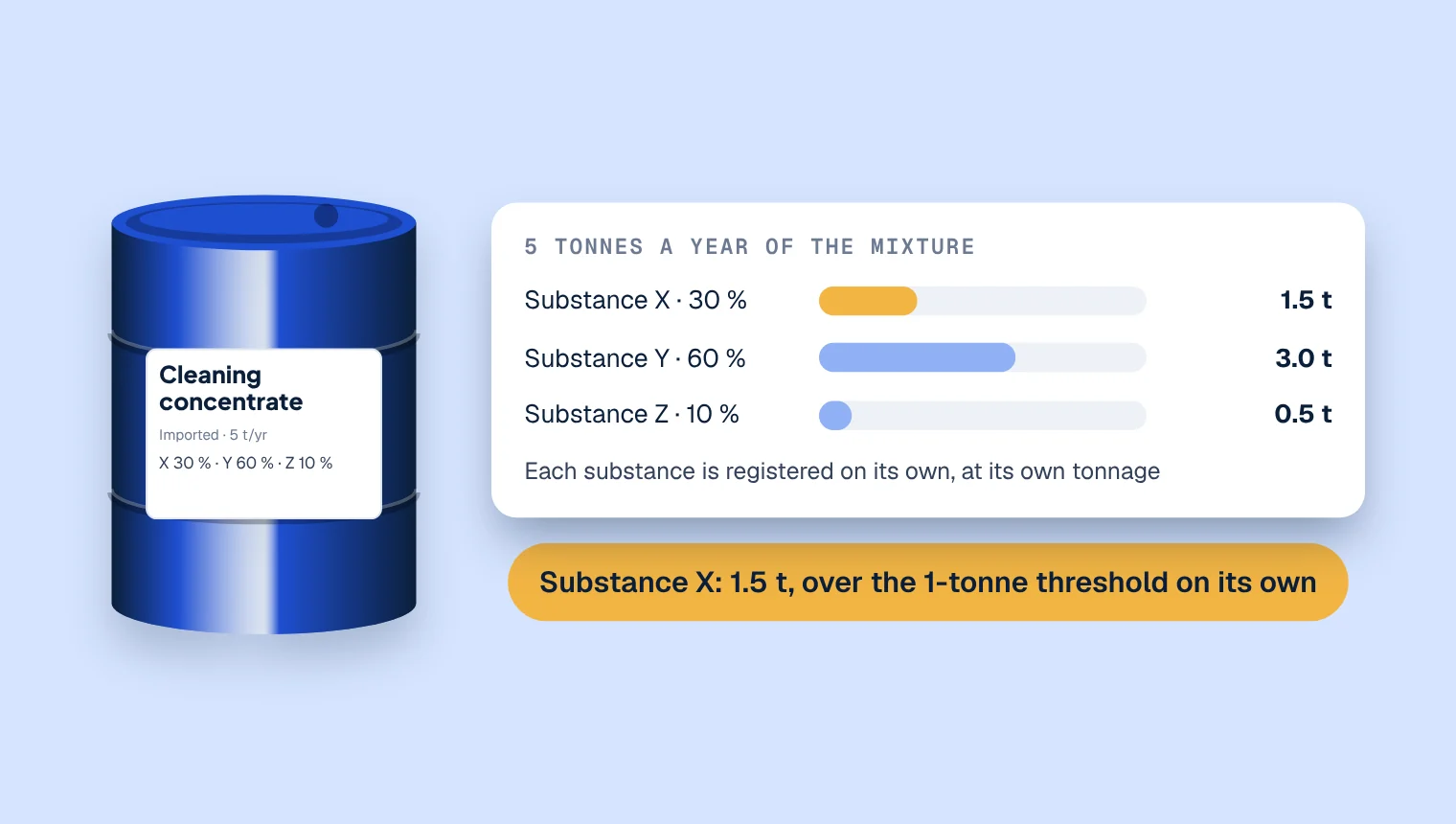
- Each substance in a mixture is counted and registered on its own; the data needed grows with the tonnage band.
- EU customers also need an EU-format SDS, the data for CLP labelling and information on Candidate List substances above 0.1% in articles.
No, a manufacturer outside the EU cannot register a substance under REACH and has no registration duty of its own. The duty sits with the company established in the EU that manufactures or imports the substance, on its own or in a mixture, at one tonne or more a year. If you export to the EU, either each of your EU importers registers the substances it brings in, or you appoint an Only Representative (OR) in the EU to register in their place.
Registration is only part of what your EU customers need. They also need an EU-format safety data sheet (SDS), the information for classification and labelling under CLP, and to know whether your products contain substances of very high concern (SVHCs).
- Transition endedAll substances made or imported at one tonne or more a year now need a registration.
- New SDS formatRegulation (EU) 2020/878 began to apply to safety data sheets.
- SCIP startsSuppliers of articles with Candidate List substances above 0.1% notify ECHA's SCIP database.
- Old SDSs endLast day an SDS in the previous format could still be provided.
Who has to register under REACH?
Under Article 6 of REACH (Regulation (EC) No 1907/2006), any manufacturer or importer of a substance, on its own or in one or more mixtures, at one tonne or more a year must register it with the European Chemicals Agency (ECHA). An importer is a person established in the EU who is responsible for the import, and import counts as placing on the market. Without a registration, the substance may not be made or placed on the market: the "no data, no market" rule of Article 5.
The threshold applies per manufacturer or per importer and per calendar year, so each EU company counts its own quantities. The transitional deadlines for existing substances ended on 1 June 2018; since then every substance in scope needs a registration before it is imported.
Some substances are outside registration. Polymers are not registered, but a polymer's manufacturer or importer registers its monomers when they make up 2% w/w or more of the polymer and one tonne or more a year in total. Substances listed in Annexes IV and V, certain re-imported substances, and substances covered by other laws, such as medicines, are partly or fully exempt.
Do I need REACH registration to export to the EU?
You do not, but someone in the EU does, and only legal entities established in the EU, Iceland, Liechtenstein or Norway can use ECHA's REACH-IT system. There are two ways to organise it:
| Your EU importers register | You appoint an Only Representative | |
|---|---|---|
| Who registers | Each importer, for what it imports at one tonne or more a year | The OR, in place of the importers in your supply chain |
| Your importers' status | Registrants | Downstream users |
| Your composition data | Shared with each registering importer | Shared with the OR, which ECHA notes can reduce disclosure to importers |
Below one tonne a year per importer, no registration is needed, but SDS and CLP duties still apply.
How does an Only Representative work?
Under Article 8, a company outside the EU that makes a substance (on its own, in mixtures or in articles), formulates a mixture or produces an article imported into the EU may, by mutual agreement, appoint an OR established in the EU to take over the importers' registration obligations. In practice:
- The OR must have enough background in the practical handling of substances and the information about them.
- It keeps up-to-date records of the quantities imported, the customers sold to, and the supply of the latest SDS.
- It must also meet the other obligations REACH places on importers.
- You must tell your importers in the same supply chain about the appointment; they then become downstream users.
- You can change your OR later.
An OR does not take over everything. ECHA states that responsibility for classification, labelling and packaging under CLP lies with the EU importer. Agree in writing which substances and which importers the OR covers, how tonnage is tracked, and who pays for data and fees.
How much data does a REACH registration need?
Article 12 links the information required to the tonnage band:
| Tonnes a year | Information required |
|---|---|
| 1 to 10 | Annex VII |
| 10 to 100 | Annexes VII and VIII, plus a chemical safety report |
| 100 to 1,000 | Annexes VII and VIII, testing proposals for Annex IX, and a chemical safety report |
| 1,000 or more | Annexes VII and VIII, testing proposals for Annexes IX and X, and a chemical safety report |
For some existing substances at 1 to 10 tonnes that do not meet the criteria in Annex III, only the physicochemical information is required. REACH works on "one substance, one registration": companies registering the same substance submit jointly, with a lead registrant submitting the shared data for the others. Data is shared to avoid repeating studies, and for pre-registered substances this was organised through substance information exchange forums (SIEFs). Dossiers are prepared in IUCLID and submitted through REACH-IT, and a fee is usually charged.
How are substances in mixtures counted?
Each substance in a mixture is registered on its own, and the tonnage is that of the substance, not the mixture. An importer bringing in 5 tonnes a year of a product that contains 30% of substance X imports 1.5 tonnes of X, which is over the threshold, even if every other ingredient stays below it.
What about substances in articles?
- Intended release. A substance intended to be released from an article must be registered when it totals over one tonne a year per producer or importer (Article 7(1)).
- Notification to ECHA. When a Candidate List substance is present above 0.1% w/w and over one tonne a year in total, the producer or importer notifies ECHA within six months of the substance's inclusion, unless exposure can be excluded (Article 7(2) and (3)).
- Information down the chain. A supplier of an article containing a Candidate List substance above 0.1% w/w must give recipients enough information for safe use, at least the substance name, and must answer a consumer's request free of charge within 45 days (Article 33).
- SCIP. Since 5 January 2021, suppliers of such articles also submit that information to ECHA's SCIP database, a duty that comes from the Waste Framework Directive, not REACH.
What do EU customers need besides registration?
- An EU-format SDS. Required for substances and mixtures classified as hazardous under CLP, for PBT and vPvB substances, and for Candidate List substances (Article 31(1)). It follows Annex II as amended by Regulation (EU) 2020/878, which has applied since 1 January 2021; older formats could be provided until 31 December 2022. Section 1.1 can carry the mixture's UFI, and nanoforms must be identified. It must be in an official language of the Member State where the product is placed on the market.
- CLP classification and labelling. Your importer needs your composition and data to classify and label the product. See our article on the new CLP hazard classes.
- Poison centre information. Hazardous mixtures may also need a poison centre notification and a UFI; see our article on that topic.
What are authorisation and restrictions?
Substances on the Authorisation List (Annex XIV) need an authorisation for each use after their sunset date, and applications are due by the latest application date set for each entry. Restrictions, listed in Annex XVII, limit or ban the manufacture, placing on the market (including import) or use of a substance on its own, in a mixture or in an article, and can apply below the one-tonne registration threshold. Each entry sets its own conditions, so check the entry text against your product. Your EU customers will often ask you to confirm both.
Does EU REACH cover the UK?
No. Since Brexit, Great Britain runs its own UK REACH, with registration deadlines now set for 27 October 2029, 2030 and 2031. An EU registration does not cover Great Britain, while Northern Ireland continues to follow EU REACH. See our article on the UK REACH deadlines.
How Hazline can help
Hazline's core work is safety data sheets and labels. A REACH question like this one we take on as a custom project: a gap assessment that maps which of your substances need an EU registration, at what tonnage, and who holds it today: an importer, an OR, or no one yet. Our SDS authoring service writes or checks your EU-format SDSs. Hazline is not an Only Representative; we work alongside the one you appoint. The fee is fixed and quoted in writing within two business days. Book a free call to start.
Sources
General information, not legal advice. Checked against the official sources above on 19 October 2026. Rules change: for your own products, ask for a spot-check.