- The BPR works in two steps: the active substance is approved at EU level for a product type, then each product is authorised, nationally or for the whole Union.
- Since 1 September 2015, a biocidal product may only contain an active substance bought from a supplier on ECHA's Article 95 list.
- Products whose active substances are still under review may stay on the market under national transitional rules until the approval decision, then have set deadlines to apply for authorisation.
- Treated articles, in-situ generated substances and nanomaterials have rules of their own, and a claim such as 'antibacterial' can turn an ordinary article into a treated article.
In the EU, a product that is meant to destroy, deter or control a harmful organism by chemical or biological action is a biocidal product: surface disinfectants, hand sanitisers, in-can preservatives, insecticides, wood preservatives and many more, sorted into 22 product types in four groups. Regulation (EU) No 528/2012, the Biocidal Products Regulation (BPR), has applied since 1 September 2013, and the European Chemicals Agency (ECHA) runs most of it. A company that is used to self-declaring a disinfectant in Canada or registering it in the US finds a different logic here: the active substance and the product are assessed separately, and both must be cleared.
- BPR appliesRegulation (EU) 528/2012 replaced the Biocidal Products Directive.
- Article 95Active substances must come from a listed supplier.
- Review programmeThe review of existing active substances continues; the end date was extended to 31 December 2030.
- Review programme endsTarget date for completing the evaluation of existing active substances.
Step one: the active substance
An active substance is approved at EU level for one or more product types, after an evaluation by a Member State and an opinion of ECHA's Biocidal Products Committee, and it is entered on the Union list of approved active substances with conditions and an expiry date. Substances that were already on the market in 2000 are being evaluated in the review programme, which has been extended several times; the current end date is 31 December 2030. Until the decision on a substance is taken, products containing it stay on the market under the national rules of each Member State. A product with a new active substance cannot be sold anywhere in the EU until the substance is approved.
Article 95: who may supply the substance
Since 1 September 2015, a biocidal product may be made available only if the supplier of its active substance (or of the product itself) is on the list ECHA publishes under Article 95 for that substance and product type. The list exists so that companies which paid for the data share the market with those who did not only if the latter contribute: to be listed, a supplier submits a full dossier or a letter of access to one. For a formulator, the practical test is simple: ask every active substance supplier for proof of its Article 95 listing for your product type, and keep the evidence in the product file.
Step two: the product authorisation
Once the active substance is approved, each product needs an authorisation before it can be sold. The routes are:
- National authorisation in one Member State, then mutual recognition in others, in sequence or in parallel.
- Union authorisation, granted by the Commission for the whole EU, available for most product types except some with national specifics.
- Simplified authorisation for low-risk products whose active substances are all on Annex I, with no substance of concern and no nanomaterials.
- Same biocidal product and biocidal product families, which let a range of similar formulations share one authorisation.
The application for a product with an existing active substance is due within set deadlines after the substance's approval date, and the product may stay on the market while the application is assessed. The dossier covers composition, physical and chemical properties, efficacy against the target organisms under the claimed conditions, human and environmental risk assessments, and the label and SDS. Efficacy is where disinfectant applications most often stall: the claims on the label must be supported by tests that match the use (surface, instrument, hand), the contact time and the organisms claimed.
Treated articles, in-situ systems and nanomaterials
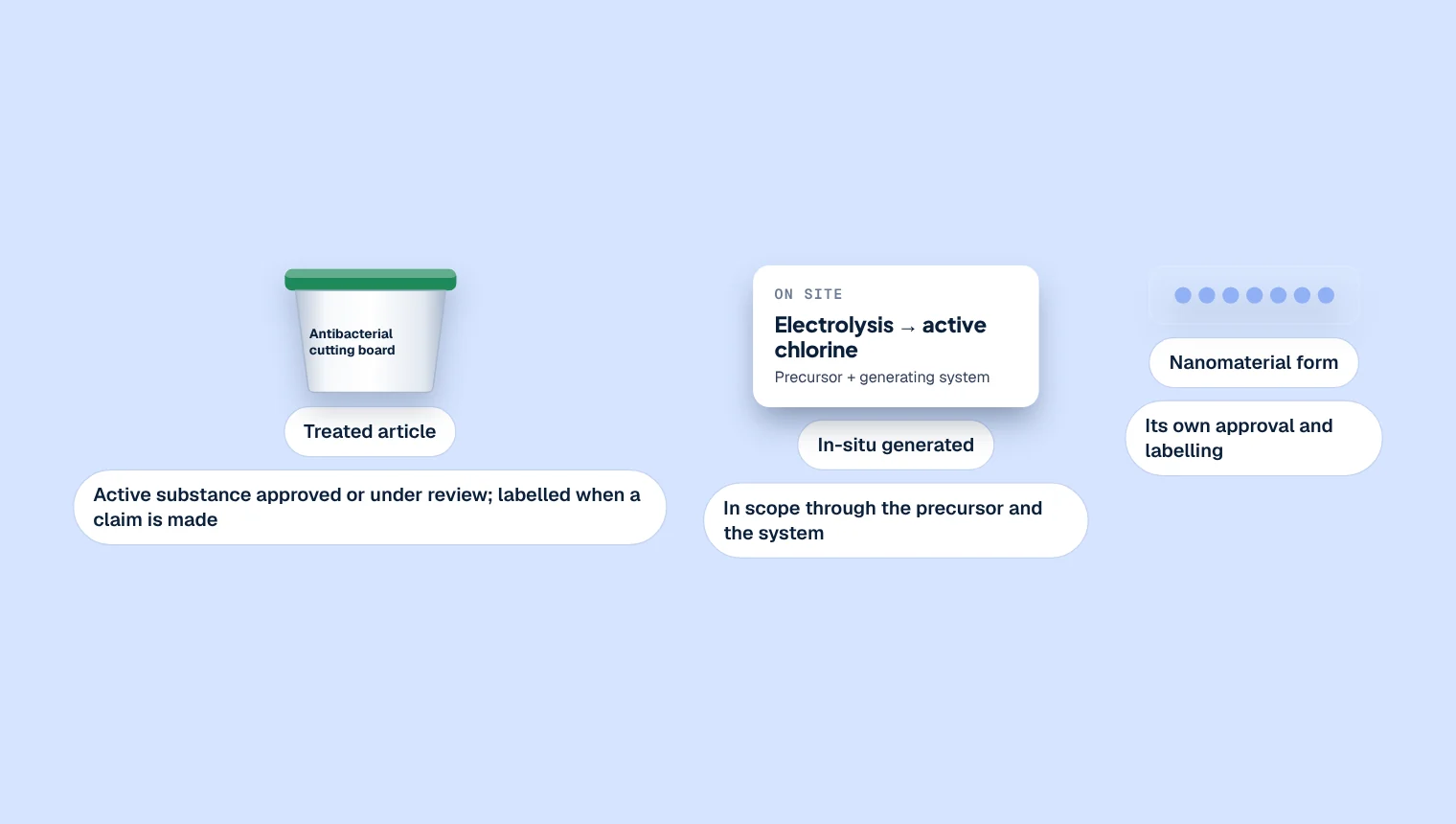
An article treated with a biocide (an antibacterial cutting board, a mould-resistant paint) may only be placed on the market if the active substance is approved or under review for that use, and it must be labelled when a biocidal claim is made or when the approval requires it. Substances generated on site, such as ozone or active chlorine from electrolysis, are also within scope, through the precursor and the generating system. Nanomaterial forms of an active substance need their own approval and labelling.
Where companies go wrong
- Assuming that a product sold in one Member State under transitional rules can be sold in another: national rules differ until the EU authorisation stage.
- Changing the active substance supplier without checking Article 95, which can make a compliant product unlawful overnight.
- Making a biocidal claim on a cosmetic or a detergent ("kills 99.9% of bacteria"), which pulls the product into the BPR.
- Missing the application window after the active substance is approved, after which the product must leave the market.
Sources
General information, not legal advice. Checked against the official sources above on 18 October 2026. Rules change: for your own products, ask for a spot-check.