- Any product that claims to kill, sanitize or disinfect microorganisms is a pesticide under FIFRA and must be registered with the EPA before it is sold or distributed.
- Public-health claims (disinfectant, sanitizer, virucide, tuberculocide, sterilant) must be supported by efficacy data submitted to the EPA; each extra organism claimed needs its own test.
- Registration is not the end: every state requires its own registration of the product, most with annual renewal, before it can be sold there.
- An EPA-registered disinfectant still needs a HazCom-compliant SDS and workplace label; the pesticide label and the SDS answer different questions.
In the United States, the word "pesticide" covers far more than insect sprays. Under the Federal Insecticide, Fungicide, and Rodenticide Act (FIFRA), any substance intended to prevent, destroy, repel or mitigate a pest is a pesticide, and microorganisms are pests. A surface disinfectant, a food-contact sanitizer, an antimicrobial laundry additive or a mould-killing paint additive is therefore an antimicrobial pesticide, regulated by the EPA's Office of Pesticide Programs. Hand sanitizers and products used on the human body are the exception: they are drugs regulated by the FDA.
- FIFRA enactedThe Federal Insecticide, Fungicide, and Rodenticide Act, amended many times since.
- PRIAThe Pesticide Registration Improvement Act set fees and review times.
- PRIA 5 in forceFees and decision times for new applications; see the EPA fee tables.
Registration before sale
A pesticide may not be sold or distributed in the US until it is registered with the EPA under section 3 of FIFRA (or sold under a registered product's supplemental distribution). The application covers the product chemistry (composition, physical and chemical properties, storage stability), the acute toxicity data that drive the signal word and precautionary statements, the efficacy data for the claims made, and the proposed label. The EPA reviews it within the decision time set by the Pesticide Registration Improvement Act (PRIA) for that category of application, against a fee that depends on the type of action. The registered product receives an EPA Registration Number that must appear on every label, together with the establishment number of the facility where it was produced.
Efficacy: the heart of a disinfectant file
The EPA divides antimicrobial claims into public health and non-public health. A public health claim is one about microorganisms that threaten people: disinfectant, sanitizer, virucide, tuberculocide, sterilant, or a claim against a named pathogen. For these, efficacy data must be submitted and accepted before the claim can appear on the label; the basic disinfectant tests use Staphylococcus aureus, Pseudomonas aeruginosa and Salmonella enterica, and each additional organism claimed (a specific virus, a fungus, a spore former) needs its own test under a recognised method, at the contact time and dilution stated on the label. A non-public health claim (an algaecide for a pool, a preservative for a paint, "controls odour-causing bacteria") still needs efficacy data to be generated, but the data are held by the registrant and submitted only on request.
Three words matter on the label. A sanitizer reduces bacteria by a stated amount (typically 99.9% or 3 log) but does not eliminate them; a disinfectant destroys or irreversibly inactivates bacteria, fungi and viruses on hard surfaces, in limited, general or hospital categories; a sterilant eliminates all microbial life, including spores. Choosing the claim means choosing the tests, the contact time and the directions for use, and the label cannot promise more than the data show.
The label is the law
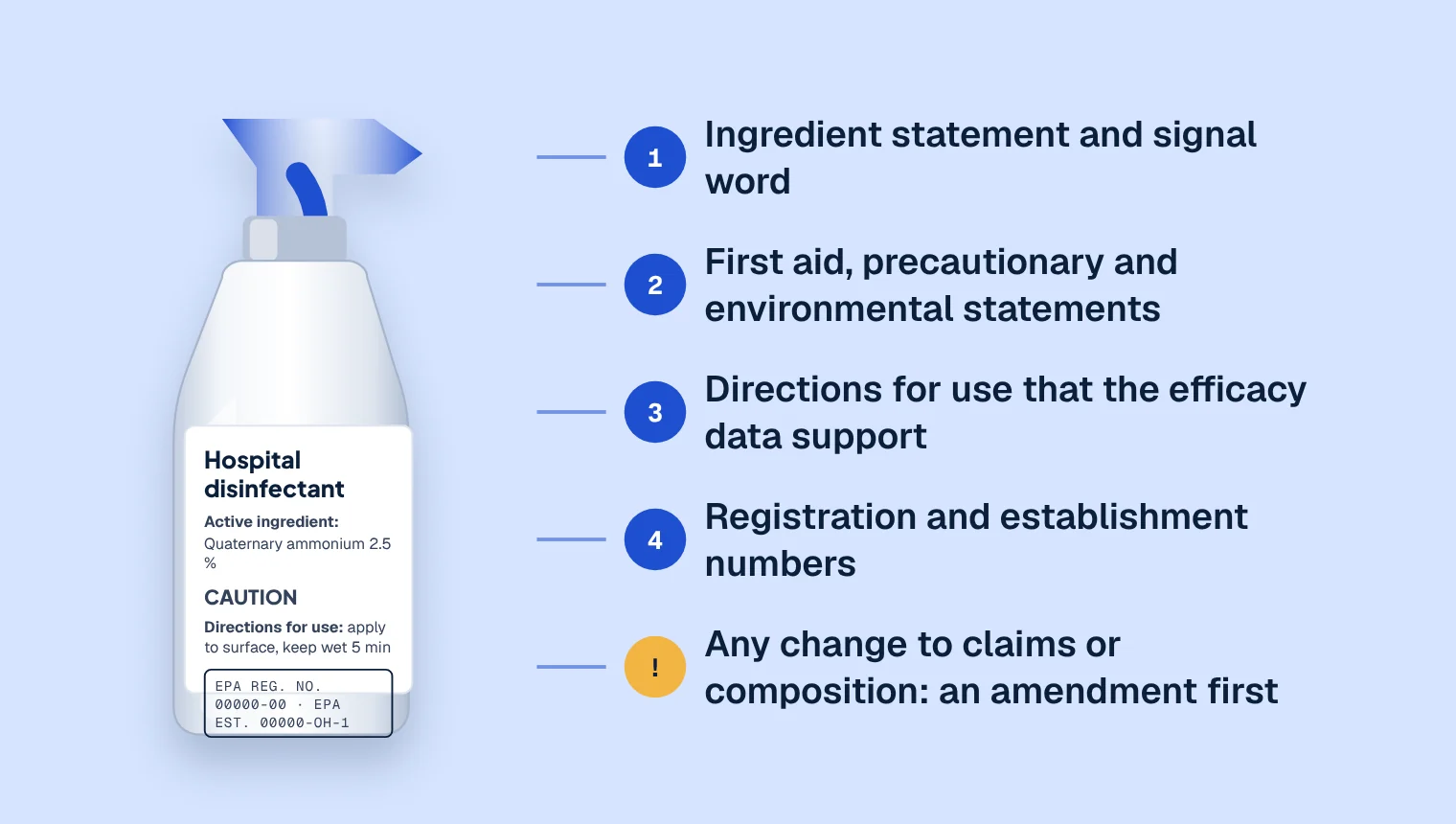
A pesticide label is a legal document: using the product in a manner inconsistent with it is a violation. It carries the ingredient statement, the signal word and first aid, precautionary and environmental statements, storage and disposal, the registration and establishment numbers, and the directions for use that the efficacy data support. Any change to the claims, the composition or the packaging that affects the label is an amendment submitted to the EPA before use. Marketing material, websites and sales sheets are held to the same claims as the label.
State registrations
Federal registration is necessary but not sufficient. Each state registers pesticides sold within its borders, most on an annual cycle with a fee per product, and some (California being the clearest example) run their own scientific review and may ask for additional data or label changes. A product launched nationally therefore needs a calendar of up to fifty state registrations and renewals, and a sale in a state where the product is not registered is a violation even though the EPA registration is valid.
SDS and HazCom still apply
An EPA-registered product is a hazardous chemical under OSHA's Hazard Communication Standard when it meets the criteria, so it needs a GHS-format SDS and the workplace label elements, in addition to the pesticide label. The two documents use different classification systems (FIFRA toxicity categories and signal words on one side, GHS classes and signal words on the other), and reconciling them is a common source of errors. See what a HazCom label must show.
Where companies go wrong
- Selling an "antibacterial" cleaner without registration because it is "just a cleaner". The claim makes it a pesticide.
- Importing a disinfectant registered in Canada or authorised in the EU and relabelling it: there is no mutual recognition.
- Adding a virus claim (or any new organism) to a label without the test for that organism.
- Forgetting the state registrations, or letting them lapse while the EPA registration stays current.
Sources
General information, not legal advice. Checked against the official sources above on 18 October 2026. Rules change: for your own products, ask for a spot-check.