- A food contact substance is a food additive unless it is exempt, so it needs a legal basis before the material is sold for food use.
- Most materials rely on an existing regulation in 21 CFR Parts 174 to 179 (polymers are in Part 177), read with its specifications and use limits.
- A new substance goes through a food contact notification: the FDA has 120 days to object, and the notification belongs to the notifier and its named manufacturer only.
- GRAS, prior sanctions and the threshold of regulation (0.5 ppb in the diet) are the other exemptions; each needs its own evidence in your file.
In the United States, a substance that is reasonably expected to migrate into food from packaging or equipment is an indirect food additive under the Federal Food, Drug, and Cosmetic Act, and a food additive may not be used without a legal basis. The FDA calls the substances in packaging and processing equipment food contact substances. The duty sits with whoever puts the material on the market for food use: the resin producer, the converter, the coating supplier and the food company all need to know which route covers each substance in each layer.
- Food Additives AmendmentFood additives, including indirect additives from packaging, need FDA clearance.
- Threshold of regulation21 CFR 170.39 exempts very low exposures.
- Food contact notificationsThe FCN programme replaced petitions for most new food contact substances.
- GRAS proposalThe FDA has proposed making GRAS notification mandatory; current rules unchanged.
Route 1: an existing regulation
Most materials in use today are covered by the regulations in 21 CFR Parts 174 to 179: adhesives and coatings (Part 175), paper and paperboard components (Part 176), polymers (Part 177), adjuvants, production aids and sanitizers (Part 178), and irradiation (Part 179). Each regulation names the substance, its specifications (purity, molecular weight, extractives) and the conditions of use, such as the type of food and the temperature. Compliance means the substance is listed and your material meets the specification and stays within the use limits; a polymer that meets the extractives test in the regulation for one condition of use may fail it for another.
Route 2: a food contact notification
Since 2000, a new food contact substance, or a new use of an existing one, goes through a food contact notification (FCN) under 21 CFR Part 170, Subpart D. The notifier submits the identity of the substance, its intended use, the migration data and the dietary exposure estimate, and the toxicology that the exposure level requires. The FDA has 120 days to object; if it does not, the notification becomes effective and is published in the FDA's inventory. Two points surprise newcomers: an effective FCN is proprietary, covering only the notifier and the manufacturer named in it, so a competitor cannot rely on it; and it covers only the use described, so a new application needs a new notification. A food additive petition remains available for substances whose exposure is high enough that a regulation is warranted, but it is now rare.
Route 3: GRAS
A substance that is generally recognized as safe by qualified experts, under the conditions of its intended use, is not a food additive. GRAS status can rest on a listing in 21 CFR Parts 182, 184 or 186, on a GRAS notification to the FDA, or on a self-determination supported by published evidence. In 2026 the FDA proposed making GRAS notification mandatory, including for food contact uses; it is a proposal, and the current rules have not changed, but a self-determination made today should be documented as if it will have to be filed.
Route 4: a prior sanction
Substances that the FDA or USDA approved for a specific use before 1958 keep that approval as a prior sanction, listed in part in 21 CFR Part 181. The list is old, the uses are narrow, and the toxicology has moved on; a prior sanction is a legal basis, not a safety assessment, and most companies back it up with current data.
Route 5: the threshold of regulation
Under 21 CFR 170.39, a substance can be exempted from regulation as a food additive when its dietary concentration is at or below 0.5 parts per billion, it is not a carcinogen and has no structural alert for carcinogenicity, and it has no technical effect in the food. The exemption is requested from the FDA with migration data and an exposure estimate; the FDA lists the exemptions it grants. A related idea, that a substance behind a functional barrier is not reasonably expected to migrate at all, is argued case by case and documented in the same way.
What goes in your file
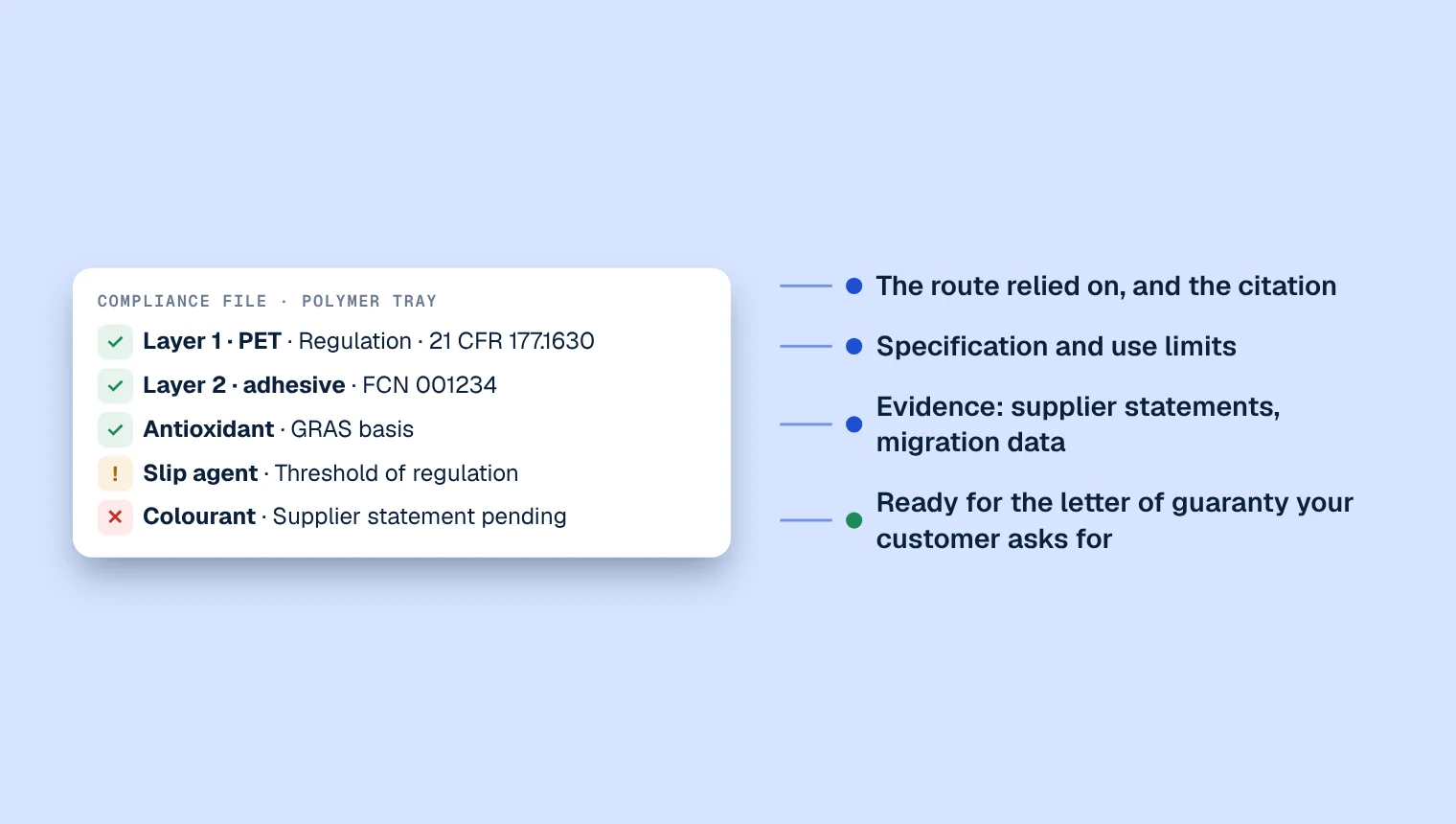
For each substance in each layer: the route relied on, the citation (regulation, FCN number, GRAS basis, exemption), the specification and use limits, and the evidence that your material meets them, usually a supplier statement for raw materials and migration or extractives data for the finished article. The food company at the end of the chain will ask for a letter of guaranty or a compliance statement; it is much easier to write when the file already exists. The US has no equivalent of the EU declaration of compliance, but the information behind one is the same.
Sources
General information, not legal advice. Checked against the official sources above on 18 October 2026. Rules change: for your own products, ask for a spot-check.