- Regulation (EC) 1935/2004 sets the rule for every food contact material: nothing may migrate into food in amounts that endanger health or change the food. Regulation (EU) 10/2011 applies it to plastics.
- Only monomers and additives on the Union list may be used in plastic layers, each with its restrictions and specific migration limit; overall migration is capped at 10 mg/dm² (60 mg/kg for food).
- A written declaration of compliance accompanies plastic materials at every stage except retail, and the supporting documents behind it must be available to the authorities on request.
- Regulation (EU) 2024/3190 bans bisphenol A in most food contact materials, with transitions running from 20 July 2026, and coatings are increasingly caught by the same rules.
Two texts govern every plastic that touches food in the EU. The framework Regulation (EC) No 1935/2004 states the principle: a material may not transfer its constituents to food in quantities that could endanger human health, change the composition of the food or change its taste and smell. Regulation (EU) No 10/2011, the "plastics regulation", turns that principle into a positive list, migration limits and a documentation chain for plastics. Good manufacturing practice under Regulation (EC) No 2023/2006 applies to the whole chain, and specific measures exist for recycled plastics, active and intelligent materials, ceramics and regenerated cellulose; most other materials, such as paper, inks and coatings, are governed by the framework regulation and national rules.
- Regulation 10/2011 appliesThe plastics measure replaced Directive 2002/72/EC.
- Supporting documentsMigration testing rules as amended by Regulation (EU) 2016/1416 apply.
- BPA regulation in forceRegulation (EU) 2024/3190 enters into force.
- BPA ban appliesMost food contact materials must be BPA-free, with set transitions.
- Packaging regulationPPWR applies, with PFAS limits for food contact packaging.
The Union list
Only the monomers, other starting substances and additives in Annex I of Regulation 10/2011 (the Union list) may be intentionally used to make plastic layers, each with any restrictions attached: a specific migration limit (SML), a maximum content, a limit to certain uses or food types. Substances not on the list may be used behind a functional barrier, or as aids to polymerisation, under conditions, and non-intentionally added substances (impurities, reaction and breakdown products) must be assessed by the manufacturer against the general safety requirement. The list is amended regularly; the amendments add substances, tighten limits and, in 2025, reworked several rules on purity, reuse and testing.
Migration limits and testing
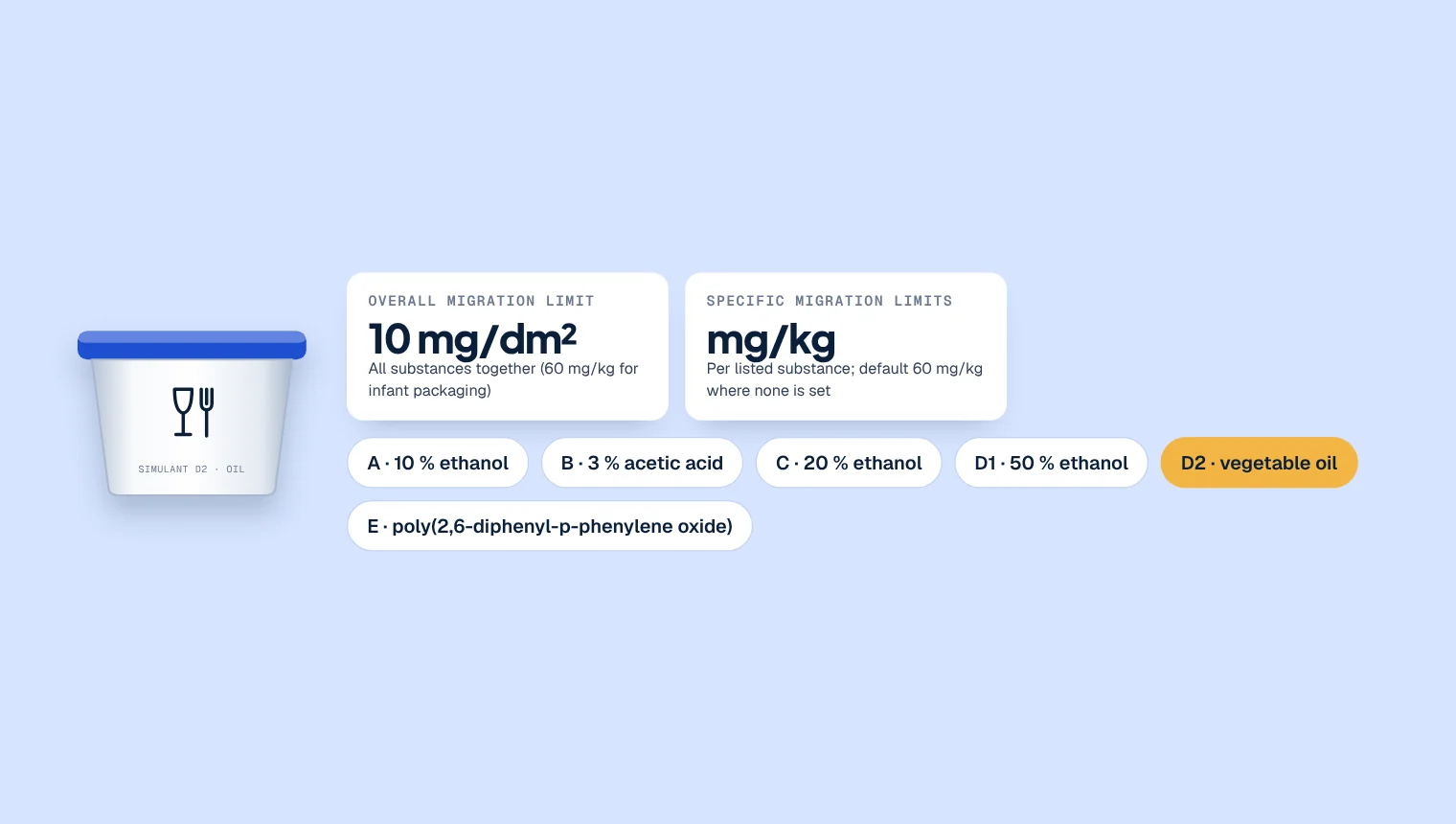
Two limits apply. The overall migration limit of 10 mg per dm² of food contact surface (60 mg per kg of food for infant packaging and some other cases) caps the total transfer of substances. Specific migration limits, in mg per kg of food, apply to individual substances on the list, with group limits for some, and a default limit of 60 mg/kg where no specific limit is set. Compliance is tested with food simulants that stand for the foods concerned (ethanol solutions, acetic acid, vegetable oil and others) under time and temperature conditions that match the intended use, following Annex V. For many materials, the manufacturer can rely on modelling, worst-case calculation or screening before resorting to full testing, as long as the approach is documented.
The declaration of compliance
At every stage of the chain other than retail, plastic materials and articles, and the intermediate products and substances meant for them, are accompanied by a written declaration of compliance (DoC). Annex IV lists what it must contain: the identity and address of the business issuing it, the identity of the material, the date, confirmation that the material complies with the regulations, the substances used that are subject to restrictions, the specifications for the use of the material (type of food, time and temperature, ratio of surface to volume), and the use of a functional barrier where relied on. The declaration is renewed when the composition or the processing changes, or when new scientific data call its basis into question. Behind the declaration sit the supporting documents: the test results, calculations and modelling that prove the limits are met. They are not sent downstream but must be produced for the authorities on request. The food business at the end of the chain relies on the declaration it receives; the converter relies on the declarations of its suppliers; everyone must be able to show the chain.
Bisphenol A and the coatings question
Regulation (EU) 2024/3190 prohibits bisphenol A and other bisphenols in food contact materials, including varnishes, coatings, adhesives and inks as well as plastics, with the ban applying from 20 July 2026 and longer transitions for a few uses, such as some can coatings for fruit, vegetables and fish products and professional food processing equipment. The same regulation requires a declaration of compliance for the materials it covers, which brings coatings and inks into a documentation regime they had largely escaped. The packaging regulation (EU) 2025/40, applying since 12 August 2026, adds limits on PFAS in food contact packaging.
Where companies go wrong
- Passing a supplier's declaration straight through without checking that the conditions of use (food type, temperature, time) match the actual use.
- Treating the declaration as a one-off: a resin change, a new additive or a new printing ink voids it.
- Assuming that a substance in a non-plastic layer (ink, adhesive, coating) is outside the rules; the framework regulation and the BPA regulation apply.
- Holding a declaration but not the supporting documents, which is what an inspector asks for.
Sources
- European Commission: food contact materials
- EUR-Lex: Regulation (EU) No 10/2011 on plastic materials and articles intended to come into contact with food
- EUR-Lex: Regulation (EU) 2024/3190 (bisphenol A and other bisphenols in food contact materials)
- EUR-Lex: Regulation (EC) No 2023/2006 on good manufacturing practice for food contact materials
General information, not legal advice. Checked against the official sources above on 18 October 2026. Rules change: for your own products, ask for a spot-check.