- Canada has no general approval system for food packaging: section B.23.001 of the Food and Drug Regulations bans packaging that may pass harmful substances to food.
- The food seller is responsible for packaging safety, and Health Canada's pre-market assessment is voluntary except for some foods such as infant formula.
- A Letter of No Objection says Health Canada found the material acceptable for the uses assessed; it is not a legal approval but buyers widely ask for it.
- The old CFIA Reference Listing is no longer maintained, so a LONO or a supplier letter of guarantee is now the usual evidence.
Canada does not approve food packaging before it is sold. The core rule is section B.23.001 of the Food and Drug Regulations: no one may sell food in a package that may yield to its contents any substance that may be injurious to the health of the consumer. The food seller, whether manufacturer or distributor, is responsible for meeting it. Health Canada offers a voluntary pre-market assessment and, where it finds no safety concern, issues a Letter of No Objection (LONO) for the material and the uses it assessed.
A LONO is not a legal approval, but it is the document Canadian food companies most often ask packaging suppliers for. Packaging for infant formula and a few other foods is different: there, Health Canada must receive information before the food is sold.
What are the food packaging regulations in Canada?
They sit in Division 23 of the Food and Drug Regulations, made under the Food and Drugs Act. The division is short:
- B.23.001 is the general safety rule above. It applies to every material: plastics, paper and board, coatings, inks, adhesives, metal and glass.
- B.23.002 to B.23.006 deal with one narrow case: PVC packaging made with octyltin stabilisers. It is prohibited except for certain foods, not including milk, malt beverages or carbonated soft drinks, and only within limits on the octyltin chemicals used and on the octyltin found in the food.
There is no Canadian equivalent of a binding positive list of approved substances, and no general migration limit in the regulations. Food businesses licensed by the Canadian Food Inspection Agency (CFIA) under the Safe Food for Canadians Regulations must still be able to show that the packaging they use is safe and suitable.
Is pre-market approval required for food packaging in Canada?
Not in general. Health Canada says packaging may be submitted to its Food Directorate voluntarily. The exceptions are packaging for infant formula (Division 25 of the regulations), foods for special dietary use (Division 24) and novel foods (Division 28), where specific information must be provided to Health Canada. The CFIA's guidance also flags packaging used in a novel process.
What is a Health Canada Letter of No Objection?
It is Health Canada's written opinion that a packaging material is acceptable, from a chemical safety point of view, for the uses described in the submission. Health Canada's own page is clear about its limits:
- it is not an approval in a legal sense, and it does not take away the food seller's duty under B.23.001;
- it covers the specific product, identified by trade name, and the conditions of use assessed;
- it has no expiry date as long as the composition and intended use stay the same, but the manufacturer must tell Health Canada about changes, and Health Canada can withdraw it if new evidence shows a possible health risk.
Suppliers of single additives, such as antioxidants or UV absorbers, can ask for an opinion on their own products. Health Canada also publishes lists of polymers that have received a LONO; a converter can swap in an equivalent listed resin and simply notify Health Canada, which may question the equivalence.
What does a LONO submission contain?
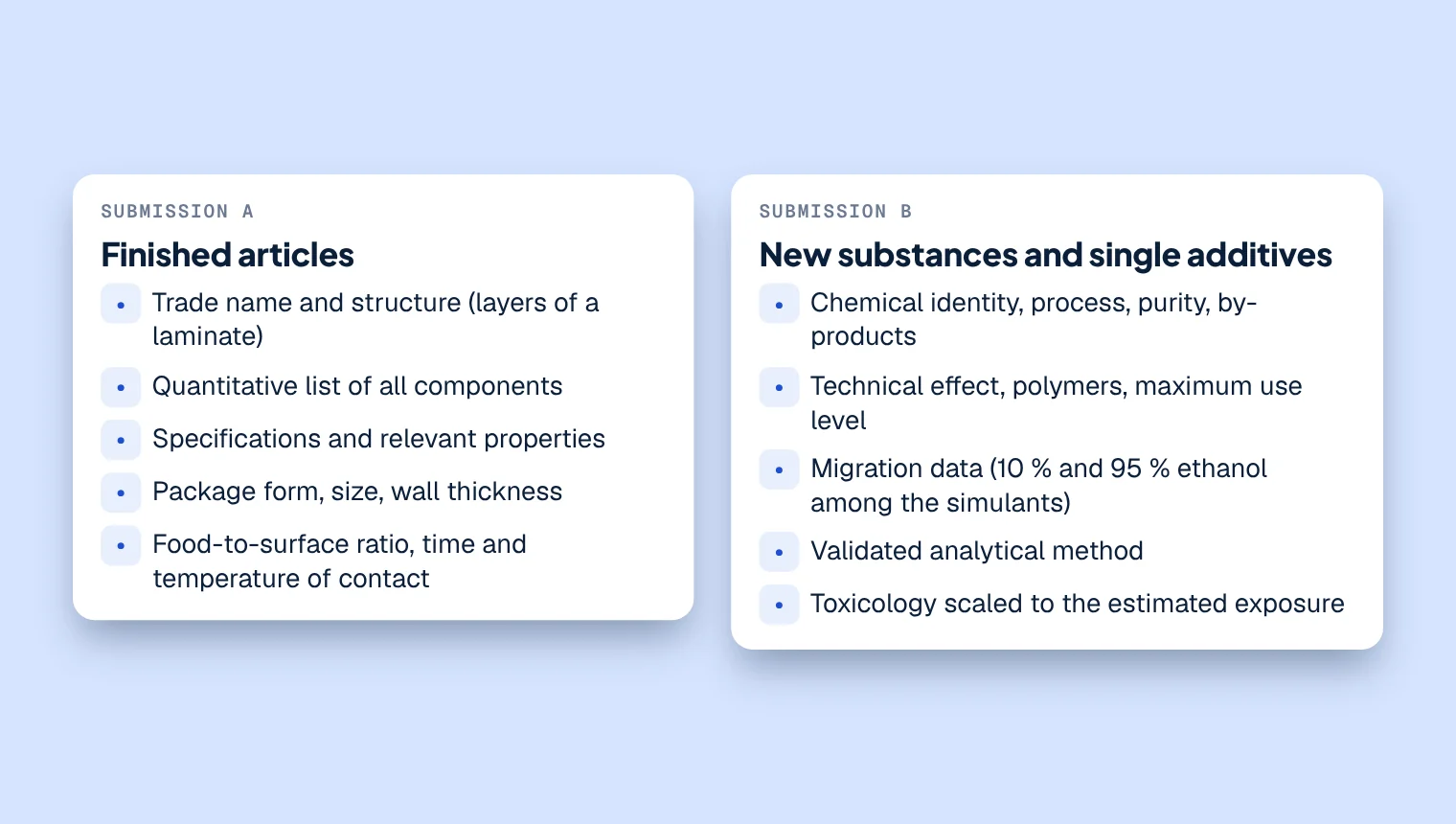
Health Canada's information requirements, updated in July 2026, distinguish two kinds of submission.
Finished articles and formulated products
- trade name, structure (for example the layers of a laminate), a quantitative list of all components, specifications and relevant properties;
- proposed use: package form and size, wall thickness, the ratio of food to packaging surface, and the time and temperature of contact during packing, distribution and use by the consumer.
If a component has not been assessed before, it needs the full data described below.
New substances and single additives
- chemical identity, manufacturing process and purity, including residual reactants and by-products;
- the technical effect, the polymers it is used in, the maximum use level, and the foods and conditions of use;
- migration or extraction data, for which Health Canada accepts 10% and 95% ethanol among other food simulants, with test conditions as close as possible to real use, plus a validated analytical method;
- toxicology data, scaled to the estimated exposure, following OECD test guidelines and good laboratory practice.
Raw material suppliers can send confidential composition details to Health Canada directly, so a converter does not need to see a supplier's formula. Submissions go through Health Canada's online application form for pre-market submissions to the Food and Nutrition Directorate. The guidance we checked gives no review timeline, so ask before promising a customer a date.
What happened to the CFIA Reference Listing?
The Reference Listing of Accepted Construction Materials, Packaging Materials and Non-Food Chemical Products was the CFIA's list of materials accepted for federally registered establishments. Since 2 July 2014 the CFIA no longer asks industry to pre-register packaging. The CFIA says the list is no longer maintained and was last updated in January 2016. It can still be used for a product listed for the same purpose, if its manufacturer still stands behind it.
Why do buyers ask for a LONO?
Because the legal duty sits with the food seller, food manufacturers and retailers ask their packaging suppliers for evidence. The CFIA's guidance lists what an establishment can keep on file: a LONO, an earlier CFIA letter of acceptance, a still-valid Reference Listing entry, or a letter of guarantee from the supplier. For imported materials, buyers often also accept FDA or EU compliance evidence as part of their own assessment, although Canadian law does not formally recognise either. A LONO is the strongest of these in Canada because it comes from Health Canada itself.
How is Canada different from the US and the EU?
| Canada | United States | European Union (plastics) | |
|---|---|---|---|
| Legal basis | General safety rule, B.23.001 | Food additive rules, with several authorisation routes | Regulation (EU) No 10/2011 |
| Pre-market review | Voluntary LONO, except infant formula and a few other cases | Required for substances that are food additives, for example through a food contact notification | Substances must be on the Union list |
| Who it covers | The product assessed, by trade name | A notification is effective only for the manufacturer or supplier named in it | Any company using listed substances within the limits |
| Paperwork in the chain | LONO or letter of guarantee, by buyer practice | Supplier evidence of the route used | Written declaration of compliance |
Our articles on FDA food contact routes and on the EU declaration of compliance cover those systems in detail.
Are there Canadian rules on bisphenol A or PFAS in food packaging?
Division 23 itself does not mention either. Polycarbonate baby bottles that contain bisphenol A are on Schedule 2 of the Canada Consumer Product Safety Act, which prohibits their manufacture, import, advertising and sale. For PFAS, the federal risk management approach published on 5 March 2025 placed food packaging materials, food additives and non-industrial food contact products such as paper plates, bowls and cups in its second phase, after firefighting foams. Check the current state of that work before you make a PFAS-free claim to a Canadian buyer.
How Hazline can help
Hazline's core work is safety data sheets and labels. A food contact question like this one we take on as a custom project: a gap assessment that reviews the composition, supplier and migration information you hold and sets out whether a LONO is worth seeking and what a submission would need. You send any submission to Health Canada from your own account. Each project is scoped first and quoted in writing within two business days at a fixed fee. Regulatory monitoring can then flag rule changes in Canada, the US and the EU that affect your materials. Book a free call to start.
Sources
- Justice Laws: Food and Drug Regulations (C.R.C., c. 870), Division 23, Food Packaging Materials
- Health Canada: Packaging materials
- Health Canada: Information requirements for food packaging submissions
- Canadian Food Inspection Agency: Guidance for food establishments concerning construction materials, packaging materials and non-food chemicals
- Government of Canada: Risk management approach for PFAS, excluding fluoropolymers
- Justice Laws: Canada Consumer Product Safety Act, Schedule 2
General information, not legal advice. Checked against the official sources above on 19 October 2026. Rules change: for your own products, ask for a spot-check.