- The Federal Plastics Registry is mandatory reporting under a section 46 notice of the Canadian Environmental Protection Act.
- For 2024 to 2026, only producers of plastic packaging, electrical and electronic equipment and single-use plastic products report.
- You do not report if you place less than 1,000 kg of plastic products or packaging on the Canadian market in a year.
- Reports are due on 29 September of the following year: 2026 data by 29 September 2027. Phases 2 and 3 were removed for 2025 and 2026.
Environment and Climate Change Canada (ECCC) runs the Federal Plastics Registry to find out how much plastic enters the Canadian market and where it goes. Reporting is not voluntary: it is required by a notice under section 46 of the Canadian Environmental Protection Act (CEPA), published in the Canada Gazette on 20 April 2024 and covering the calendar years 2024, 2025 and 2026.
- Notice publishedSection 46 notice covering 2024, 2025 and 2026.
- First report2024 data due.
- Notice amendedPhases 2 and 3 removed for 2025 and 2026.
- Second report2025 data due.
- Third report2026 data due.
Who has to report
For 2024 to 2026, reporting is limited to producers in three sectors:
- plastic packaging, including packaging that arrives already filled;
- electrical and electronic equipment;
- single-use or disposable plastic products.
Resin manufacturers, waste generators and service providers do not report for 2025 and 2026.
The notice decides who the producer is in a fixed order. It is the first of these that applies: a brand owner resident in Canada; the first Canadian-resident importer or manufacturer; the Canadian retailer that sold the product to the consumer; or, where that retailer sells through an online marketplace, the marketplace facilitator. A foreign brand selling through a Canadian importer therefore usually leaves the duty with the importer.
The 1,000 kg threshold
A producer does not have to report for a year in which it placed less than 1,000 kg of plastic products or packaging on the Canadian market. Above that, everything in scope is reported, not just the amount over the threshold.
What goes in the report
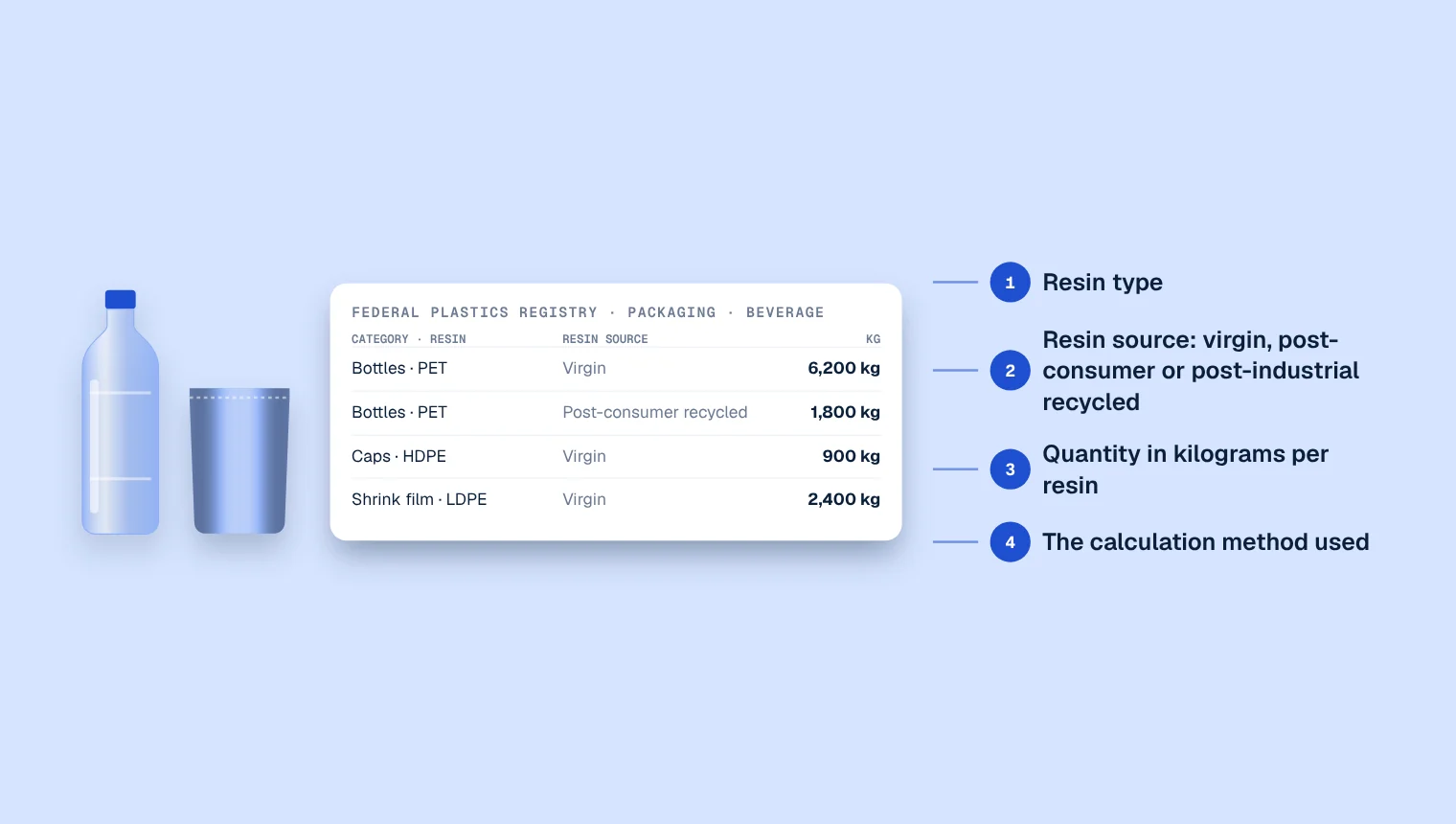
For each category and subcategory of packaging or product, the producer reports the resin type, the resin source (virgin, or post-consumer or post-industrial recycled), the quantity in kilograms for each resin, and the calculation method used. Most of this comes from two sources: units sold in Canada, and the specification of each piece of packaging.
Deadlines
| Data for | Report due |
|---|---|
| 2024 | 29 September 2025 |
| 2025 | 29 September 2026 |
| 2026 | 29 September 2027 |
If you missed a deadline, report as soon as possible: the duty does not lapse with the date.
What changed in 2026
The original plan added a second and third phase for 2025 and 2026, bringing in more sectors, resin makers, waste data and end-of-life data. A notice published on 14 March 2026 removed those phases for 2025 and 2026, without any retroactive reporting. Phase 1 continues unchanged.
The same day, ECCC published a notice of intent for a new section 46 notice covering 2027, 2028 and 2029. As of mid-October 2026 it had not been published, so the scope and deadlines after 2026 are not yet known.
How it fits with provincial programs
The registry is separate from provincial packaging programs such as Ontario's Blue Box, which has its own registration with RPRA and a supply report due on 31 May each year. The categories differ, but the same sales and packaging data feeds both, so it pays to build it once and keep the working.
Sources
General information, not legal advice. Checked against the official sources above on 15 October 2026. Rules change: for your own products, ask for a spot-check.