- A chemical substance that is not on the TSCA Inventory is new, and it cannot be made or imported for a commercial purpose until EPA has reviewed a notice or an exemption applies.
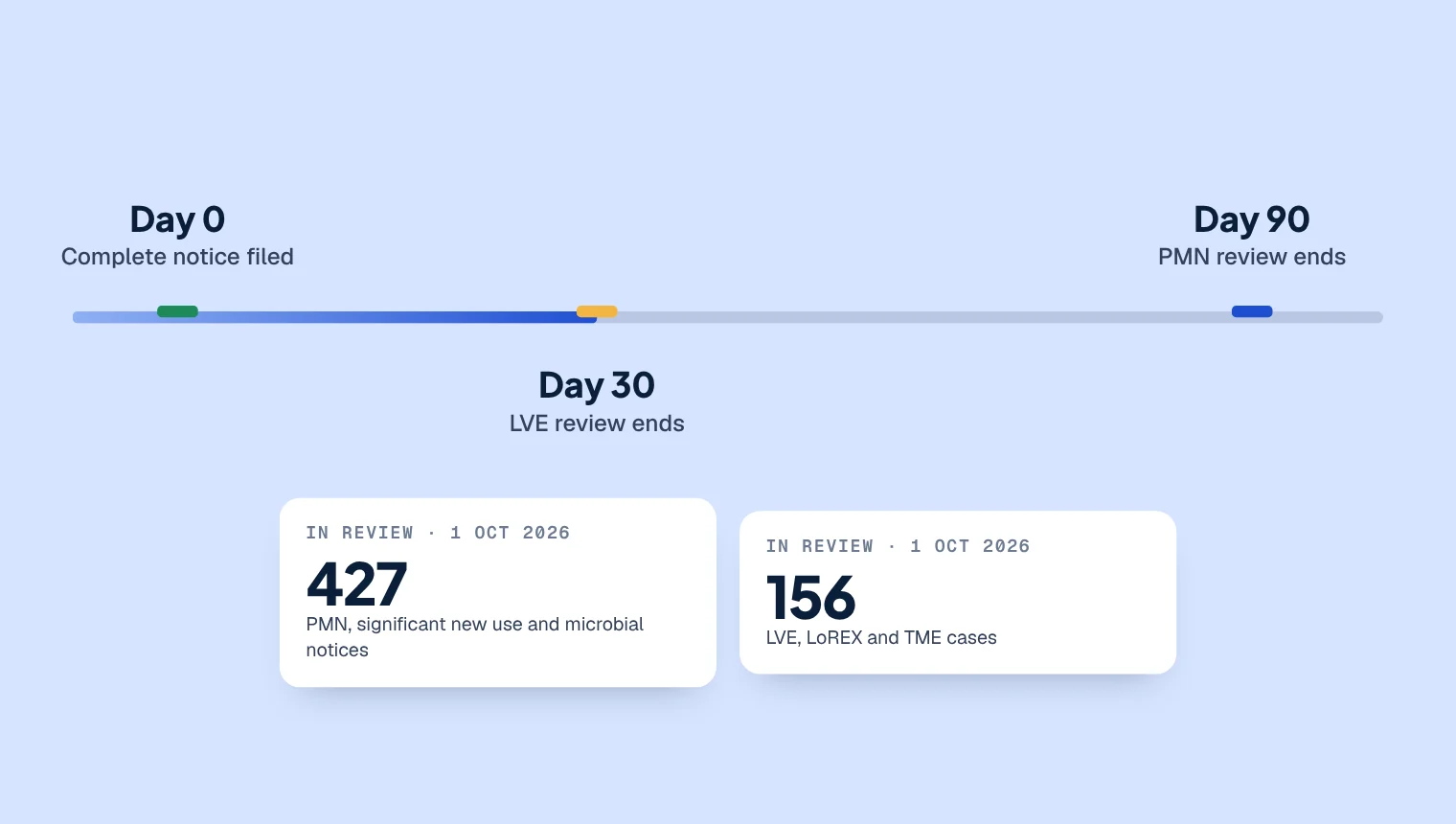
- A PMN is filed at least 90 days ahead and has no volume limit; once you start, a notice of commencement within 30 days puts the substance on the Inventory.
- A low volume exemption covers up to 10,000 kg a year, has a 30-day review, and binds you to the sites, uses and controls in your notice. PFAS and certain PBT chemicals are not eligible.
- Fees are $37,000 for a PMN and $10,870 for an LVE, or $6,480 and $2,180 for a qualifying small business.
If your chemical substance is not on the TSCA Inventory, you must tell EPA before you make or import it for a commercial purpose. For most substances that means a premanufacture notice (PMN), filed at least 90 days ahead. If you will make or import 10,000 kg a year or less, a low volume exemption (LVE) is often the better fit: a 30-day review and a lower fee, in exchange for staying within the sites, uses and controls you describe. Either way, you cannot start until EPA has reached its decision.
If you mainly import, our article on the TSCA Inventory and import certification covers the customs side.
- Current fees in forceEPA's 2024 fees rule set the PMN fee at $37,000 and the LVE fee at $10,870.
- New chemicals rule in forcePFAS and certain PBT chemicals lost LVE and LoREX eligibility; exemptions need EPA's go-ahead first.
- Fee authority extendedA continuing resolution extended EPA's TSCA fee authority past 30 September 2026.
- Fee authority endsEPA's authority to collect TSCA fees ends on this date unless Congress reauthorizes it.
When is a chemical "new" under TSCA?
A chemical substance is new when it is not on the TSCA Chemical Substance Inventory. Check every component of a mixture by exact chemical identity and CAS number, not by trade name. Some substances sit in a confidential portion, shown only under a generic name.
If unsure, file a bona fide intent to manufacture request through EPA's Central Data Exchange (CDX) under 40 CFR 720.25. You give the chemical identity, a signed statement of intent, the intended use and an infrared spectrum or other suitable data. EPA answers within 30 days of a complete request. A foreign supplier that will not share the identity with you can send it to EPA directly.
Who must submit a PMN or LVE?
Under TSCA, "manufacture" includes import. Anyone who intends to manufacture or import a new chemical substance for a commercial purpose must notify EPA, unless the substance is excluded or arrives as part of an article (40 CFR 720.22). When several companies are involved in an import, the principal importer files. Only companies incorporated, licensed or doing business in the US may submit, so a manufacturer outside the US usually relies on its US importer to file.
How does a premanufacture notice work?
- Timing. At least 90 calendar days before manufacture or import begins (40 CFR 720.40(b)).
- Form and route. EPA Form 7710-25, prepared in EPA's e-PMN software and submitted through CDX.
- Contents. The chemical identity, production volume, uses, process, worker exposure and releases, any existing SDS, as far as they are known or reasonably ascertainable, plus any test data in your possession or control (40 CFR 720.40(d), 720.45).
- Review. 90 days from the date EPA receives a complete notice. EPA can extend it by up to 90 days for good cause, and you can ask to suspend it if EPA agrees (40 CFR 720.75).
What can EPA decide?
EPA must make one of the determinations in TSCA section 5(a)(3) before you start (40 CFR 720.75(d)):
| EPA finds the substance | What follows |
|---|---|
| Not likely to present an unreasonable risk (5(a)(3)(C)) | You may proceed. EPA may still issue a significant new use rule (SNUR) for other uses. |
| Lacks enough information for a reasoned evaluation, may present an unreasonable risk, or will be made in substantial volumes with substantial release or exposure (5(a)(3)(B)) | A section 5(e) order setting conditions, usually followed by a SNUR |
| Presents an unreasonable risk (5(a)(3)(A)) | A section 5(f) order or rule that limits or prohibits the activity |
What happens after you start?
Within 30 calendar days of the first day of commercial manufacture, you file a notice of commencement on EPA Form 7710-56 through CDX (40 CFR 720.102). For an importer, that day is the date the substance clears US customs. EPA adds the substance to the Inventory once it receives a complete notice of commencement, open to others subject to any SNUR.
How does the low volume exemption work?
The LVE in 40 CFR 723.50(c)(1) covers a new chemical substance made or imported in quantities of 10,000 kg or less per year.
- Timing. Submit at least 30 days before you start, on EPA Form 7710-25 through CDX. The review runs 30 days from a complete notice, and you may ask to suspend it.
- No start without EPA. You may not begin until EPA tells you the substance meets the terms of the exemption (723.50(g)(2)). This has applied since the new chemicals rule took effect on 17 January 2025.
- Not eligible. PFAS, PBT chemicals with expected releases and potentially unreasonable exposures, and substances EPA finds may cause serious health or environmental effects (723.50(d)).
- Conditions. You make or import only at the sites, for the uses, and with the exposure and release controls in your notice, keep the physical form you described, and stay within the volume (723.50(j)). You tell customers the substance may be used only for the notified uses (723.50(k)), and you keep records for five years (723.50(n)).
An LVE never puts the substance on the Inventory; it covers only you.
Can you change an LVE later?
Yes, through a new notice, often called an LVE modification. You need one before using a new site or use, dropping a control, switching to a form with more exposure, or exceeding a volume you committed to. It needs less information than a first notice and quotes your earlier exemption number (723.50(j)(4) and (5)). A new site with no greater worker exposure and surface water concentrations of 1 part per billion or less can be added without a new notice, but you must tell EPA within 30 days of starting there (723.50(j)(6)). If you will need more than 10,000 kg a year, plan for a PMN.
What is the LoREX exemption?
The low release and low exposure exemption (723.50(c)(2)) has no volume limit, but strict conditions: no dermal or inhalation exposure for consumers and the general public, inhalation controlled for workers, no more than 1 milligram a year through drinking water, no surface water concentration above 1 part per billion, and no release to groundwater, land or landfill except as the rule allows. Timing, fees and the PFAS and PBT exclusions match the LVE.
What other TSCA exemptions exist?
- Polymer exemption (40 CFR 723.250): no notice before manufacture for polymers that meet the criteria, with a report by 31 January of the following year; some polymers, including certain perfluoroalkyl ones, are excluded.
- Research and development (40 CFR 720.36): small quantities used solely for R&D, under a technically qualified individual; no notice to EPA.
- Test marketing exemption (40 CFR 720.38): an application that EPA approves or denies within 45 days.
How much does a PMN or LVE cost in EPA fees?
EPA's fees are set in 40 CFR 700.45(c) by the 2024 fees rule (89 FR 12961, in force since 22 April 2024). As checked on 25 October 2026:
| Submission | Fee | Small business fee |
|---|---|---|
| PMN (or consolidated PMN), SNUN | $37,000 | $6,480 |
| LVE, LoREX, test marketing exemption | $10,870 | $2,180 |
The fee is paid in full through Pay.gov when you submit. Small business status is based on employee numbers by industry (500 or fewer where the industry is not listed), counting parents and affiliates (40 CFR 700.43). If you withdraw within the first 10 business days of review, EPA refunds all but 25%; if EPA misses its review deadline, the fee is refunded unless you caused the delay.
Two caveats: the rule's next three-yearly inflation adjustment cycle begins on 1 October 2026, and EPA's authority to collect TSCA fees now ends on 11 December 2026 unless Congress reauthorizes it (Public Law 119-103, Division B, section 2005). Check EPA's fees page on the day you file.
How long does EPA actually take?
The rules set 90 days for a PMN and 30 for an LVE, from a complete notice. EPA publishes no average review time, only its caseload: on 1 October 2026, 427 PMN, significant new use and microbial notices and 156 LVE, LoREX and TME cases were in review.
TSCA new chemical checklist
| Step | What | Who | Timing |
|---|---|---|---|
| 1. Identify | Exact identity and CAS number of every component | Manufacturer or importer, with the foreign supplier | Before quoting a US customer |
| 2. Check the Inventory | Public Inventory; bona fide intent request if needed | Intending manufacturer or importer | EPA replies within 30 days |
| 3. Choose the route | PMN, LVE, LoREX, polymer, R&D or TME; screen out PFAS and PBT for LVE and LoREX | Manufacturer or principal importer | Before planning launch dates |
| 4. Prepare the dossier | Form 7710-25 data, test data held, uses, volumes, exposure and releases | Submitter, with supplier data | Before submitting |
| 5. Submit and pay | e-PMN through CDX; fee through Pay.gov | Submitter | PMN 90 days, LVE 30 days before start |
| 6. Respond to EPA | Answer questions; agree any 5(e) order terms | Submitter | During review |
| 7. Start | Only after EPA's determination or LVE approval | Manufacturer or importer | After EPA notifies you |
| 8. Follow up | PMN: notice of commencement. LVE: keep to conditions and records | Submitter | NOC within 30 days; LVE records 5 years |
How Hazline can help
Hazline checks your substances against the Inventory, helps you choose between a PMN and an exemption, and prepares the PMN or LVE dossier for you to submit in your own name. We do not submit as your agent. LVE work is a fixed fee, quoted in writing within two business days; PMNs are quoted case by case. Book a free call to talk through your substance.
Sources
- eCFR: 40 CFR 720.25, determining whether a substance is on the Inventory (bona fide intent)
- eCFR: 40 CFR 720.22, persons who must report (premanufacture notices)
- eCFR: 40 CFR 720.75, notice review period
- eCFR: 40 CFR 720.102, notice of commencement
- eCFR: 40 CFR 723.50, low volume and low release and exposure exemptions
- eCFR: 40 CFR 700.45, fees for TSCA section 5 notices (fiscal years 2024 to 2026 amounts)
- EPA: Filing a pre-manufacture notice with EPA
- EPA: Actions under TSCA section 5
- EPA: TSCA fees table
- Federal Register: Updates to New Chemicals Regulations Under TSCA, 89 FR 102773 (18 December 2024)
- EPA: Statistics for the new chemicals review program
- govinfo: Continuing Appropriations and Extensions Act, 2027 (Public Law 119-103), Division B, section 2005
General information, not legal advice. Checked against the official sources above on 25 October 2026. Rules change: for your own products, ask for a spot-check.