- Every market wants its own SDS and label, written to its own GHS rules and in its own language, with a local company named as supplier.
- Each substance in the product must be on the local chemical inventory, or notified or registered where required, before the product arrives.
- Product-specific laws for cosmetics, disinfectants and food contact can replace or add to the general chemical rules.
- Transport, poison centre notifications, packaging reporting and substance restrictions complete the checklist, and each step needs evidence on file.
Before the first shipment to a new market, you need five answers: how the product must be classified and labelled there, whether every substance in it is on the local chemical inventory, whether a product-specific law takes over, how it ships as dangerous goods, and which company in that market carries the legal duties. Then come poison centre notifications, packaging reporting and restrictions on particular substances.
Canada, the US, the EU and the UK all base hazard communication on the UN Globally Harmonized System (GHS), so the steps look alike. The details are not the same, and each market puts the duties on a company inside it. The table sets out the steps by market; the sections after it explain where companies get caught.
- CanadaThe transition to the amended Hazardous Products Regulations ended.
- CanadaThe Prohibition of Certain Toxic Substances Regulations, 2025 came into force.
- EUThe Packaging and Packaging Waste Regulation started to apply, on a phased basis.
- USDeadline for manufacturers, importers and distributors to apply OSHA's 2024 HazCom rules to mixtures.
What are the regulatory steps before selling a chemical in a new market?
| Step | Canada | United States | European Union | Great Britain |
|---|---|---|---|---|
| SDS and label | Hazardous Products Act and Regulations (WHMIS), for workplace products; English and French | OSHA Hazard Communication Standard; English, with a US address and phone number | REACH (SDS) and CLP (label), in the official language(s) of each Member State where sold, unless that state provides otherwise | UK REACH (SDS) and GB CLP (label); Northern Ireland follows the EU rules |
| Who carries the duties | The supplier: whoever sells or imports the product in the course of business | The manufacturer or importer: the first US business with employees that receives the product to supply it | The EU importer or downstream user; a non-EU manufacturer can appoint an only representative for REACH registration | The GB importer; a non-GB manufacturer can appoint a GB-based only representative for UK REACH |
| Chemical inventory | Substances not on the Domestic Substances List are new and must be notified before manufacture or import above set quantities | Substances not on the TSCA Inventory need a premanufacture notice at least 90 days before manufacture, which includes import | REACH registration from 1 tonne a year per importer | UK REACH registration from 1 tonne a year per GB company |
| Product-specific laws | Cosmetics, drugs, food and pest control products are outside the WHMIS supplier rules; surface disinfectants are moving to biocide market authorizations under the Biocides Regulations | Disinfectants and other pesticides need EPA registration; cosmetics need FDA facility registration and product listing | Cosmetics Regulation, Biocidal Products Regulation, food contact framework regulation | GB cosmetic product notification and GB Biocidal Products Regulation |
| Transport | Transportation of Dangerous Goods Regulations; the consignor classifies | Hazardous Materials Regulations (49 CFR); the shipper classifies | ADR, RID and ADN under Directive 2008/68/EC | ADR through the Carriage of Dangerous Goods Regulations |
| Poison centres | No pre-market notification under WHMIS | No pre-market notification under HazCom | Notification for mixtures classified for health or physical hazards, and a UFI on the label | No mandatory notification; a voluntary arrangement with the National Poisons Information Service |
| Packaging | Provincial EPR programs and the Federal Plastics Registry | State EPR laws, such as California, Oregon and Minnesota | Packaging and Packaging Waste Regulation | Packaging EPR above set turnover and tonnage thresholds |
| Restrictions | Prohibition of Certain Toxic Substances Regulations, 2025; federal VOC concentration limits | EPA rules under TSCA section 6; state laws on PFAS and VOCs | REACH Annex XVII | UK REACH restrictions, now separate from the EU's |
Can you reuse the SDS and label from your home market?
Rarely as they are. Each market adopted the GHS on its own timetable: Health Canada says its amended regulations align with the 7th revised edition of the GHS and certain provisions of the 8th, while OSHA's 2024 update aligns primarily with the 7th. Hazard classes, cut-off values, mandatory statements and the supplier details still differ. Reclassify the product under each market's rules rather than translating the existing documents, then write the SDS and label from that classification.
Who is the legal supplier or importer in each market?
Always a company inside the market. ECHA puts it plainly: REACH and CLP only apply to legal entities established in the EU, so duties fall on the EU importer unless the non-EU manufacturer appoints an only representative for registration. Great Britain works the same way for UK REACH. In Canada, whoever imports a hazardous product in the course of business is a supplier under the Hazardous Products Act. Decide who will play this role before you ship. Otherwise your customer becomes the importer by default and may not know it.
Do you have to check every ingredient against the inventory?
Yes. Inventories list substances, not products, so each component of a mixture must be checked. A product can be on sale in the US for years and still contain a substance that is new to Canada, or that no one has registered in the EU or GB in the quantity you will import. These are the steps that take longest, so start with them.
Which rules can override the general chemical rules?
Product-specific laws come first. In Canada, cosmetics, drugs, food and pest control products are outside the Hazardous Products Act's supplier rules, and the Biocides Regulations, in force since 31 May 2025, require a biocide market authorization for surface disinfectants and sanitizers, with a transition for products that already hold a DIN until 31 May 2029. In the US, the HazCom label rules give way to the labels required by EPA, FDA or the Consumer Product Safety Commission where those apply.
What else belongs on the checklist?
- Restrictions. EU restrictions can limit or ban a substance on its own, in a mixture or in an article, imports included. Minnesota has prohibited intentionally added PFAS in 11 categories of new products since 1 January 2025. Canada and some US states, including California, set VOC limits for certain products.
- Packaging. In the UK, packaging EPR reporting applies to organisations with a turnover of £1 million or more that handled more than 25 tonnes of packaging the year before.
- Evidence. Keep the classification rationale, test reports, raw-material SDSs, dated inventory checks, notification receipts and label proofs. That file is what you show a customer, an inspector or a new distributor.
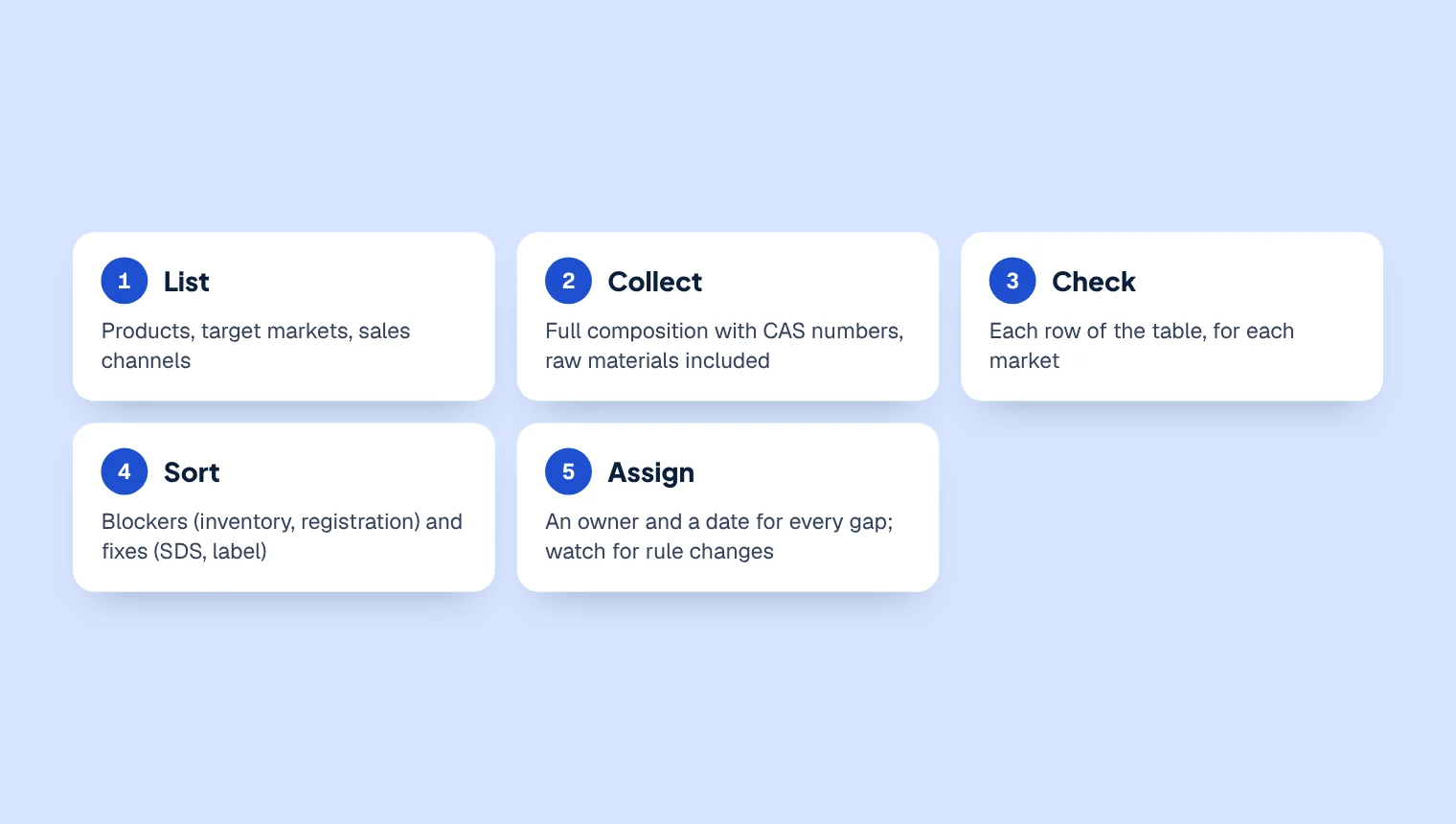
How do you run a regulatory gap assessment?
- List the products, target markets and sales channels (workplace, professional, consumer).
- Collect the full composition with CAS numbers, including the composition of raw materials.
- Work through each row of the table for each market and record what is already in place.
- Sort the gaps: blockers, such as an inventory or registration problem, and fixes, such as a new SDS or label.
- Give each gap an owner and a date, and watch for rule changes until launch.
How Hazline can help
Our gap assessment runs this checklist for your products and target markets and gives you a written list of gaps, in order of priority. Our GHS tracker and regulatory monitoring then flag rule changes that affect them. Where a notification or registration is needed, we tell you what it involves and who has to file it. We do not file on your behalf and are not an EU only representative or responsible person, and we tell you when you need one. The fee is fixed and quoted in writing within two business days. Book a free call to start.
Sources
- Justice Laws: Hazardous Products Act (R.S.C. 1985, c. H-3)
- Environment and Climate Change Canada: Domestic Substances List
- EPA: About the TSCA Chemical Substance Inventory
- ECHA: REACH and CLP for non-EU companies
- HSE: Duties of a GB-based importer (GB CLP)
- HSE: Guidance for new registrants under UK REACH
General information, not legal advice. Checked against the official sources above on 19 October 2026. Rules change: for your own products, ask for a spot-check.