- Minnesota has banned intentionally added PFAS in 11 product categories since 1 January 2025, and Maine banned a similar group from 1 January 2026.
- Minnesota's first PFAS-in-products reports were due 15 September 2026, or 14 December 2026 for manufacturers granted an extension, with an $800 fee per manufacturer.
- Since its 2024 amendment, Maine asks for reports only from manufacturers whose products rely on a currently unavoidable use (CUU) determination.
- From 1 January 2032 both states prohibit almost all products with intentionally added PFAS unless a CUU applies, and those CUU rules are still being written.
Minnesota and Maine have the widest state PFAS laws for products in the United States. As of October 2026, Minnesota's Amara's Law (Minn. Stat. 116.943) has banned intentionally added PFAS in 11 product categories since 1 January 2025, and requires manufacturers to report the PFAS in products sold in the state: the first reports were due on 15 September 2026, or 14 December 2026 with an approved extension. Maine's law (38 MRSA §1614) bans PFAS in a similar set of categories from 1 January 2026 and, since a 2024 amendment, asks for reports only for products covered by a currently unavoidable use (CUU) determination.
From 1 January 2032 both states prohibit almost every product with intentionally added PFAS unless the use is currently unavoidable. These rules change often, so each status below is dated.
- Minnesota bans in forceSale of 11 product categories with intentionally added PFAS became prohibited in Minnesota.
- Maine bans in forceMaine's prohibition on cleaning products, cookware, cosmetics, textile articles and other categories took effect.
- Minnesota reports dueFirst reports of intentionally added PFAS in products were due to the MPCA.
- Extended Minnesota deadlineLast date for manufacturers that were granted the one-time 90-day extension.
- Maine: turf and outdoor apparelArtificial turf and outdoor apparel for severe wet conditions join Maine's prohibitions.
- All-products prohibitionBoth states prohibit products with intentionally added PFAS unless the use is a currently unavoidable use.
What counts as intentionally added PFAS?
Both laws define PFAS as fluorinated organic chemicals with at least one fully fluorinated carbon atom. That reaches far beyond PFOA and PFOS: fluoropolymers such as PTFE are in scope. PFAS are "intentionally added" when they are put into the product or one of its components on purpose, to give it a function, characteristic or quality. Maine's definition also takes in the breakdown products of PFAS added on purpose.
In both states the manufacturer is the company that makes the product or whose brand name is on it. For imports, the importer or first domestic distributor takes that role when the maker and brand owner have no presence in the US.
Which products has Minnesota banned since 2025?
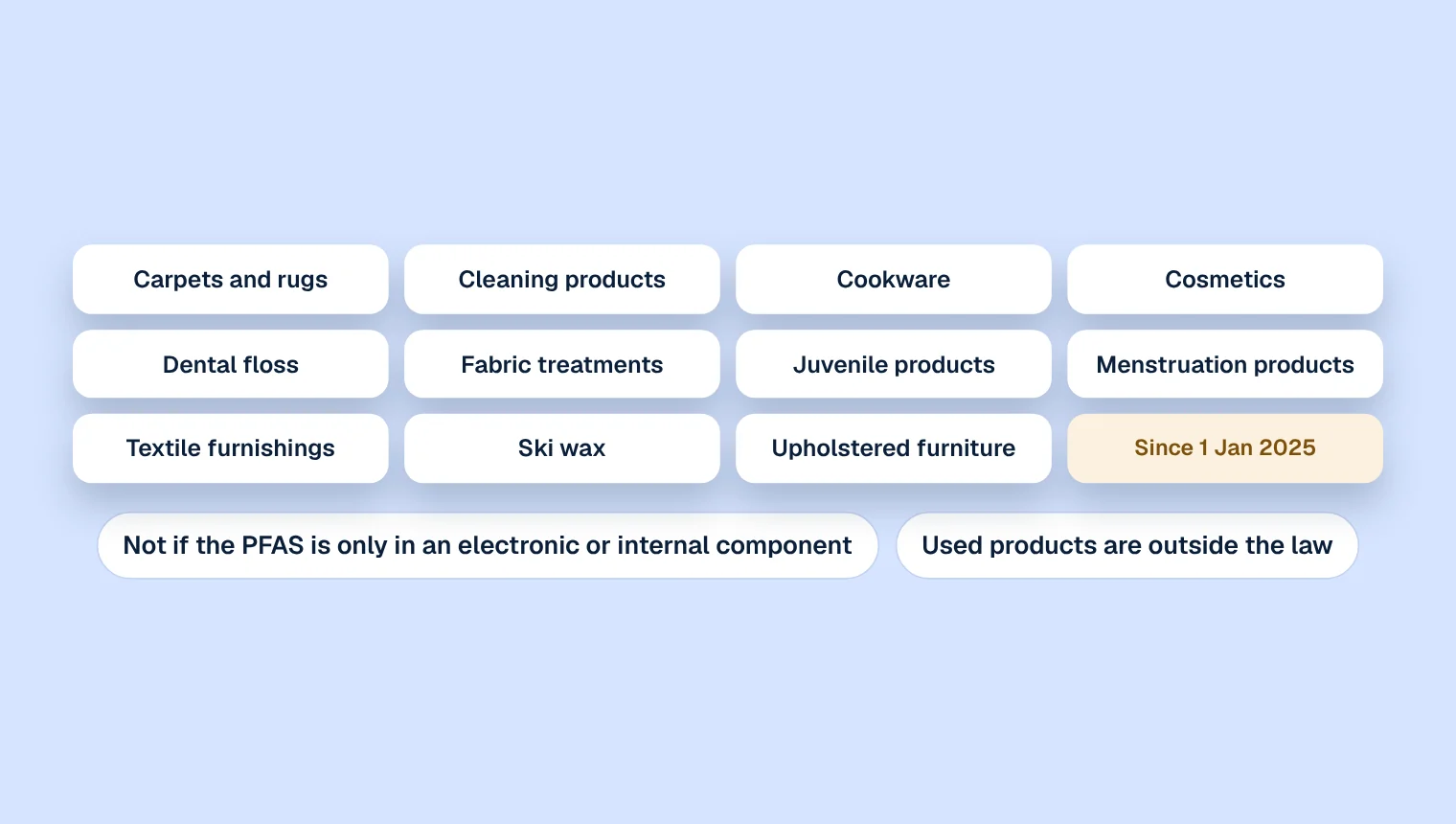
Since 1 January 2025, no one may sell, offer for sale or distribute in Minnesota the following products if they contain intentionally added PFAS:
- carpets or rugs;
- cleaning products;
- cookware;
- cosmetics;
- dental floss;
- fabric treatments;
- juvenile products (for children under 12);
- menstruation products;
- textile furnishings;
- ski wax;
- upholstered furniture.
The ban does not apply where the PFAS is only in an electronic or internal component; the Minnesota Pollution Control Agency (MPCA) describes this as temporary, with the 2032 rule applying afterwards. The juvenile product definition leaves out children's electronic products, adult mattresses and certain children's off-road vehicles. Used products are outside the law. FDA-regulated drugs and medical devices are exempt from the bans, but the MPCA says they must still be reported. Separate laws restrict PFAS in food packaging (since 1 January 2024) and firefighting foam.
Who must report PFAS in products to Minnesota, and when?
Every manufacturer of a product sold, offered for sale or distributed in Minnesota, online sales included, that contains intentionally added PFAS. The statute set the date as 1 January 2026; the MPCA adopted its reporting rule (Minnesota Rules, chapter 7026) on 8 December 2025 and set the first deadline at 15 September 2026. As of October 2026:
- Manufacturers that asked for and received the one-time 90-day extension have until 14 December 2026. The MPCA said requests had to be postmarked by 16 August 2026.
- A 2026 amendment limits reporting to products made after 1 July 2023. Products still on sale but made before that date do not need a report.
- After the first report, new products and significant changes are reported by 1 February each year.
- The fee is $800 per manufacturer, including each manufacturer in a group report, and an extension request costs $300. Fees are adjusted for inflation from 1 July 2027.
Reports go through the MPCA's PFAS Reporting Information System for Manufacturers (PRISM); pesticides and soil amendments go to the Minnesota Department of Agriculture. A report covers each product or component with intentionally added PFAS: a description with a code such as a UPC, SKU or HTS code, the function of each PFAS, its name and CAS number, its concentration range in each homogeneous material, and the manufacturer's contacts. Where amounts cannot be found with due diligence, total organic fluorine may be reported instead.
Approved reports are public. Chemical identities can be claimed as trade secret, but a chemical subclass must then be given for the public record. Manufacturers must keep asking their supply chain for PFAS information and keep records for at least five years. One manufacturer can report for others under a written agreement, but each verifies the data and pays its own fee. A manufacturer that missed the deadline can face penalties under Minn. Stat. 116.072, so it should file as soon as possible and speak to the MPCA.
What happens in Minnesota in 2032?
From 1 January 2032, Minnesota prohibits the sale of any product with intentionally added PFAS unless the MPCA has decided, by rule, that the use is a currently unavoidable use: essential for health, safety or the functioning of society, with no reasonably available alternative. Products in the 11 banned categories cannot receive a CUU. The MPCA can also add categories by rule before 2032.
As of October 2026 the CUU rule is still at the pre-proposal stage. The MPCA's timeline shows a proposed rule developed in 2027, with no adoption date yet. The Department of Agriculture decides for pesticides, fertilizers and soil and plant amendments.
What does Maine ban, and from when?
| From | Products with intentionally added PFAS that may not be sold |
|---|---|
| 1 January 2023 | Carpets and rugs; fabric treatments |
| 1 January 2026 | Cleaning products, cookware, cosmetics, dental floss, juvenile products, menstruation products, textile articles, ski wax, upholstered furniture |
| 1 January 2029 | Artificial turf; outdoor apparel for severe wet conditions unless labelled "Made with PFAS chemicals" |
| 1 January 2032 | Any other product, unless a CUU determination applies |
| 1 January 2040 | Heating, ventilation, air conditioning and refrigeration equipment; refrigerants, foams and aerosol propellants |
The 2026 textile category leaves out outdoor apparel for severe wet conditions and textiles in vehicles, watercraft and aircraft. Exemptions include used products, packaging, FDA-regulated drugs and medical devices, motor vehicles and watercraft (except their textiles and refrigerants), semiconductors and non-consumer electronics. A retailer is caught only once told that a sale is prohibited.
Who must report PFAS to Maine now?
Far fewer companies than first planned. The original law required a general notification by 1 January 2025. Public Law 2023, chapter 630 (LD 1537), in effect since 9 August 2024, removed it. As of October 2026, a manufacturer must notify the Maine Department of Environmental Protection (DEP) only if its product relies on a CUU determination. It files a PFAS Notification Form with a fee through the DEP's online system to keep selling the product, and from 1 January 2032 a CUU product may not be sold without that notice. Manufacturers with 100 or fewer employees are exempt from notification.
CUU decisions are made by rule by the Board of Environmental Protection. An amended Chapter 90 rule with the first determinations took effect on 7 October 2025. The DEP had received 11 proposals for the 2026 categories and recommended only 2, both for container parts of cleaning and cosmetic products. A product without an approved CUU must meet the prohibition. A CUU lasts five years from the rule or from the prohibition date, whichever ends later. Proposals for the 2029, 2032 and 2040 dates must arrive between 60 and 18 months before each date, so the window for 2029 closes in mid-2027.
What about other states and federal TSCA reporting?
Other states, including New Mexico, Colorado, California, Washington and New York, have their own PFAS product laws with different scopes and dates; check each state where you sell. Federal one-time PFAS reporting under TSCA section 8(a)(7) is a separate obligation, covered in our TSCA PFAS reporting article.
What should manufacturers do now?
- List every product sold into both states, online sales included, and ask suppliers in writing about intentionally added PFAS.
- Check each product against the banned categories and dates.
- For Minnesota, file in PRISM or confirm your extension date, and diary the 1 February updates.
- For products sold after 2032, judge whether a CUU is realistic and plan substitution where it is not.
How Hazline can help
Hazline's core work is safety data sheets and labels. PFAS questions we take on as a custom project: a gap assessment that works through your product list, sorts each product against the Minnesota and Maine categories and dates, and sets out what you report and by when. You submit from your own PRISM account. Regulatory monitoring then tracks the CUU rulemakings and new state laws for your products. We do not give legal advice. The fee is fixed and quoted in writing within two business days; start with a free call.
Sources
- Minnesota Revisor of Statutes: Minn. Stat. 116.943, Products containing PFAS (Amara's Law)
- Minnesota Revisor of Statutes: Minn. R. ch. 7026, Products containing PFAS; reporting
- Minnesota Pollution Control Agency: PFAS use prohibitions and reporting
- Minnesota Pollution Control Agency: Groundbreaking reports on PFAS in products are due three months from today (15 June 2026)
- Maine Legislature: 38 MRSA §1614, Products containing PFAS
- Maine Department of Environmental Protection: PFAS in Products
General information, not legal advice. Checked against the official sources above on 19 October 2026. Rules change: for your own products, ask for a spot-check.