- Seven states have packaging EPR laws, enacted between 2021 (Maine, Oregon) and 2025 (Maryland, Washington). No eighth state had enacted one by October 2026.
- The producer is generally the brand owner, or the importer or first distributor when the brand owner has no US presence; each law has its own small-producer exemption, typically around US$1 million to US$5 million in revenue or one ton of packaging.
- Circular Action Alliance is the producer responsibility organisation in Oregon, Colorado, California, Minnesota, Maryland and Washington; Maine is contracting a stewardship organisation.
- 2026 was the year of first registrations and reports in several states: reports by 31 May in Oregon, California, Minnesota, Maryland and Washington, registration by 1 July in Maryland and Washington, and Colorado's first dues.
Packaging extended producer responsibility arrived in the United States in 2021 and spread to seven states by 2025. The laws are state laws, with different definitions, materials, fee structures and dates, but they share a design: producers of packaging (and in some states paper products and food service ware) join a producer responsibility organisation (PRO), report what they put on the market in the state, and pay fees that fund collection and recycling, with eco-modulation that rewards recyclable designs. For most producers, the PRO is the same in six states, which simplifies the work, but the obligations and dates still have to be tracked state by state.
- Maine and OregonThe first two state laws.
- Oregon obligationsProducers obligated; the program launched on 1 July 2025.
- Reports dueAnnual data in Oregon, California, Minnesota, Maryland and Washington.
- RegistrationProducers register in Maryland and Washington.
- CaliforniaFirst payment into the California fund.
- MinnesotaProducers fund at least half of net recycling costs.
Who is the producer
The laws point first at the brand owner of the packaged product sold into the state, and, where the brand owner has no US presence or is not the one placing the product there, at the importer or the first distributor; some laws treat the manufacturer of the packaging itself as the producer of packaging sold empty. Each law exempts small producers, by revenue, by tonnage or both: Minnesota exempts producers under US$2 million in global revenue or one ton of covered material into the state; Oregon offers several routes including revenue under US$5 million or under one metric ton; Maine uses US$2 million for the first three years and US$5 million afterwards, plus a one-ton test; California exempts gross sales under US$1 million but requires the producer to register to claim it. Maryland and Washington are setting their thresholds through rulemaking. Perishable food, medical products and some other categories are carved out in most states.
The seven states
| State | Law | PRO | Where things stood in 2026 |
|---|---|---|---|
| Maine | 2021, LD 1541 | Stewardship organisation being contracted | Registration and first invoicing expected around the end of 2026 |
| Oregon | 2021, SB 582 | Circular Action Alliance | Program launched 1 July 2025; annual report by 31 May |
| Colorado | 2022, HB22-1355 | Circular Action Alliance | Registration closed in 2024; dues due each 1 January |
| California | 2022, SB 54 | Circular Action Alliance | Registration closed 1 June 2026; reports by 31 May; first fund payment 1 March 2027 |
| Minnesota | 2024 | Circular Action Alliance | Reports by 31 May 2026; producers fund at least half of costs from 1 February 2029 |
| Maryland | 2025, SB 901 | Circular Action Alliance | Registration by 1 July 2026; data by 31 May |
| Washington | 2025, SB 5284 | Circular Action Alliance | Registration by 1 July 2026; reports by 31 May; producer fees from 2027 |
What producers report
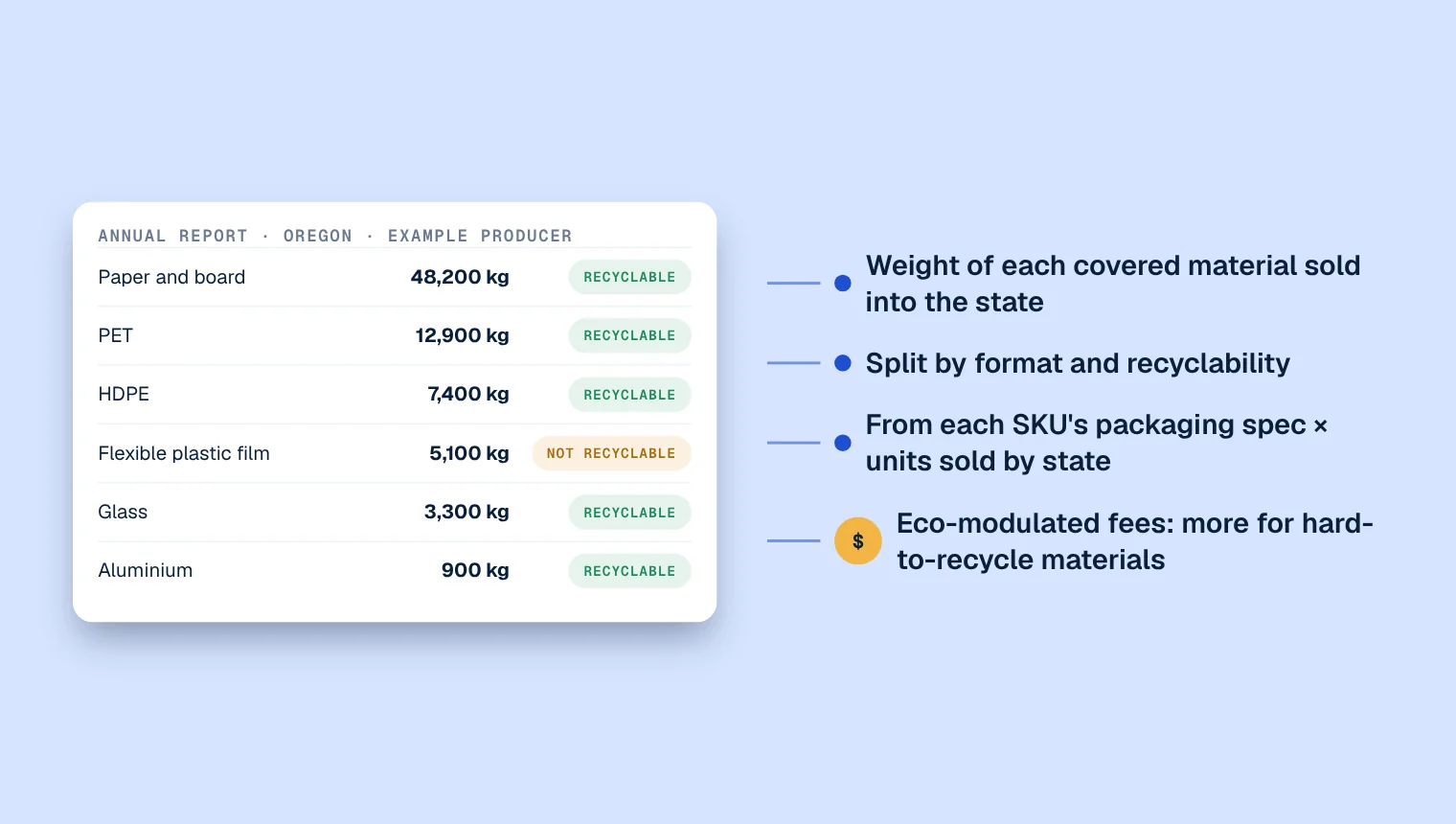
The unit of reporting is the weight of each covered material (paper, each plastic resin, glass, metals, and so on) sold into the state in the year, usually split by format and by whether the packaging is recyclable in the state's assessment. The data come from the packaging specification of each SKU and the units sold by state; a company that sells online into every state needs the breakdown by destination. The PRO uses the data to set each producer's share of the costs, with eco-modulated fees that charge more for materials that are hard to recycle and less for recycled content and reusable designs.
PFAS and other packaging restrictions
Several of the same states restrict intentionally added PFAS in food packaging and, increasingly, in other products, and California's SB 54 sets reduction targets for single-use plastic packaging. These rules sit beside the EPR duties, with their own dates, and are tracked product by product. See the federal PFAS reporting rule.
Where companies go wrong
- Assuming that joining the PRO in one state covers the others. Each state has its own registration and its own report.
- Claiming a small-producer exemption without checking each state's test, or without registering where registration is required to claim it.
- Reporting packaging weights from a national average instead of state sales.
- Missing that a Canadian brand's US importer or distributor can be the producer, and vice versa.
Sources
General information, not legal advice. Checked against the official sources above on 18 October 2026. Rules change: for your own products, ask for a spot-check.