- Extended producer responsibility for packaging and paper is provincial: Ontario, British Columbia, Quebec, Saskatchewan, Manitoba, Alberta, New Brunswick and others each have their own regulation, producer definition and reporting cycle.
- The producer is usually the brand owner with a presence in the province, otherwise the first importer or the retailer, in an order each regulation sets, and most provinces exempt small producers by revenue or tonnage.
- Ontario's Blue Box moved to full producer responsibility on 1 January 2026; Alberta's program started in 2025 with phase II from 1 October 2026; Quebec's modernised system now runs on deadlines from 2027 to 2030.
- The Federal Plastics Registry is a separate, federal report; the same packaging data, collected once, feeds every provincial report and the registry.
In Canada, the companies that put packaging and printed paper on the market pay for collecting and recycling it, under provincial extended producer responsibility (EPR) regulations. There is no national packaging EPR; each province decides whether to have a program, who the producer is, what materials are covered, how data are reported and who runs the system. A brand selling across the country therefore faces a patchwork of registrations, reports and fee schedules, and in 2026 that patchwork was still moving.
- AlbertaPackaging and paper EPR begins; phase II from 1 October 2026.
- OntarioBlue Box fully producer-run; the legacy program ended 31 December 2025.
- Annual reportsReporting season in several provinces and programs.
- QuebecAll institutions and businesses served under the modernised system.
- SaskatchewanFull EPR for household packaging and paper expected complete.
Who is the producer
Each regulation names the obligated producer in a hierarchy. The pattern is: the brand owner resident in the province (or in Canada), failing that the first importer into the province, failing that the retailer that supplied the consumer, with special rules for franchises and online marketplaces. Importers and distributors are often surprised to be the producer for brands made abroad. Most programs exempt small producers below a revenue threshold (Ontario's Blue Box, for example, uses a gross revenue test) or a tonnage threshold, but the exemption usually has to be claimed, and the numbers differ by province.
Province by province, as of October 2026
- Ontario: under the Resource Recovery and Circular Economy Act, the Blue Box program became fully producer-run on 1 January 2026, with the legacy Stewardship Ontario program wound up on 31 December 2025. Producers register with the Resource Productivity and Recovery Authority (RPRA), report the weight of Blue Box materials supplied each year, and meet their obligations through a producer responsibility organisation. A separate program covers hazardous and special products (solvents, paints, pressurised containers and others).
- British Columbia: the longest-running full EPR program for packaging and paper, run by Recycle BC under the Recycling Regulation; producers either join Recycle BC or submit their own plan, and report supply annually.
- Quebec: producers contribute through Éco Entreprises Québec. The modernised selective collection system has been revised: under a June 2026 order, all institutions and businesses must be served by 7 July 2027 and the residential sector by 1 April 2030, with some targets moved to 2030.
- Alberta: EPR for packaging and paper and for hazardous and special products started in 2025, with phase II extending services to all remaining communities from 1 October 2026; amendments in May 2026 narrowed the exclusion for flexible plastics.
- Saskatchewan: household packaging and paper is moving from shared responsibility to full EPR through SK Recycles, with completion expected by 1 February 2028.
- Manitoba: a transition to full producer responsibility led by Multi-Material Stewardship Manitoba is under consideration after consultation in early 2026.
- New Brunswick, Nova Scotia and the other provinces: programs exist or are being set up on their own timetables; check the tracker for the current state of each.
What a producer actually does
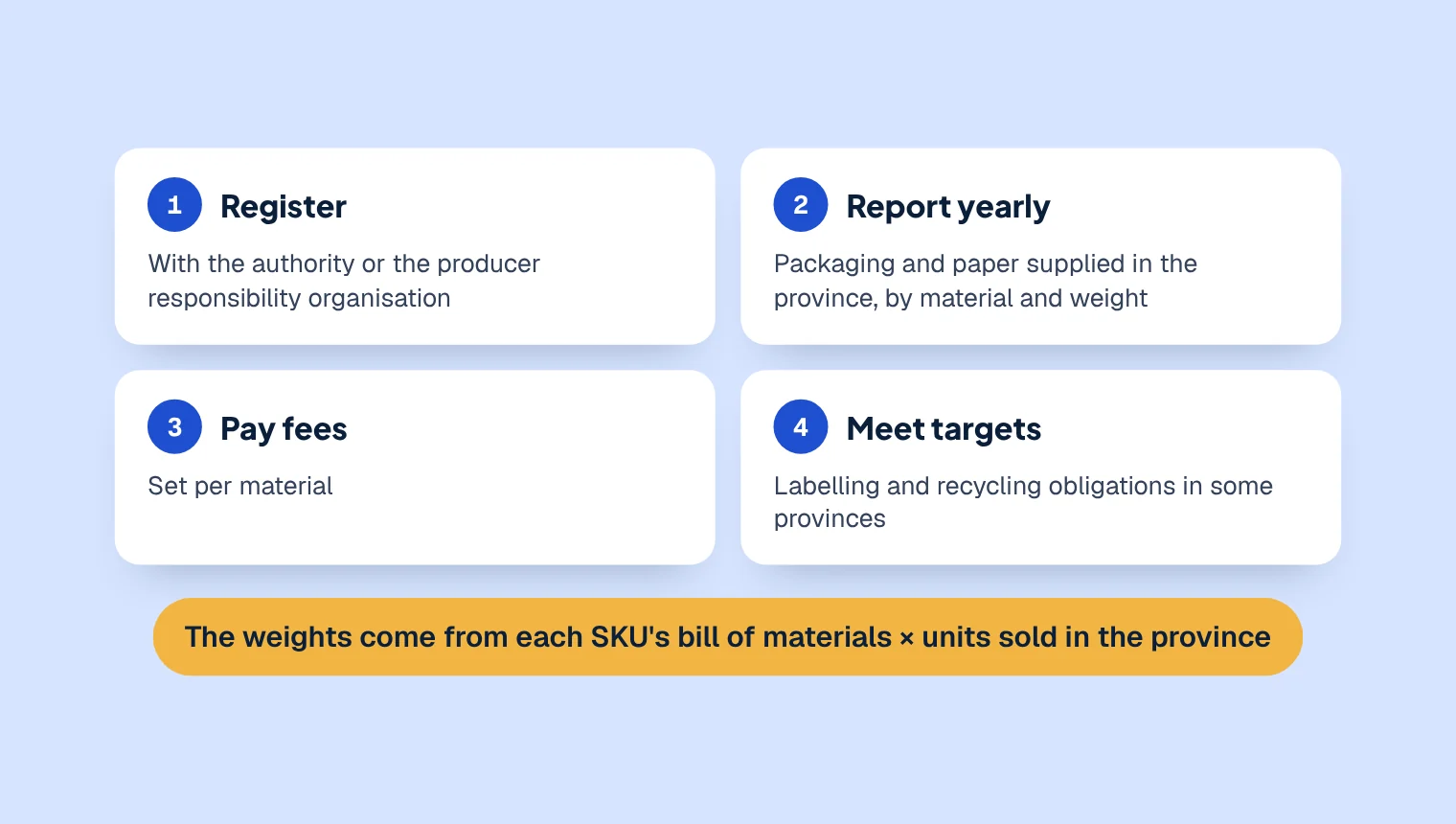
Registration with the authority or the producer responsibility organisation; a yearly report of the packaging and paper supplied in the province, by material category and weight; payment of fees set per material; and, in some provinces, obligations on labelling and on meeting recycling targets. The weight data come from the bill of materials of each SKU and the units sold in the province, which is why the same packaging data, collected once and kept current, serves every province and the federal registry.
The Federal Plastics Registry is separate
The federal report under CEPA covers plastic packaging and products placed on the whole Canadian market, with its own producer hierarchy, its 1,000 kg threshold and a 29 September deadline. It does not replace a provincial report and no provincial report replaces it. See Federal Plastics Registry: who must report, what to report and when.
Sources
General information, not legal advice. Checked against the official sources above on 18 October 2026. Rules change: for your own products, ask for a spot-check.