- Canada has no pre-market approval for cosmetics. You notify Health Canada within 10 days after the first sale, and amend the notification within 10 days of any change.
- Every ingredient is checked against the Cosmetic Ingredient Hotlist, which lists prohibited and restricted substances; the formula must also be safe in use.
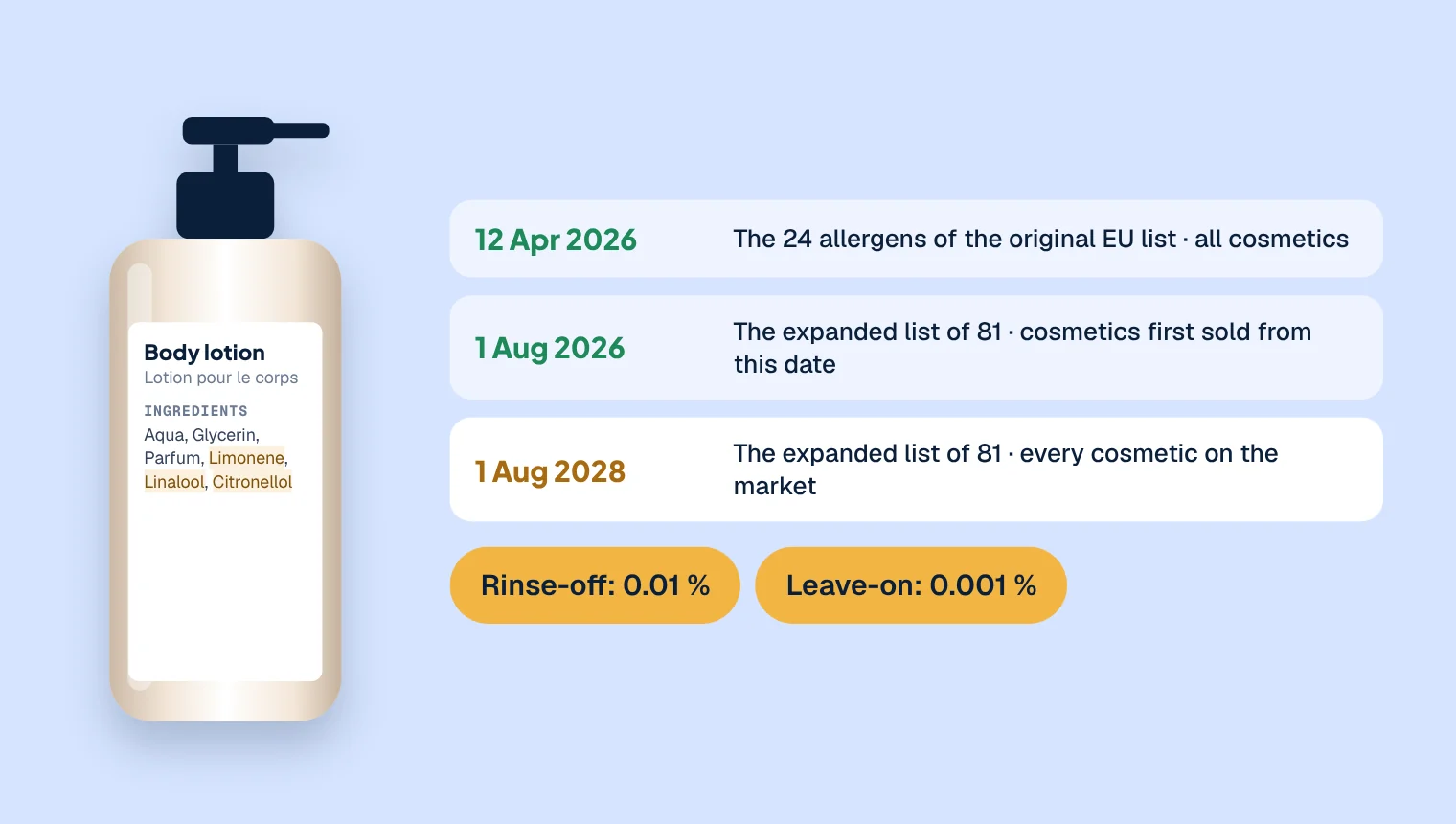
- Labels are bilingual and list ingredients by INCI name. Since 12 April 2026, fragrance allergens above 0.01% (rinse-off) or 0.001% (leave-on) are named individually; the list grows to 81 allergens for new products from 1 August 2026 and for all products from 1 August 2028.
- Since 5 March 2025 the notification needs a Canadian address: a brand with no Canadian company needs an authorised person in Canada.
In Canada, a cosmetic is any product used to clean, improve or alter the complexion, skin, hair or teeth, including deodorants and perfumes. It is regulated under the Food and Drugs Act and the Cosmetic Regulations, and Health Canada does not approve cosmetics before sale. Instead, the law puts the duties on the manufacturer or importer: a safe formula, a notification after the first sale and a compliant bilingual label. Products that make a therapeutic claim (sunscreens, anti-dandruff shampoos, antiperspirants, most acne products) are drugs or natural health products and follow a different road, so the first step is always to check which side of that line your product sits on.
- Amendments publishedCosmetic Regulations amended: fragrance allergens, Canadian address, digital contact.
- Canadian addressThe notification form requires a Canadian manufacturer or importer address.
- 24 allergensFragrance allergens above threshold named on all labels and in notifications.
- 81 allergens, new productsThe expanded list applies to cosmetics first sold from this date.
- 81 allergens, all productsThe expanded list applies to every cosmetic on the market.
The notification: within 10 days after first sale
The Cosmetic Notification Form (CNF) is filed online with Health Canada within 10 days after a cosmetic is first sold in Canada. It is not an approval: there is no fee and no review before sale, but selling is prohibited if the notification is incomplete after the 10-day window, or if a correction that Health Canada asks for is not provided within 10 days. The form names the product, its function and form, the manufacturer and importer, and every ingredient with its concentration or concentration range. Since 5 March 2025 it must give a Canadian address for the manufacturer or importer, so a brand with no company in Canada needs an authorised person here. A change of name, contact details or formula is notified as an amendment within 10 days, and a product that is withdrawn gets a discontinuation notice.
The Hotlist and the safety of the formula
Health Canada publishes the Cosmetic Ingredient Hotlist, a list of substances that are prohibited in cosmetics or restricted to certain concentrations, uses or warnings. It is an administrative tool that signals which ingredients Health Canada considers likely to breach the general prohibition on unsafe cosmetics in the Food and Drugs Act. Screening a formula means checking each ingredient against the Hotlist, confirming the concentration and use conditions, and keeping the evidence that the product is safe as sold: the supplier documentation, the preservative system and the stability data. The Hotlist is updated from time to time, so a formula that passed two years ago is worth checking again before a relaunch.
The label
Labels show the product identity, the net quantity, the name and Canadian address of the manufacturer or importer, directions and warnings where needed, and the list of ingredients by their INCI name in descending order of concentration (ingredients at 1% or less can be listed in any order after those above 1%). Mandatory text is bilingual, English and French; a single INCI name serves both languages when it is the same in each. Since the 2024 amendments, the inner label must also carry at least one form of digital contact, such as a website or email address.
Fragrance allergens, in three steps
Until 2026, "parfum" or "aroma" could hide every fragrance ingredient. The 2024 amendments align Canada with the EU approach: allergens above a threshold are named individually, after "Parfum" in the ingredient list. The threshold is 0.01% in rinse-off products and 0.001% in leave-on products, and the allergens can come from essential oils and botanical extracts as well as from a fragrance compound.
| From | Which allergens | Which products |
|---|---|---|
| 12 April 2026 | The 24 allergens of the original EU list | All cosmetics, new and existing |
| 1 August 2026 | The expanded list of 81 allergens | Cosmetics first sold in Canada from this date |
| 1 August 2028 | The expanded list of 81 allergens | Every cosmetic on the Canadian market |
The practical work is upstream: you need the concentration of each allergen in each fragrance from your fragrance supplier, then a calculation at the level of the finished product. The same allergens are declared individually in the notification.
Raw materials, SDSs and the shop floor
A finished cosmetic is excluded from WHMIS, so it does not need a safety data sheet. The raw materials and bulk products you buy and handle are not excluded: they are hazardous products like any other and need compliant SDSs and labels in the workplace. See when a product needs an SDS.
Where companies go wrong
- Notifying "when we get to it". The 10-day clock starts at the first sale, including the first online order shipped into Canada.
- Using a US or EU label as it is. The Canadian address, the bilingual text and the Canadian allergen dates all differ.
- Listing "parfum" alone after April 2026, or applying the 81-allergen list to an existing product too late.
- Calling a product a cosmetic when its claim makes it a drug. "Treats", "heals" and "SPF" change the regime entirely.
Sources
General information, not legal advice. Checked against the official sources above on 18 October 2026. Rules change: for your own products, ask for a spot-check.