- Every facility that manufactures or processes cosmetics for the US market registers with the FDA, renews every two years, and registers within 60 days of starting.
- Every cosmetic product is listed with the FDA, with its ingredients; new products within 120 days of entering the market, and changes within 60 days.
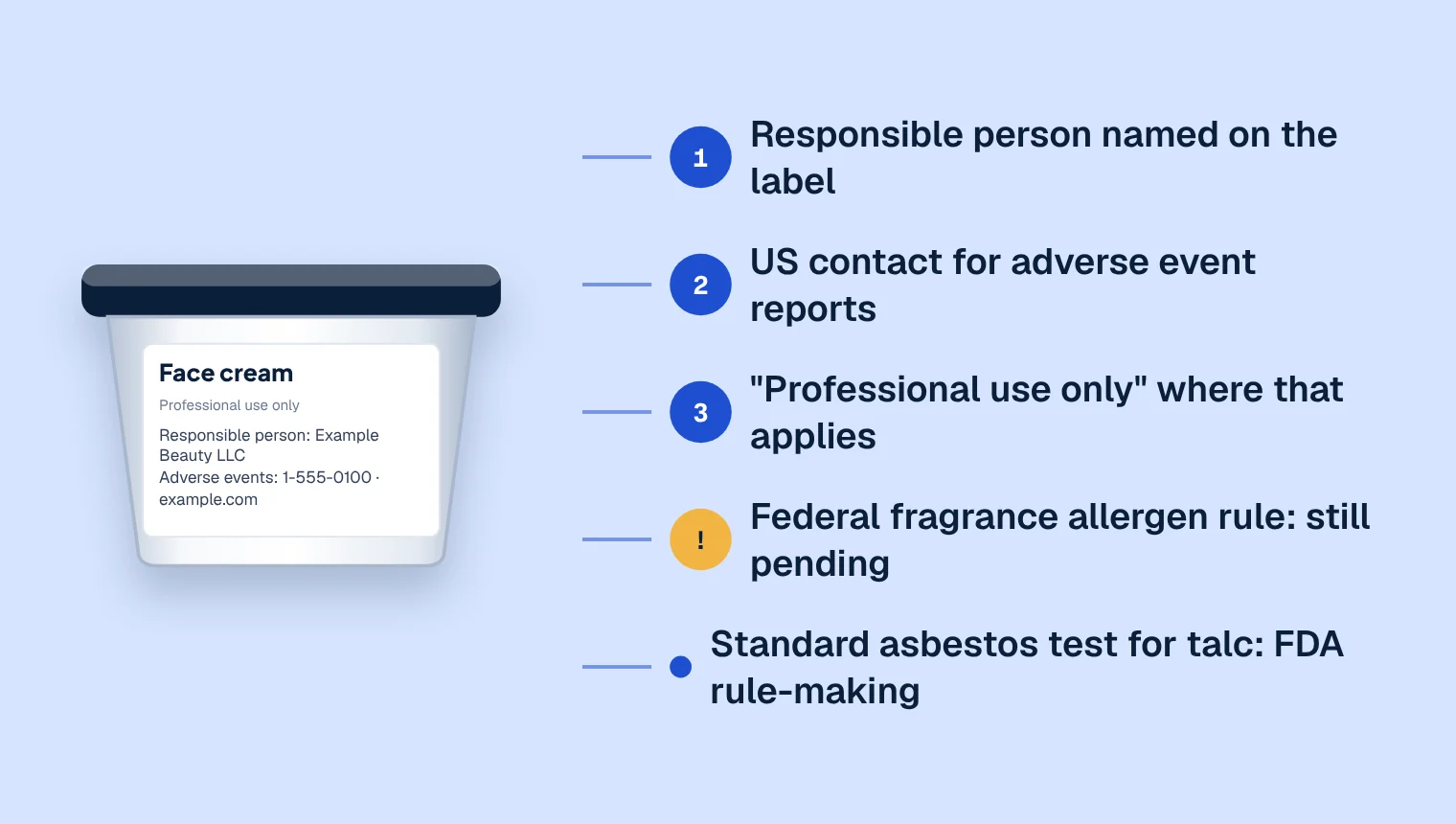
- The responsible person named on the label must hold safety substantiation for each product and report serious adverse events to the FDA within 15 business days.
- Small businesses under US$1 million in average annual sales are exempt from registration, listing and GMP, but not from safety substantiation or adverse event reporting.
For eighty years, the FDA could not require a cosmetics company to register, list a product or report an injury. The Modernization of Cosmetics Regulation Act of 2022 (MoCRA) changed that. It applies to every cosmetic sold in the United States, imported or domestic, and most of its duties fall on the responsible person: the manufacturer, packer or distributor whose name appears on the label. If your brand is on the label, you are the responsible person, wherever the product is made.
- MoCRA signedPart of the Consolidated Appropriations Act, 2023.
- Registration and listingStatutory date; the FDA exercised discretion until 1 July 2024.
- Existing products listedFacilities registered and existing products listed in Cosmetics Direct.
- Allergen rule dueStatutory date for the fragrance allergen rule, missed; a proposal is expected.
- RenewalsFirst two-year renewal of facility registrations.
Facility registration
Every establishment that manufactures or processes a cosmetic for the US market registers with the FDA through the Cosmetics Direct portal, including foreign facilities, which must also name a US agent. A new facility registers within 60 days of starting operations; registrations are renewed every two years; a material change is updated within 60 days. A contract manufacturer registers its own facility; the brand that uses it does not register the plant, but must know the facility's registration number to list its products.
Product listing
The responsible person lists each cosmetic product: the name, the category, the facility where it is made and its ingredients, including fragrance and flavour ingredients. Products already on the market by the statutory date were due by 1 July 2024; a new product is listed within 120 days of entering interstate commerce, and listings are updated within 60 days of a change. A flexible listing can cover several colours or sizes of one formulation.
Safety substantiation
MoCRA does not require a safety report in a set format, but the responsible person must hold adequate evidence that each product is safe: tests, studies, analyses or other information that qualified experts would accept as sufficient. In practice, this is the same file a European safety assessor builds: ingredient toxicology, concentration limits, stability and preservative efficacy, and the history of use of the formula. The file is not filed, but it must exist and be available to the FDA.
Adverse events
The label must carry a domestic address, phone number or electronic contact where adverse events can be reported. A serious adverse event (death, hospitalisation, disfigurement, a significant intervention, and similar outcomes) is reported to the FDA within 15 business days of receipt, with follow-up information within a year. Records of every adverse event, serious or not, are kept for six years (three for most small businesses).
Labels and talc
Beyond the contact details, products for professional use only must say so on the label, and MoCRA directs the FDA to set a fragrance allergen labelling rule and a standard test for asbestos in talc. The allergen rule missed its statutory date of 29 December 2025; until a final rule applies, there is no federal allergen disclosure in the US, although California's own requirements apply there. Expect the US list to follow the EU and Canadian lists when it comes, so a brand selling in all three markets should calculate allergens once and label for each.
Who is exempt
A business whose average gross annual sales of cosmetics over the previous three years are under US$1 million is exempt from facility registration, product listing and the coming good manufacturing practice rule, unless it makes higher-risk products: those that regularly contact the eye's mucous membrane, that are injected, intended for internal use, or that alter appearance for more than 24 hours. The exemption never covers safety substantiation or adverse event reporting.
Still to come
The GMP rule, the fragrance allergen rule and the talc test method were all overdue in October 2026. The duties above are already in force and are inspected; the sensible plan is to work to ISO 22716 for GMP now, so that the rule, when it comes, changes little.
Sources
General information, not legal advice. Checked against the official sources above on 18 October 2026. Rules change: for your own products, ask for a spot-check.