- Every cosmetic on the EU market has a Responsible Person established in the EU, who answers for its safety, its file and its notification. A manufacturer outside the EU appoints one in writing.
- The product is notified in the Cosmetic Products Notification Portal (CPNP) before it is placed on the market; Great Britain has its own portal, the SCPN, and needs a UK-based Responsible Person.
- The product information file holds the safety report (CPSR), the manufacturing method, proof of claims and the animal testing data, and is kept for 10 years after the last batch.
- Fragrance allergen labelling expanded to 80-plus allergens: products placed on the market from 31 July 2026 must comply, and non-compliant stock can be sold until 31 July 2028.
Regulation (EC) No 1223/2009 sets one rule book for cosmetics in all 27 Member States (and, through the EEA, in Norway, Iceland and Liechtenstein). There is no pre-market approval, but three things must exist before the first unit is sold: a Responsible Person, a notification and a product information file. Great Britain kept a copy of the Regulation at the end of 2020 and now runs it separately, so a brand selling in both needs two of each.
- Regulation appliesRegulation (EC) 1223/2009 replaced the 1976 Directive.
- Great Britain separatesUK cosmetics regulation and SCPN notification for GB; Northern Ireland stays with the EU.
- Allergens, placingProducts placed on the EU market must show the expanded allergen list.
- Allergens, saleEnd of sale for products without the expanded allergen labelling.
The Responsible Person
Only a cosmetic for which a legal or natural person established in the EU has been designated as the Responsible Person may be placed on the market. For a product made in the EU, that is the manufacturer by default; for an imported product, the importer; and a manufacturer or importer can appoint another EU company by written mandate. The Responsible Person keeps the product information file, makes the notification, ensures the label and claims comply, reports serious undesirable effects, and acts when a product is unsafe. Hazline does not act as a Responsible Person; we prepare the file, the safety assessment inputs and the labels for the one you appoint.
The notification (CPNP)
Before a product is placed on the market, the Responsible Person notifies it in the CPNP: the product category, the name, the Responsible Person and the Member State of first placing, the frame formulation or composition, the label and, for nanomaterials, additional data six months in advance. The notification is free and immediate, and is the key that lets poison centres and authorities identify the product. It is not a review: the duty to have a safe product and a complete file is separate.
The product information file and the safety report
The product information file (PIF) is kept at the Responsible Person's address for 10 years after the last batch was placed on the market. It contains the product description, the cosmetic product safety report (CPSR), the manufacturing method and a statement of compliance with good manufacturing practice (ISO 22716), proof of the effects claimed, and data on animal testing. The CPSR has two parts: the safety information (quantitative composition, physical and chemical characteristics, stability, microbiological quality, impurities and packaging, normal and foreseeable use, exposure, the toxicological profile of each substance, undesirable effects) and the safety assessment, signed by an assessor with a qualification in pharmacy, toxicology, medicine or a similar discipline.
Ingredients and the annexes
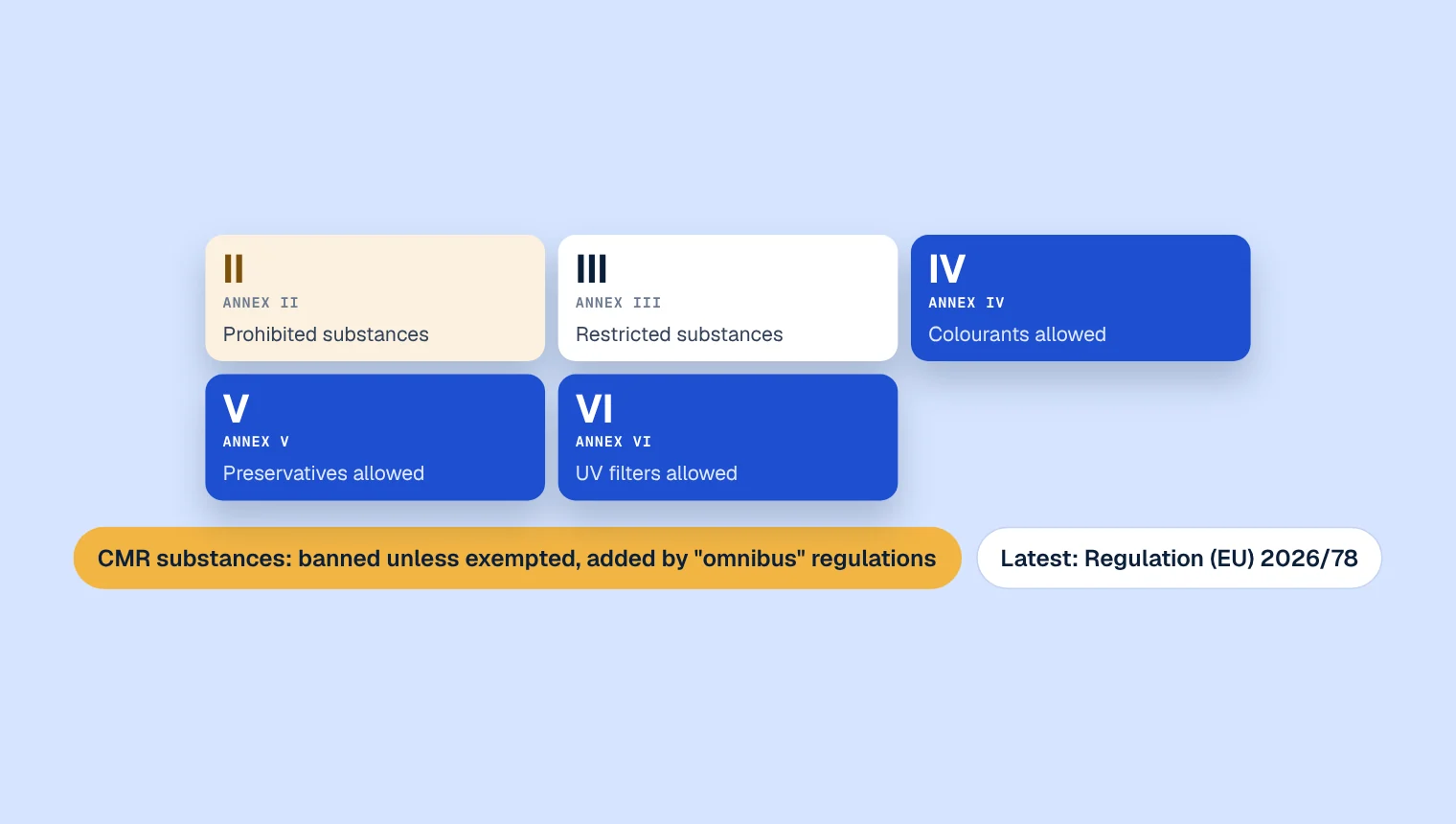
The annexes to the Regulation list prohibited substances (Annex II), restricted substances (Annex III) and the positive lists of colourants, preservatives and UV filters (Annexes IV to VI). Substances classified as carcinogenic, mutagenic or toxic for reproduction under CLP are banned in cosmetics unless a specific exemption is granted, and the Commission adds them to Annex II in periodic "omnibus" regulations (Regulation (EU) 2026/78 is the latest, after 2025/877). Each omnibus has its own dates for placing on the market and for sell-through, so an ingredient that is fine this year can be out next year. Screening a formula therefore means checking the annexes as they stand today and the omnibus texts already adopted for the next dates.
Fragrance allergens
Regulation (EU) 2023/1545 expanded the list of fragrance allergens that must be named individually on the label from 26 to over 80. Products placed on the market from 31 July 2026 must comply, and products already on the market can be sold until 31 July 2028. The thresholds stay at 0.001% in leave-on and 0.01% in rinse-off products. Canada adopted the same expanded list on a slightly different timetable (see cosmetics in Canada), so one allergen calculation serves both markets.
Great Britain
Since 1 January 2021, Great Britain applies the UK Cosmetics Regulation, a retained copy of the EU text. Products need a Responsible Person established in the UK and are notified through the Submit Cosmetic Product Notifications (SCPN) service of the Office for Product Safety and Standards, with the same product information file kept in Great Britain. The two regimes have started to drift: Great Britain banned TPO in cosmetics from 15 August 2026, with sell-through to 14 February 2027, on its own timetable, and its allergen and CMR updates follow their own dates. Northern Ireland continues to follow the EU Regulation.
Sources
- EUR-Lex: Regulation (EC) No 1223/2009 on cosmetic products
- European Commission: cosmetics legislation
- European Commission: Cosmetic product notification portal (CPNP)
- EUR-Lex: Regulation (EU) 2023/1545 (fragrance allergen labelling)
- GOV.UK: Submit cosmetic product notifications to the Office for Product Safety and Standards
General information, not legal advice. Checked against the official sources above on 18 October 2026. Rules change: for your own products, ask for a spot-check.