Canadian manufacturers and formulators
New products, reformulations, or labels nobody has checked in years.
Hazline Regulatory, an SDS consultancy in Ottawa, Canada, writes WHMIS supplier labels in English and French together with your safety data sheet, from the same classification, for one product or a whole range. A hazardous product sold or imported for use in a Canadian workplace needs a supplier label that meets the Hazardous Products Regulations, in both official languages. We write the label text from the same classification as your SDS, so the two always agree, and a regulatory specialist signs off both.
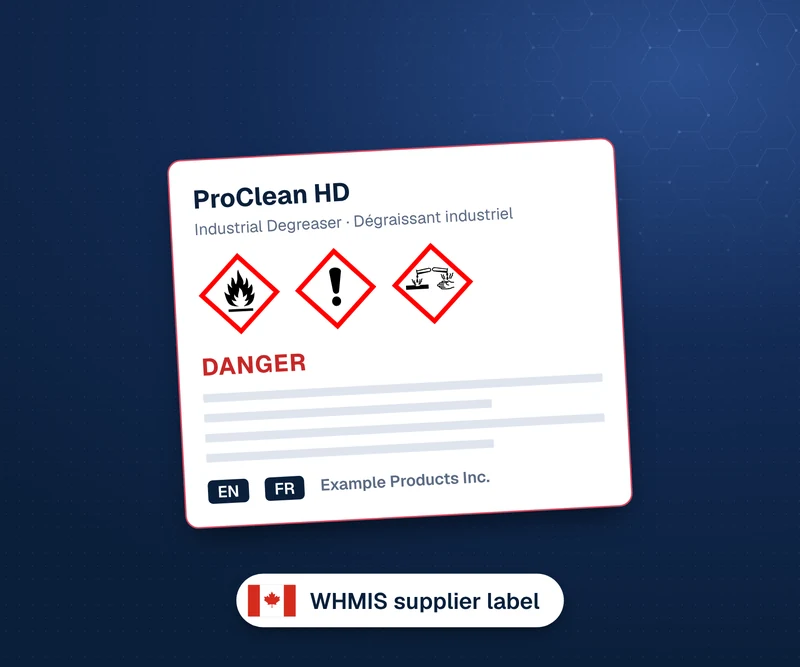
The list of required content is short, but the rules on it are strict, and an inspector visiting your customer reads the label first.
Product identifier, the Canadian manufacturer or importer, pictograms, signal word, hazard statements and precautionary statements, plus any supplemental information the classification calls for. The pictogram, signal word and hazard statement are grouped together.
Learn moreEvery element in both official languages, on one bilingual label or in two unilingual parts. An English-only label does not comply in any province, not only in Quebec.
Learn moreNormally the Canadian manufacturer or importer. A distributor may put its own name, address and phone number in place of the initial supplier, and an importer using the product in its own workplace may keep the foreign supplier on the label.
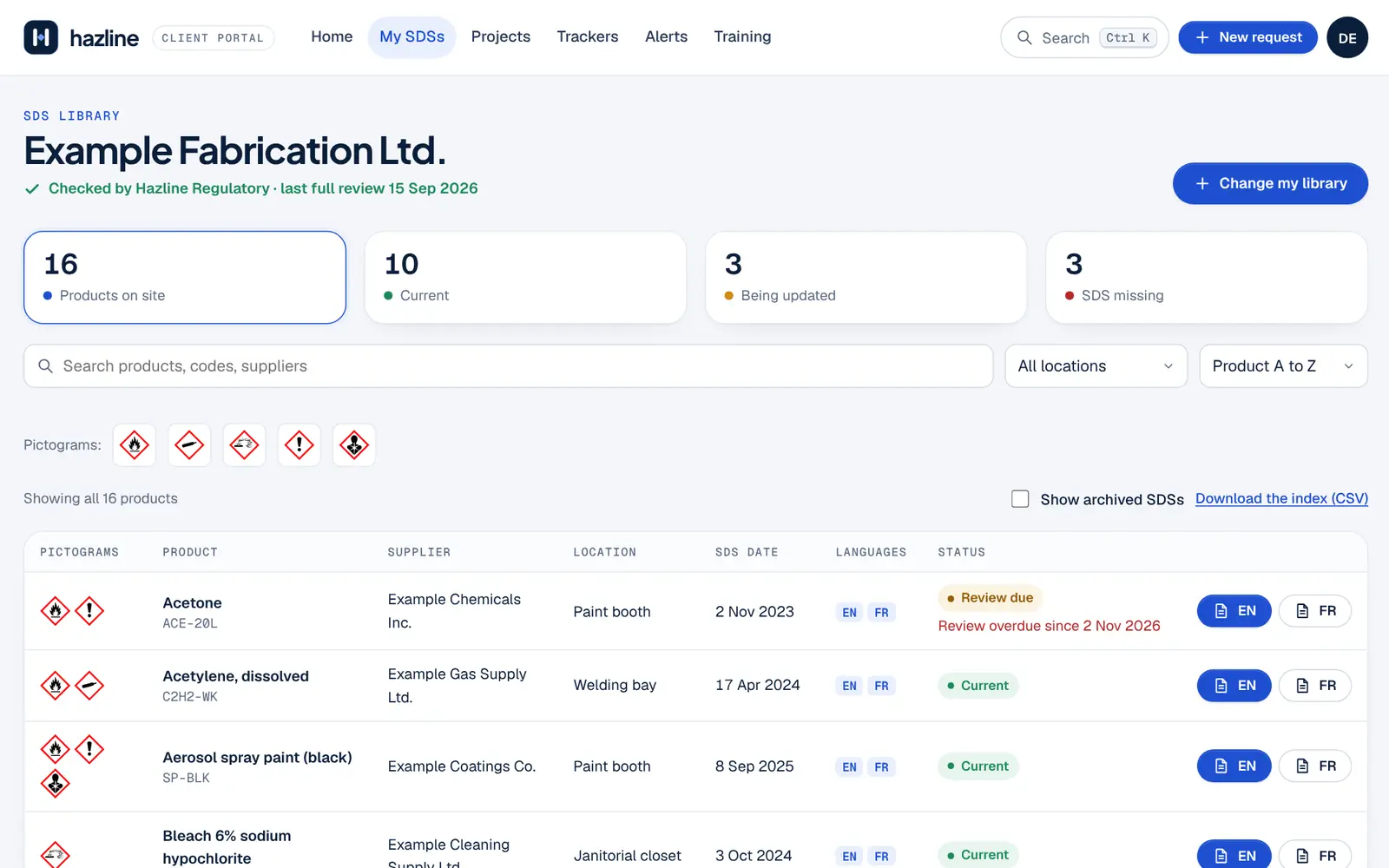
Learn moreThe pictograms, signal word and statements must match section 2 of the SDS. When significant new hazard data comes in, the label has to be updated within 180 days and the SDS within 90, with buyers given the changes in writing meanwhile.
Learn moreSend the full formula, under your non-disclosure agreement if you prefer, with the raw-material SDSs, your current SDS and label if you have them, and your container sizes. We classify the product under the Hazardous Products Regulations, write the SDS and the label text in English and French from that one classification, choose the pictograms and statements, and set out what changes for containers of 100 mL or less and for outer packaging. A regulatory specialist signs off the SDS and the label text, and you receive them in your portal, ready for your designer or printer. You get a written, fixed quote within two business days.
New products, reformulations, or labels nobody has checked in years.
Foreign labels brought up to WHMIS, with your company as the Canadian supplier.
Your own name on the label in place of the initial supplier, done the right way.
English-only labels turned into bilingual WHMIS labels for your Canadian customers.
Illustrative scopes, not client results; every project is quoted on its own.
Starting point. Twelve products with labels printed years ago, English on the front and French on a separate sticker, and a customer asking whether they are current.
What we do. Each label checked against the SDS and the Hazardous Products Regulations, the classification redone where the SDS was out of date, and new bilingual label text written where it was needed.
What you receive. A short list of what was wrong on each label, signed-off label text for the products that needed it, and matching SDSs.
Starting point. European labels and SDSs from the manufacturer, and the first shipment to Canada already booked.
What we do. Each product classified under the Hazardous Products Regulations, the importer named as the Canadian supplier, English and French label text written, and the small-bottle version set out for the 100 mL size.
What you receive. Bilingual WHMIS SDSs and label text for every product, signed off before the shipment arrives.
Not as it is. A WHMIS supplier label must be in English and French, name the Canadian manufacturer or importer, and show the pictograms and statements from a classification made under the Hazardous Products Regulations. Much of the content can carry over, but it has to be checked and completed.
Containers of 100 mL or less may leave out the hazard and precautionary statements, but they still need the product identifier, the supplier identifier, the pictograms and the signal word. On containers of 3 mL or less, if a label would get in the way of normal use, it can be one that comes off during use, as long as it stays legible during transport and storage.
Not if the label on the inner container can be read through the outer one, or if the outer container carries a label that meets the Transportation of Dangerous Goods Regulations.
No. The supplier label goes on the product you sell or import. Workplace labels are the employer's duty under provincial, territorial or federal health and safety law, for products made on site, poured into another container, or whose supplier label is lost or unreadable. This page is about supplier labels.
We write the label content in English and French and choose the pictograms, signal word and statements. Your designer or printer produces the artwork from it.
The full formula with CAS numbers and percentages, the raw-material SDSs, your current SDS and label if you have them, the container sizes and the Canadian supplier's details. The fee is fixed per product, set by the number of products, how complex the formula is and how complete your data are, and quoted in writing within two business days. From complete data, it takes about 10 business days on the standard route and about 5 on the fast track.
The six elements every WHMIS supplier label needs, the English and French and layout rules, small-container exemptions, and when a workplace label is needed instead.
Read article
Yes. WHMIS requires every SDS and supplier label to be in both official languages. What counts as bilingual, how the two versions must be delivered, and how to keep the French accurate.
Read article
Nine GHS pictograms, plus one used only in Canada. What each symbol covers, which markets require it, and the precedence rules that decide which ones appear together.
Read articleSend one SDS for a free spot-check. A specialist replies with a short written summary within one business day.