- WHMIS training is an employer duty under provincial, territorial or federal health and safety law, not under the Hazardous Products Act.
- Workers who handle or may be exposed to hazardous products need general WHMIS education plus training on the products and procedures of their own workplace.
- Federal workplaces and most provinces we checked require the program to be reviewed at least once a year; Alberta sets no interval.
- No WHMIS law issues a certificate or sets an expiry date, and a generic online course does not replace workplace-specific training.
Yes, WHMIS training is mandatory for every worker who works with a hazardous product or may be exposed to one at work. The duty sits with the employer. It comes from the occupational health and safety law of the province or territory where the work is done, or, for federally regulated workplaces, from Part X of the Canada Occupational Health and Safety Regulations. The training has to cover the products and procedures of your own workplace, and in most jurisdictions the program must be reviewed at least once a year.
There is no national WHMIS certificate with an expiry date. What an inspector looks for is a program: general education, training specific to the workplace, a regular review, and evidence that workers can use what they were taught.
Who sets the WHMIS training rules?
WHMIS has two halves. The Hazardous Products Act and the Hazardous Products Regulations, administered by Health Canada, apply to suppliers: they set what goes on the label and the safety data sheet (SDS) of a product sold or imported for workplace use. They do not deal with training.
The employer half, including education and training, is set by each province and territory in its health and safety law, and by the Canada Labour Code and the Canada Occupational Health and Safety Regulations (COHSR) for federally regulated employers. The rules are close to one another but not identical, so always work from the rules of the jurisdiction where your workers are.
Who needs WHMIS training?
Every worker who handles a hazardous product, is exposed to one, or is likely to be. The federal rules also name workers who install, operate, maintain or repair piping and equipment that carries hazardous products. In practice this reaches well beyond the people who mix or pour chemicals: maintenance staff, cleaners, shipping and receiving, and anyone who works next to a process that uses hazardous products.
What is the difference between WHMIS education and training?
The Canadian Centre for Occupational Health and Safety (CCOHS) separates the two:
- Education is general knowledge that a worker can carry from job to job: how WHMIS works, the hazard classes, and what labels and SDSs contain.
- Training is specific to the workplace and the job: the products actually used, where the SDSs are kept, and the site's own procedures for storage, handling, use, disposal, spills and emergencies.
Both are required. British Columbia's regulation says training must be specific to the workplace (section 5.7(2)), and Ontario's says the program must be developed and implemented for the workplace (Regulation 860, section 7(2)).
What must WHMIS training cover?
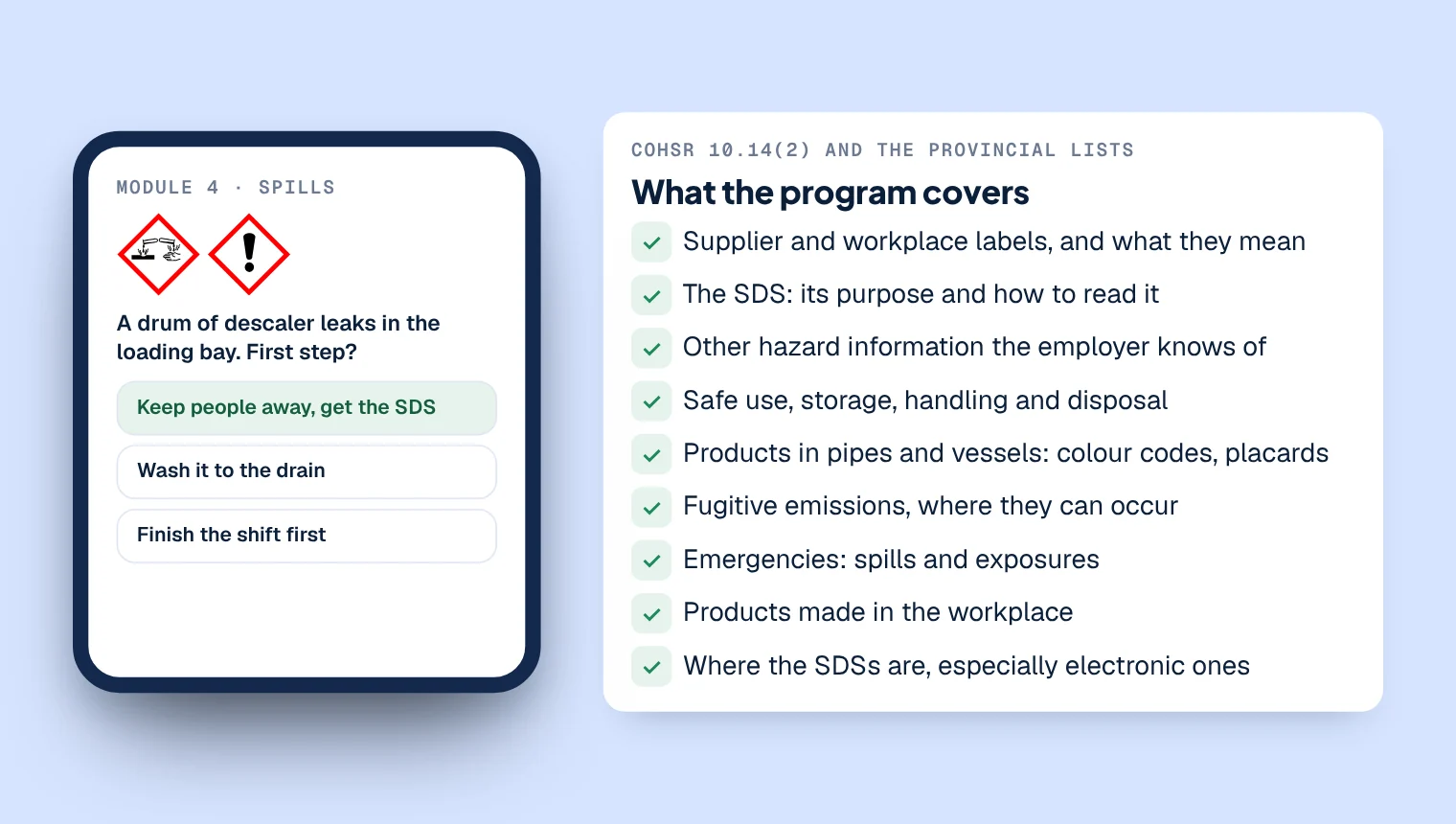
The wording differs by jurisdiction, but the federal list in COHSR section 10.14(2) and the provincial lists we checked cover the same ground:
- the information on supplier and workplace labels, and what it means;
- the information on the SDS, and its purpose and significance;
- any further hazard information the employer knows of, or ought to know of;
- procedures for the safe use, storage, handling and disposal of hazardous products;
- procedures for products in pipes, process vessels and other systems where there is no label, and what the colour codes or placards mean;
- procedures for fugitive emissions, where they can occur;
- procedures to follow in an emergency, including spills and exposures;
- hazardous products made in the workplace, with their workplace labels and SDSs;
- how to reach the SDSs, especially when they are kept electronically.
How often is WHMIS training required?
The rules mostly set a review of the program, not a fixed retraining date. A review looks at whether the training still matches the products, procedures and hazard information in the workplace. As of October 2026:
| Jurisdiction | Review rule | Provision |
|---|---|---|
| Federally regulated workplaces | At least once a year, when conditions change, and when new hazard information becomes available | COHSR s. 10.14(3) |
| British Columbia | WHMIS program reviewed at least annually, or more often if conditions or hazard information change | OHS Regulation s. 5.5 |
| Alberta | No set interval: Alberta's guidance says the law does not specify how often training is given | OHS Code, Part 29 |
| Ontario | Reviewed at least once a year with the joint committee or representative, and more often if circumstances change | OHS Act s. 42(3) and (4) |
| New Brunswick | At least annually, or more often if conditions or hazard information change | N.B. Reg. 2016-6, s. 7(4) |
| Nova Scotia | At least annually, or more often if conditions or hazard information change | Workplace Health and Safety Regulations, s. 3.5(5) |
| Prince Edward Island | At least annually, and more often if conditions or hazard information change | WHMIS Regulations, s. 5(5) |
| Newfoundland and Labrador | At least annually, or more often if conditions or hazard information change | WHMIS Regulations, 2018, s. 6(4) |
| Yukon | At least annually, or more often if conditions or hazard information change | WHMIS Regulations, s. 5(4) |
Saskatchewan, Manitoba, Quebec, the Northwest Territories and Nunavut have their own provisions; check the current text of your regulation. In Quebec, the French version is the authoritative one.
A review does not always mean everyone sits the course again. Retraining is needed when the review finds gaps, when new products arrive, when a product's hazards or safe-use information change, or when procedures change. Even in Alberta, where no interval is set, a yearly review is a sensible default.
Does a WHMIS certificate expire?
Not in law. None of the WHMIS rules above requires workers to hold a certificate or card, and none sets an expiry date for one; Alberta's guidance says plainly that workers do not need to be "certified". An expiry date printed on a course certificate is the course provider's policy. The legal test is whether the worker has been educated and trained for the products in your workplace, and whether your program has been reviewed when the rules require.
When someone joins from another employer, CCOHS notes that the employer decides whether their general education needs repeating. The workplace-specific training is always needed, because it is about your site.
Is a generic online WHMIS course enough?
No. An online course can deliver the general education part well. It cannot show a worker your labels, your SDS binder or terminal, your decanting rules, your spill kit or your emergency procedures. Use the course for education, then add a short, documented session on the products and procedures of your workplace.
Do you have to test workers and keep training records?
Several jurisdictions expect the training to work, not just to happen. British Columbia requires worker knowledge to be evaluated periodically, for example by written tests or practical demonstrations (section 5.5). Ontario requires the employer to ensure, so far as is reasonably practicable, that the program lets workers use the information to protect their health and safety (Regulation 860, section 7(3)).
Ontario's guide notes that there is no specific record-keeping requirement for WHMIS training, and the rules elsewhere vary. The federal rules refer to records of the education and training given and require workers to be shown how to reach them. Whatever your jurisdiction, a simple record of who was trained, on what, when and by whom is the easiest way to show an inspector that the program exists.
How Hazline can help
Hazline's WHMIS for workers video course covers the general education part: ten short lessons, a quiz after each, a final exam and a certificate for each person who passes, at one price per company. The workplace-specific part, on your own products, labels and procedures, stays with you as the employer. Training only works if the SDSs it points to are current, which is what our SDS library service looks after. Book a free call, or send us a few SDSs for the free SDS spot-check.
Sources
- Justice Laws: Canada Occupational Health and Safety Regulations (SOR/86-304), Part X
- CCOHS: WHMIS, education and training
- Ontario: WHMIS and the employer (guide to the legislation)
- WorkSafeBC: OHS Regulation, Part 5 (chemical and biological substances)
- Government of Alberta: WHMIS 2015 for employers
- Nova Scotia: Workplace Health and Safety Regulations, Part 3 (WHMIS)
General information, not legal advice. Checked against the official sources above on 19 October 2026. Rules change: for your own products, ask for a spot-check.