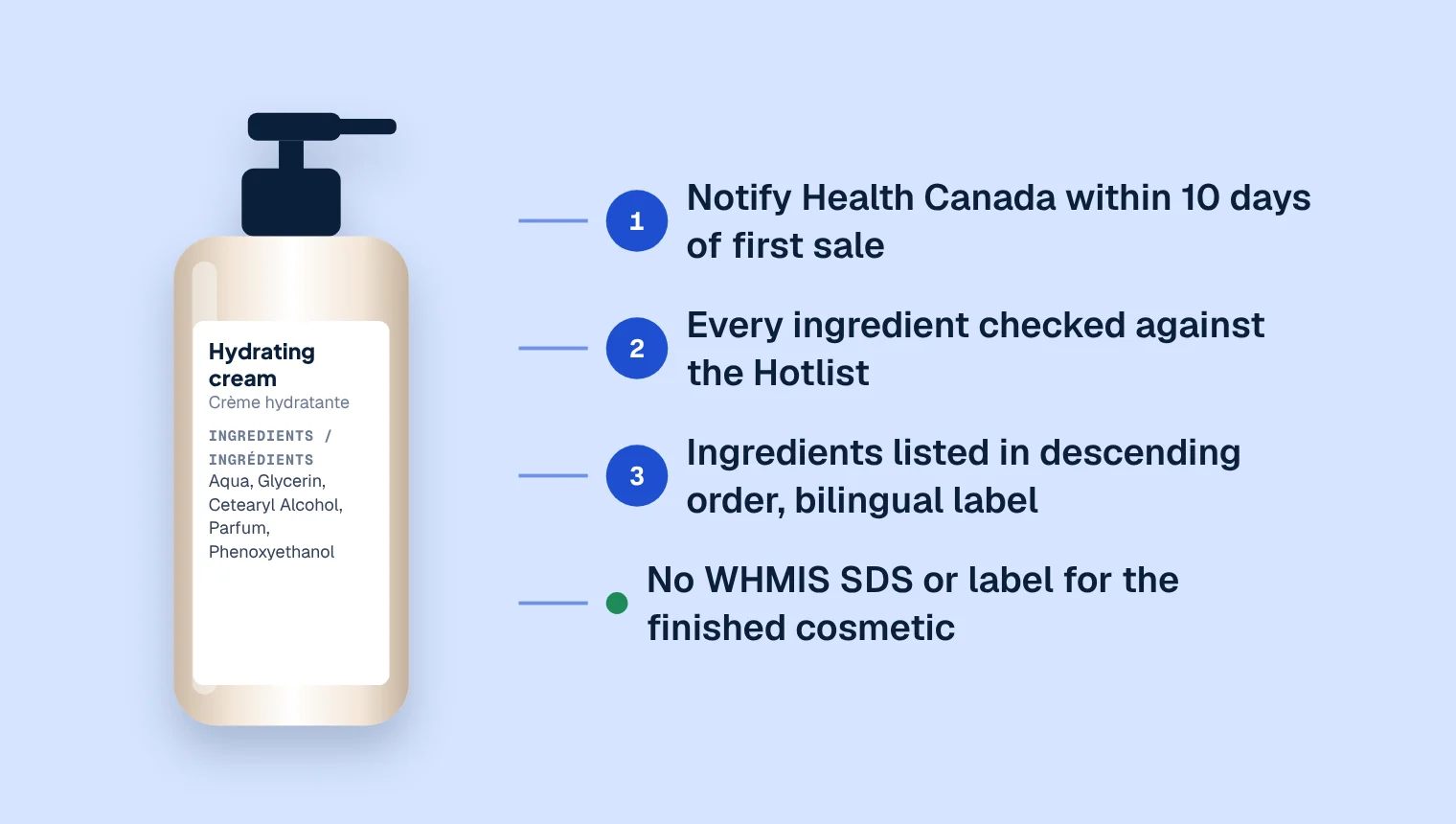
- A cosmetic, as defined in the Food and Drugs Act, is listed in Schedule 1 to the Hazardous Products Act, so the supplier does not need a WHMIS label or SDS for it.
- The exclusion follows the definition of a cosmetic. Hazardous raw materials sold to a cosmetic manufacturer are sold for use in a workplace and need WHMIS labels and SDSs.
- Salon and spa products are still cosmetics, so no WHMIS SDS is required from the supplier, but the employer must still train workers who use them.
- In the US, OSHA exempts cosmetics packaged for retail sale to consumers, not professional products used at work.
Mostly no. Cosmetics are excluded from the supplier side of WHMIS: Schedule 1 to the Hazardous Products Act lists "any cosmetic, device, drug or food, as defined in section 2 of the Food and Drugs Act", and products in Schedule 1 are outside Part II of the Act (section 12(j)). So a company that sells a cosmetic does not need a WHMIS label or a WHMIS safety data sheet (SDS) for it, even if the formula would meet a hazard class.
That is not the end of it. The exclusion does not reach the hazardous raw materials a cosmetic is made from, and it does not take away the employer's duty to train workers who use cosmetic products on the job. Cosmetics follow their own rules instead, under the Cosmetic Regulations.
Why are cosmetics excluded from WHMIS?
WHMIS has a supplier half and an employer half. The supplier half is the Hazardous Products Act (HPA) and the Hazardous Products Regulations: section 13 of the HPA requires a supplier who sells a hazardous product for use, handling or storage in a Canadian workplace to have a compliant SDS, give it to the buyer and label the product. Section 12 then switches Part II off for certain products, including everything listed in Schedule 1. The schedule covers pest control products, explosives, cosmetics, devices, drugs and food, consumer products, and wood. These products are regulated under other federal laws, which set their own labels and safety rules.
The Food and Drugs Act defines a cosmetic as "any substance or mixture of substances manufactured, sold or represented for use in cleansing, improving or altering the complexion, skin, hair or teeth", including deodorants and perfumes. If your product meets that definition, the WHMIS supplier rules do not apply to it. If it makes a therapeutic claim and is really a drug or natural health product, it is still excluded, as a drug under the same Schedule 1 item, but the Cosmetic Regulations no longer apply.
Do cosmetic raw materials need a WHMIS SDS?
Yes, if they are hazardous. The exclusion is tied to the definition of a cosmetic, not to the industry. A drum of solvent, a fragrance compound, a preservative or a surfactant concentrate sold to a cosmetic manufacturer is sold as a raw material for use in a workplace, not for use on skin. When it is classified in a WHMIS hazard class, it is a hazardous product, and the supplier or importer must provide a WHMIS SDS and supplier label under section 13 of the HPA. We found no Health Canada guidance that extends the cosmetic exclusion to ingredients.
| What is sold | WHMIS supplier label and SDS? |
|---|---|
| Finished cosmetic sold to shops or consumers | No: Schedule 1 exclusion |
| Finished cosmetic sold to salons and spas | No: still a cosmetic under the Food and Drugs Act |
| Hazardous ingredient sold to a cosmetic manufacturer | Yes: a hazardous product for workplace use |
| Hazardous ingredient imported by a manufacturer for its own plant | Yes: an employer that imports for its own workplace counts as a supplier |
One case is less clear-cut: a finished formula sold in bulk to a contract filler. Whether it is already "a cosmetic" depends on how it is made, sold and represented. If you are relying on the exclusion for a bulk product, get a written position before you stop sending an SDS, because your customer's workers handle it in volume every day.
Are salon and professional cosmetics covered by WHMIS?
A professional product does not stop being a cosmetic because a hairdresser or an esthetician applies it. The definition looks at what the product is for, not who uses it, and Health Canada's labelling guide notes that the Food and Drugs Act and Cosmetic Regulations govern cosmetics applied by cosmeticians and hairdressers to their clients. So the supplier of a professional hair colour or nail product does not owe a WHMIS SDS under the HPA. The salon owner, as an employer, still has duties, which is the next question.
What do employers owe workers for excluded products?
The employer half of WHMIS sits in provincial, territorial and federal health and safety law, and the exclusion there is narrower. CCOHS sums it up: a product may be exempt from the WHMIS label and SDS requirements, but "employers must still provide education and training on health effects, safe use, and storage". Two provinces show how the law is written:
- Ontario. Regulation 860, section 4(2)(b), switches off only the supplier label, laboratory sample and SDS sections (sections 8, 14, 17 and 18) for a cosmetic, device, drug or food. The ministry's guide adds that if these products are used, handled or stored at a workplace, the employer is still required to train workers who are or may be exposed, so that they understand the existing labels and use the products safely.
- British Columbia. OHS Regulation section 5.3(2) likewise disapplies only "the provisions concerning a supplier label and SDS" for products under the Food and Drugs Act. The rest of the WHMIS requirements in sections 5.4 to 5.18, including education and training, are not excluded.
Other jurisdictions word this differently, so check your own regulation. In practice, a salon, spa or cosmetics plant should keep a list of the products in use, ask suppliers for whatever safety information they have, and train staff on the hazards, ventilation, gloves, storage and first aid for each one.
What do cosmetics need instead of WHMIS?
Cosmetics have their own regime under the Food and Drugs Act and the Cosmetic Regulations:
- Notification. Manufacturers and importers notify Health Canada within 10 days after they first sell a cosmetic in Canada (section 30), and send a revised notification within 10 days of any change (section 31).
- Ingredients. Every ingredient is checked against the Cosmetic Ingredient Hotlist of prohibited and restricted substances.
- Labelling. The label lists ingredients in descending order of predominance and carries the warnings the regulations require, for example for certain hair dyes.
Our guide to selling cosmetics in Canada walks through each step, including the new fragrance allergen labelling.
Are cosmetics covered by OSHA HazCom in the US?
Partly. OSHA's Hazard Communication Standard does not apply to "cosmetics which are packaged for sale to consumers in a retail establishment, and cosmetics intended for personal consumption by employees while in the workplace" (29 CFR 1910.1200(b)(6)(viii)). That is narrower than the Canadian exclusion. Professional products are not packaged for retail sale, and OSHA's nail salon guidance says the standard requires manufacturers to give salon owners an SDS for products that contain hazardous chemicals, and requires employers to make SDSs available and train workers. Raw materials sold to cosmetic manufacturers are covered in the US as well. For the 2024 update to the standard, see our OSHA HazCom update article.
How Hazline can help
Our cosmetics tracker compares the rules of 14 markets side by side, Canada and the US included. A specific question, such as a formula against the Hotlist or a label for Canada or the US, can be scoped as a custom project; you file your own notifications. For raw material and fragrance suppliers, our SDS authoring service writes WHMIS and OSHA SDSs and labels for the ingredients you sell to cosmetic manufacturers, in English and French. The fee is fixed and quoted in writing within two business days. Book a free call to talk through your products.
Sources
- Justice Laws: Hazardous Products Act (R.S.C. 1985, c. H-3), section 12 and Schedule 1
- Justice Laws: Food and Drugs Act, section 2 (definition of cosmetic)
- CCOHS: WHMIS, general (products not covered by WHMIS)
- Ontario: R.R.O. 1990, Reg. 860 (WHMIS), section 4
- Ontario: A guide to the legislation, WHMIS (hazardous products exempt from WHMIS)
- WorkSafeBC: OHS Regulation, Part 5, section 5.3
- Health Canada: Notification of cosmetics
- Health Canada: Cosmetic Ingredient Hotlist
- Health Canada: Industry guide for the labelling of cosmetics
- eCFR: 29 CFR 1910.1200, Hazard Communication, paragraph (b)(6)
- OSHA: Health hazards in nail salons, chemical hazards
General information, not legal advice. Checked against the official sources above on 25 October 2026. Rules change: for your own products, ask for a spot-check.