Private-label brands
Cleaning, automotive, coatings or maintenance products made for you and sold under your name.
Hazline Regulatory, an SDS consultancy in Ottawa, writes safety data sheets and label text in the brand owner's name for private-label and toll-blended chemical products sold in the US and Canada. The manufacturer's own SDS rarely fits: the product name, the company named on the sheet and often the market are wrong for your label. The formula can come to us straight from your manufacturer under a non-disclosure agreement, and every SDS is signed off by a regulatory specialist.
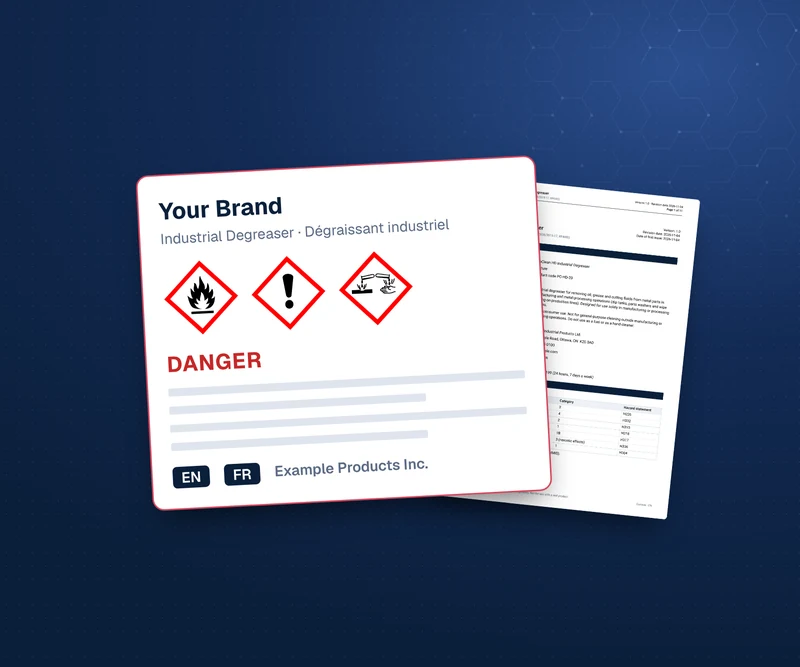
The chemistry is the maker's, but the SDS travels with your brand. These are the points we check and write for each product.
The product identifier on the SDS has to match the label and the name your customers see, not the maker's internal code.
Learn moreIn the US the SDS names the manufacturer, importer or other responsible party, which can be your company. In Canada a supplier who bought the product may put its own name, address and phone number on the SDS and label instead of the initial supplier's.
Learn moreExact percentages can be withheld as a trade secret and shown as the prescribed concentration ranges in the US. In Canada, confidential ingredient information needs a claim under the Hazardous Materials Information Review Act, and the SDS shows the claim's registry number.
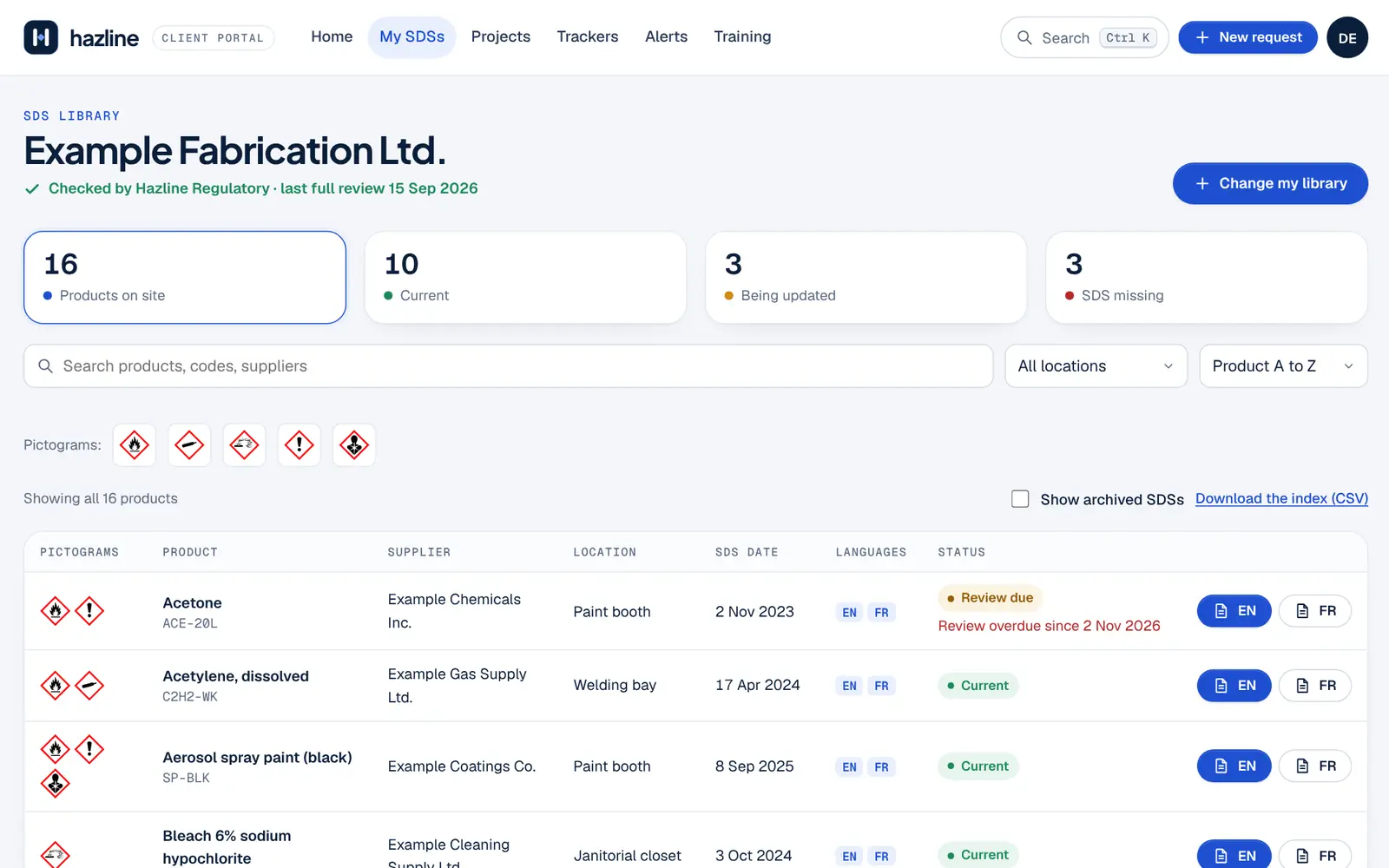
Learn moreWhen the maker changes the formula or a raw material, your SDS has to follow. We keep each sheet's review date and update it when your maker tells you of a change.
Learn moreYou tell us the products, the brand names and where they are sold. Your toll blender or contract manufacturer sends the full formula and raw-material SDSs straight to us under a non-disclosure agreement, so you do not have to hold their formula. We classify each product for the US and Canada, write the SDS and label text in your brand's name, and a regulatory specialist signs off each one. You receive Word and PDF files in your portal, and a written, fixed quote within two business days of the first call or spot-check.
Cleaning, automotive, coatings or maintenance products made for you and sold under your name.
SDSs for a customer's brand without handing them your formula.
A house line next to the brands you resell, with SDSs that match your labels.
An OSHA SDS and a bilingual WHMIS SDS for each product, or one dual US/Canada SDS.
Illustrative scopes, not client results; every project is quoted on its own.
Starting point. A new private-label range of cleaning products. The blender has SDSs in its own name for similar products, and will not share the formulas with the brand owner.
What we do. The blender sends the formulas to us under a non-disclosure agreement. Each product is classified for the US and Canada and the SDSs and labels are written in the brand owner's name, with the confidential percentages shown as ranges.
What you receive. Signed-off SDSs and label text for all eight products in the brand owner's portal; the formulas stay between the blender and us.
Starting point. The same base products sold under a dozen customer brands, each needing SDSs in its own name.
What we do. One master classification per formula, then an SDS per brand with that customer's product name and company details, kept in step when the formula changes.
What you receive. A set of brand SDSs per customer, all tied to the master classification, with review dates in the portal.
In the US the SDS names the chemical manufacturer, importer or other responsible party, so a brand owner can be the responsible party named with its address and phone number, provided it can answer for the sheet. In Canada a supplier that bought the product may give its own name, address and phone number on the SDS and label instead of the initial supplier's. We set up each sheet so the right company is named for each market.
Yes. The blender sends the full formula and raw-material SDSs to us directly, under a non-disclosure agreement with us. The finished SDS shows only what the rules require, and percentages can be given as ranges where they are a trade secret.
Yes. We classify the formula once and issue an SDS for each brand with its own product name and company details. When the formula changes, every brand's SDS is updated in the same pass.
Yes. The label text is written from the same classification as the SDS: pictograms, signal word, hazard and precautionary statements, and in Canada the French version. Your designer places it on your artwork.
Yes, from one product. Each SDS has a fixed fee per product and market, set by how complex the formula is and how complete the data are, quoted in writing within two business days. From complete data it takes about 10 business days on the standard route and about 5 on the fast track.
The data behind a compliant SDS: what to gather from your formula, your raw-material suppliers and your own testing before the work starts, and why each item matters.
Read article
Canada and the US now use the same 13 concentration ranges when a supplier withholds an exact percentage as a trade secret. The ranges, the rules for narrower and combined ranges, and how withholding a chemical name differs.
Read article
A supplier's SDS has no fixed expiry date in Canada, the US or the EU, but several Canadian provinces still set a 3-year check for employers, and every market sets a deadline once you learn something new.
Read articleSend one SDS for a free spot-check. A specialist replies with a short written summary within one business day of what your own-brand SDS needs.